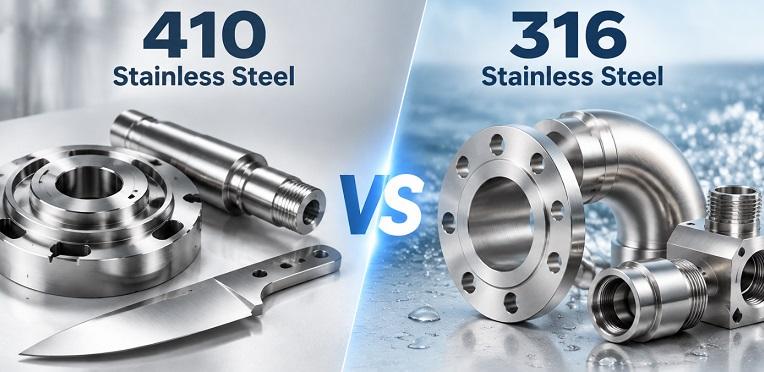
410 and 316 stainless steel are two widely used stainless steel grades with different combinations of mechanical strength, hardness, corrosion resistance, thermal properties, magnetic behavior, and manufacturing characteristics. Although both materials contain chromium and are designed to resist corrosion, they belong to different metallurgical families and are selected for different engineering requirements.
This article explains the differences between 410 and 316 stainless steel, including their chemical composition, mechanical properties, density, hardness, tensile strength, corrosion resistance, heat resistance, magnetic properties, cost, machinability, weldability, and common applications.
What Is 410 Stainless Steel?
410 stainless steel is a martensitic stainless steel that contains approximately 11.5–13.5% chromium and a controlled amount of carbon. Its chemical composition allows it to develop high strength and hardness through heat treatment while maintaining useful resistance to atmospheric corrosion and mildly corrosive environments.
Unlike many common austenitic stainless steels, 410 can be hardened by quenching and tempering. This makes it particularly suitable for engineering components that require a combination of mechanical strength, wear resistance, and moderate corrosion resistance.
410 stainless steel is commonly supplied in annealed, hardened, or tempered conditions, depending on the requirements of the final application. Annealing improves machinability and formability, while quenching and tempering can substantially increase hardness and strength. The final properties depend on the heat-treatment procedure, section thickness, and material condition.
Typical applications include valves, pump components, shafts, fasteners, turbine components, mechanical parts, and certain types of cutlery. These applications benefit from the ability of 410 stainless steel to achieve relatively high hardness without requiring the addition of large quantities of expensive alloying elements.
However, 410 stainless steel does not provide the same general corrosion resistance as 316 stainless steel, particularly in chloride-containing environments. Its lower nickel content and lack of the molybdenum addition found in 316 make it less suitable for prolonged exposure to seawater, salt spray, and many aggressive chemical environments.
For applications where mechanical performance is more important than maximum corrosion resistance, 410 can be an economical and practical choice. For applications involving severe corrosion, however, a different stainless steel grade may be necessary.
What Is 316 Stainless Steel?
316 stainless steel is an austenitic stainless steel known for its excellent corrosion resistance, good ductility, and reliable performance in demanding industrial environments. Its principal alloying elements include chromium, nickel, and molybdenum, with molybdenum providing an important improvement in resistance to pitting and crevice corrosion.
Typical 316 stainless steel contains approximately 16–18% chromium, 10–14% nickel, and 2–3% molybdenum. Exact composition limits depend on the applicable material specification and product form.
The combination of chromium and nickel helps maintain the austenitic microstructure, while molybdenum improves corrosion resistance in environments containing chlorides and certain industrial chemicals. As a result, 316 is widely used in marine equipment, chemical processing systems, food-processing machinery, pharmaceutical equipment, and outdoor installations.
Unlike 410 stainless steel, conventional 316 stainless steel cannot be significantly hardened by ordinary quenching and tempering. Its strength can be increased through cold working, but it is generally selected for corrosion resistance, toughness, and formability rather than for achieving the very high hardness available from heat-treated martensitic steel.
316 stainless steel also offers good weldability and is commonly fabricated into tanks, pipes, sheet-metal assemblies, fittings, and complex components. Its austenitic structure typically makes it non-magnetic in the annealed condition, although cold working or certain manufacturing operations can introduce some magnetic response.
316 is not completely immune to corrosion. Under unsuitable conditions, it can still suffer from pitting, crevice corrosion, stress corrosion cracking, or other forms of degradation. Material selection must therefore consider the chemical environment, chloride concentration, temperature, surface finish, and cleaning requirements.
Overall, 316 stainless steel is often preferred when long-term corrosion resistance and fabrication flexibility are more important than maximum hardness or low initial material cost.
What Is the Difference Between 410 and 316 Stainless Steel?
The primary difference between 410 and 316 stainless steel is their balance of mechanical properties and corrosion resistance. Grade 410 is a heat-treatable martensitic stainless steel designed for strength, hardness, and wear resistance. Grade 316 is an austenitic stainless steel designed primarily for corrosion resistance, ductility, and dependable performance in demanding environments.
410 contains less chromium than 316 and does not contain the deliberate molybdenum addition that distinguishes 316. It can develop much higher hardness through heat treatment, but its corrosion resistance is generally lower. Grade 316 offers better protection against chloride-induced pitting and crevice corrosion, although its hardness is more limited.
The following table summarizes the general differences between these two stainless steel grades.
| Feature | 410 Stainless Steel | 316 Stainless Steel |
|---|---|---|
| Steel family | Martensitic | Austenitic |
| Chromium content | Approximately 11.5–13.5% | Approximately 16–18% |
| Nickel content | Typically low, often up to about 0.75% | Approximately 10–14% |
| Molybdenum content | No intentional addition in the standard grade | Approximately 2–3% |
| Hardening by heat treatment | Yes | No, not by conventional quenching and tempering |
| Hardness | Can become high after hardening | Generally moderate in the annealed condition |
| Strength | Can achieve high strength after heat treatment | Good strength and toughness; increases with cold work |
| Corrosion resistance | Good in mild environments | Generally excellent in many industrial environments |
| Chloride resistance | Limited | Better, but not immune to chloride corrosion |
| Magnetic behavior | Magnetic | Usually non-magnetic when annealed |
| Weldability | Requires careful procedures and may require preheating and post-weld heat treatment | Generally good |
| Machinability | Depends on condition; hardened material is more difficult to machine | Can be challenging because of work hardening and toughness |
| Relative material cost | Generally lower | Generally higher |
| Common applications | Valves, shafts, fasteners, mechanical parts | Marine equipment, chemical tanks, piping, food-processing equipment |
These differences are general rather than absolute. A hardened 410 component and an annealed 410 component can have substantially different mechanical properties. Likewise, 316 sheet, bar, plate, and cold-worked products may not have identical strength or hardness. The specific grade specification and supply condition should always be checked before making a final material selection.
Chemical Composition of 410 vs 316 Stainless Steel
Chemical composition is one of the main reasons 410 and 316 stainless steel behave differently. The types and quantities of alloying elements determine their microstructure, hardenability, corrosion resistance, and response to manufacturing processes.
Both grades contain chromium, which creates a thin passive oxide film on the material surface. This film helps protect the underlying metal from corrosion. However, the higher chromium content and additional molybdenum in 316 generally provide better corrosion resistance than 410.
| Element | 410 Stainless Steel | 316 Stainless Steel | Primary Function |
|---|---|---|---|
| Iron | Balance | Balance | Forms the principal metallic base |
| Chromium | 11.5–13.5% | 16–18% | Provides passive-film formation and corrosion resistance |
| Nickel | Typically low | 10–14% | Stabilizes austenite and supports toughness and ductility |
| Molybdenum | No intentional addition | 2–3% | Improves resistance to pitting and crevice corrosion |
| Carbon | Approximately 0.08–0.15% | Generally 0.08% maximum | Influences strength, hardness, and microstructure |
| Manganese | Generally up to 1.0% | Generally up to 2.0% | Supports steelmaking and alloy behavior |
| Silicon | Generally up to 1.0% | Generally up to 1.0% | Acts as a deoxidizer and affects material properties |
The values above are representative composition ranges for standard grades and are not a substitute for the applicable specification. In particular, 316L is a low-carbon variant of 316, so its carbon limit is lower than that of standard 316.
Mechanical Properties of 410 vs 316 Stainless Steel
Mechanical properties describe how a material responds to forces, including tension, compression, bending, impact, and repeated loading. When comparing 410 and 316 stainless steel, it is important to consider both the alloy type and the condition in which the material is supplied.
410 stainless steel has an advantage when high hardness and heat-treatable strength are required, while 316 stainless steel is often preferred when toughness, ductility, and corrosion resistance must be maintained together. The actual mechanical performance of either grade depends on composition, heat treatment, cold working, product dimensions, and applicable material specifications.
| Mechanical Property | 410 Stainless Steel | 316 Stainless Steel |
|---|---|---|
| Tensile strength | Often around 480–700 MPa in common annealed references; can exceed 1,000 MPa after suitable heat treatment | Typically at least about 515 MPa under common product specifications |
| Yield strength | Often around 275–450 MPa in annealed references; can rise considerably after hardening | Typically at least about 205 MPa for common annealed product specifications |
| Hardness | Can reach high hardness after suitable hardening and tempering | Generally lower in the annealed condition; increases with cold work |
| Young's modulus | Approximately 200 GPa | Approximately 193–200 GPa |
| Ductility | Depends on heat treatment; decreases as hardness increases | Generally good in the annealed condition |
| Toughness | Depends strongly on tempering and microstructure | Generally good, including useful toughness at low temperatures |
| Wear resistance | Can be good in hardened conditions | Usually less suitable for severe abrasive wear without additional treatment |
Tensile Strength and Yield Strength
Tensile strength is the maximum tensile stress a material can withstand before fracture, while yield strength is the stress at which permanent deformation begins. Both properties are important when designing shafts, fasteners, pressure-related components, structural parts, and machinery.
410 stainless steel can achieve high tensile and yield strengths after suitable hardening and tempering. This makes it useful for parts that must withstand substantial mechanical loads while maintaining corrosion resistance in relatively mild environments.
316 stainless steel generally offers lower yield strength in its annealed condition, but its toughness, ductility, and corrosion resistance make it valuable in fabricated equipment and systems exposed to corrosive media. Cold-worked 316 can have substantially higher strength than annealed material.
Hardness and Wear Resistance
Hardness measures resistance to indentation and localized deformation. Wear resistance describes how effectively a material withstands material loss caused by friction, abrasion, or repeated contact. Although these properties are related, hardness alone does not fully determine wear performance.
410 stainless steel is generally the better choice when high bulk hardness is a primary requirement. Its martensitic microstructure can be hardened through heat treatment, making it suitable for components such as valve parts, shafts, and selected cutting or wear-resistant components.
Grade 316 cannot normally achieve comparable bulk hardness through conventional quench-and-temper treatment. It can become harder through cold working or certain surface-hardening methods, but the suitability of these processes depends on the application and the required corrosion performance.
In abrasive or sliding-contact applications, engineers should also evaluate surface finish, lubrication, contact pressure, counterface material, and the risk of galling. Selecting 410 solely because it can be hardened does not guarantee the best wear performance under every operating condition.
Young's Modulus and Stiffness
Young's modulus measures a material's resistance to elastic deformation. The elastic moduli of 410 and 316 stainless steel are broadly similar, typically around 190–200 GPa. Therefore, neither grade offers a major general advantage in stiffness when components have the same geometry and experience the same load.
Differences in the dimensions, geometry, heat treatment, and loading conditions of a component will often have a greater influence on its overall deformation than the modest difference in elastic modulus between these two grades.
If a component must resist permanent deformation, hardness and yield strength become more important. If the main requirement is limiting elastic deflection, designers should evaluate component geometry and elastic modulus together.
Physical Properties of 410 vs 316 Stainless Steel
Physical properties describe characteristics such as density, thermal expansion, and material structure. These properties influence component weight, dimensional stability, thermal behavior, and the suitability of a stainless steel grade for particular industrial applications.
The density of 410 stainless steel is approximately 7.7 g/cm³, while 316 stainless steel is approximately 8.0 g/cm³. Consequently, 410 is slightly lighter than 316 for components of identical volume. However, this difference is relatively small compared with the weight differences between materials such as aluminum and stainless steel.
| Physical Property | 410 Stainless Steel | 316 Stainless Steel |
|---|---|---|
| Density | Approximately 7.7–7.8 g/cm³ | Approximately 8.0 g/cm³ |
| Material structure | Martensitic | Austenitic |
| Typical appearance | Metallic silver-gray | Metallic silver-gray |
| Thermal expansion | Approximately 10–11 µm/m·K | Approximately 16 µm/m·K |
| Response to cold working | Depends on the starting condition and processing | Can strengthen significantly through work hardening |
| Magnetic response | Magnetic | Usually low when annealed; may increase after deformation |
Density and Weight Difference
Density measures mass per unit volume. The density of 410 stainless steel is typically around 7.7–7.8 g/cm³, while 316 is approximately 8.0 g/cm³. For equal component volumes, 410 may therefore be slightly lighter, but the difference is relatively small.
In practice, the material selection between these grades is rarely driven by density alone. Corrosion resistance, required hardness, fabrication method, and expected service life usually have a much greater effect on the overall design.
Thermal Properties of 410 vs 316 Stainless Steel
Thermal properties describe how a material conducts heat, expands when heated, stores thermal energy, and responds to elevated temperatures. These characteristics are important for heat exchangers, industrial machinery, process equipment, valves, and components exposed to repeated temperature changes.
410 and 316 stainless steel have different thermal behaviors because of their distinct alloy compositions and microstructures. Grade 410 generally has higher thermal conductivity and a lower coefficient of thermal expansion than 316. Grade 316 typically offers good oxidation resistance in many service conditions, but its maximum operating temperature depends on the environment, loading, and applicable design requirements.
| Thermal Property | 410 Stainless Steel | 316 Stainless Steel |
|---|---|---|
| Thermal conductivity near room temperature | Approximately 24–30 W/m·K | Approximately 14–16 W/m·K |
| Coefficient of thermal expansion | Approximately 10–11 µm/m·K | Approximately 16 µm/m·K |
| Specific heat capacity | Approximately 460–500 J/kg·K | Approximately 500 J/kg·K |
| Melting range | Approximately 1,480–1,530°C | Approximately 1,370–1,400°C |
| High-temperature behavior | Depends on strength, oxidation, and heat treatment | Depends on oxidation, creep, corrosion, and loading |
These figures are approximate reference values rather than guaranteed design properties. Thermal values change with temperature and may vary by product specification and composition.
Thermal Conductivity
Thermal conductivity describes how efficiently heat travels through a material. Grade 410 generally conducts heat more effectively than 316 at room temperature.
Higher thermal conductivity can help distribute heat through a component, although actual heat-transfer performance also depends on geometry, contact resistance, surface conditions, and the surrounding environment.
Grade 316's lower thermal conductivity can create larger temperature gradients during heating and cooling. In machining, both grades require suitable cutting conditions, but 316 is particularly prone to work hardening if the cutting process causes excessive rubbing instead of effective chip formation.
Coefficient of Thermal Expansion
The coefficient of thermal expansion indicates how much a material changes dimension when its temperature changes. Grade 316 typically expands more than 410 for the same temperature increase.
This difference can matter in precision assemblies, piping systems, and equipment exposed to repeated thermal cycles. Engineers should account for expansion when designing joints, clearances, supports, and connections between different materials.
The actual dimensional change depends on the component's initial dimensions, temperature range, and thermal constraints. A lower expansion coefficient does not automatically make a grade better for every thermal application.
High-Temperature Performance
Both 410 and 316 stainless steel can be used in selected elevated-temperature applications, but their suitability depends on the combination of temperature, applied stress, atmosphere, and exposure duration.
Grade 410 is used in some turbine, furnace, and mechanical components where strength and heat resistance are important. However, prolonged exposure to elevated temperatures can change its hardness and mechanical properties, depending on the heat treatment and service conditions.
Grade 316 offers good oxidation resistance in many elevated-temperature environments, but its resistance to creep, sensitization, and other temperature-related degradation mechanisms must also be evaluated. Neither grade should be selected solely by comparing melting temperatures.
Corrosion Resistance of 410 vs 316 Stainless Steel
Corrosion resistance is one of the most important differences between 410 and 316 stainless steel. Both grades form protective passive films, but their alloy compositions result in different levels of protection across a range of environments.
image
410 stainless steel provides useful corrosion resistance in clean atmospheric conditions, fresh water, steam, and many mildly corrosive environments. Its performance depends on surface finish, heat treatment, maintenance, and the presence of contaminants.
316 stainless steel generally offers superior corrosion resistance because it contains more chromium and includes molybdenum. This composition improves its ability to resist localized corrosion, particularly pitting and crevice corrosion caused by chloride-containing solutions.
| Corrosion Property | 410 Stainless Steel | 316 Stainless Steel |
|---|---|---|
| Atmospheric corrosion | Good under suitable conditions | Generally very good |
| Fresh water | Often suitable, depending on water chemistry | Generally suitable in many applications |
| Seawater exposure | Generally unsuitable for prolonged direct exposure without careful engineering | Better resistance, but may still suffer pitting and crevice corrosion |
| Chloride resistance | Limited compared with 316 | Improved resistance due to molybdenum |
| Mild chemicals | Suitable for selected environments | Suitable for a broader range of environments |
| Strong acids or oxidizing chemicals | Requires specific compatibility evaluation | Also requires specific compatibility evaluation |
| Protective surface film | Chromium-rich passive oxide | Chromium-rich passive oxide enhanced by alloy composition |
Why 316 Has Better Corrosion Resistance
The principal advantage of 316 is its higher chromium content combined with molybdenum. These elements help the passive film resist localized breakdown under conditions that can attack less corrosion-resistant stainless steels.
This is particularly important in environments where salt, chloride-bearing water, deposits, or narrow gaps create conditions favorable to pitting and crevice corrosion. In such applications, 316 often offers a longer service life than 410.
However, 316 is not immune to corrosion in seawater. Long-term immersion, stagnant seawater, biofouling, deposits, high chloride concentrations, and elevated temperatures can still lead to localized attack. For severe seawater service, duplex stainless steels, super-austenitic grades, or other materials may be more appropriate.
Magnetic Properties of 410 vs 316 Stainless Steel
Magnetic behavior is another useful way to distinguish 410 and 316 stainless steel. The difference arises primarily from their metallurgical structures rather than simply from the amount of chromium they contain.
410 stainless steel is martensitic and is magnetic in both annealed and hardened conditions. Its magnetic response can be useful when components need to interact with magnetic fields or when magnetic identification is part of a manufacturing process.
316 stainless steel is austenitic and is generally non-magnetic in the annealed condition. However, cold working, forming, welding, or other processing can introduce some magnetic response, so 316 should not be assumed to have absolutely zero magnetic permeability.
Electrical Properties of 410 vs 316 Stainless Steel
Electrical properties describe how a material responds to electric current. Electrical resistivity and conductivity can be relevant in grounding hardware, electrical enclosures, industrial equipment, heating systems, and applications where electrical contact behavior matters.
Both 410 and 316 conduct electricity, but neither is commonly chosen as a high-conductivity electrical material. Copper and aluminum are usually much better choices when efficient current transmission is the main requirement.
410 generally has lower electrical resistivity than 316 in commonly referenced room-temperature data. This means 410 can conduct electricity somewhat more effectively under comparable conditions, although the actual performance depends on composition, temperature, and material condition.
| Electrical Property | 410 Stainless Steel | 316 Stainless Steel |
|---|---|---|
| Electrical resistivity | Approximately 0.55–0.60 µΩ·m in common references | Approximately 0.70–0.75 µΩ·m in common references |
| Electrical conductivity | Relatively low compared with copper and aluminum | Relatively low compared with copper and aluminum |
| Temperature effect | Electrical properties change with temperature | Electrical properties change with temperature |
| Primary selection factor | Mechanical requirements and moderate corrosion resistance | Corrosion resistance and fabrication requirements |
Electrical Resistivity
Electrical resistivity measures how strongly a material opposes the flow of electric current. Higher resistivity means lower conductivity for the same material geometry and temperature.
Although 410 may provide somewhat lower resistivity than 316, the difference is usually not sufficient to make either grade an attractive replacement for copper or aluminum conductors. Contact resistance, surface oxide films, connection design, and temperature can also affect real electrical performance.
When stainless steel is used in electrical assemblies, the selection should therefore consider both electrical requirements and environmental exposure. For example, 316 may be preferred for a corrosive outdoor enclosure even if electrical conductivity is not its strongest property.
Cost of 410 vs 316 Stainless Steel
Cost is a major consideration when selecting stainless steel for industrial production. Although 410 and 316 are both stainless steels, their alloying requirements and processing characteristics lead to different material prices and total manufacturing costs.
410 is generally less expensive than 316 because it typically contains much less nickel and does not require the deliberate molybdenum addition found in 316. Nickel and molybdenum contribute significantly to alloy cost, and their market prices can fluctuate.
316 often has a higher initial material cost, but its improved corrosion resistance may reduce maintenance, replacement frequency, and downtime in demanding environments. The lower purchase price of 410 does not necessarily make it the more economical choice if corrosion causes premature failure.
| Cost Factor | 410 Stainless Steel | 316 Stainless Steel |
|---|---|---|
| Raw material cost | Generally lower | Generally higher |
| Alloying elements | Lower nickel content; no intentional molybdenum addition | Higher nickel content and molybdenum addition |
| Heat-treatment cost | May be higher if hardening and tempering are required | Generally does not require quench-and-temper hardening |
| Machining cost | Depends strongly on hardness and supply condition | Can increase because of work hardening and tough machining behavior |
| Welding cost | May require specialized procedures and additional heat treatment | Generally easier to weld using appropriate procedures |
| Maintenance cost | Can be higher in corrosive environments | May be lower when its corrosion resistance extends service life |
| Lifecycle cost | Often attractive for mechanical parts in mild environments | Often attractive for corrosive or hygiene-sensitive applications |
Material cost is only one component of the total cost of a finished part. Machining, heat treatment, welding, surface finishing, inspection, maintenance, and replacement can have a substantial effect on the overall budget.
For a hardened shaft operating in a relatively dry industrial environment, 410 may offer a favorable balance of strength and cost. For a pipe fitting exposed to chloride-bearing water, 316 may provide better long-term value because it generally resists corrosion more effectively.
Manufacturing and Machinability of 410 vs 316 Stainless Steel
Manufacturing characteristics influence production speed, tool life, dimensional accuracy, joining methods, and finished-component quality. Both 410 and 316 can be machined and fabricated, but they respond differently because of their microstructure, work-hardening behavior, and heat-treatment requirements.
410 can be relatively straightforward to machine in an annealed condition. However, machining becomes more demanding as hardness increases. Components that require high hardness are often machined before final hardening, followed by finishing operations where necessary.
316 is generally ductile and tough, but it can work harden during machining. If cutting conditions are unsuitable, the material may become harder near the surface, increasing cutting forces, tool wear, and the risk of poor surface finish.
| Manufacturing Property | 410 Stainless Steel | 316 Stainless Steel |
|---|---|---|
| Machinability | Often reasonable in the annealed condition; harder after heat treatment | Can be challenging because of toughness and work hardening |
| Cold forming | Best performed in suitable softer conditions | Generally good, with appropriate allowance for work hardening |
| Heat treatment | Can be hardened and tempered | Usually solution annealed rather than conventionally hardened |
| Weldability | Requires careful control to reduce cracking and hard heat-affected zones | Generally good with suitable filler and procedures |
| Surface finishing | Can be polished; surface condition affects corrosion performance | Can achieve a range of finishes, including hygienic and polished finishes |
| Production planning | Must account for the specified heat-treatment sequence | Must account for work hardening and possible distortion |
Applications of 410 Stainless Steel
410 stainless steel is widely used where moderate corrosion resistance must be combined with useful strength, hardness, and wear performance. Its ability to be heat treated makes it especially attractive for mechanical components that operate in relatively mild environments.
- Valves and pump components: 410 can be used for selected valve parts, pump components, and related mechanical elements where strength and moderate corrosion resistance are required.
- Shafts and machine parts: Hardened 410 is suitable for certain shafts, pins, and components that need strength and resistance to surface damage.
- Fasteners: Selected fasteners can use 410 where mechanical strength and moderate corrosion resistance are acceptable for the service environment.
- Turbine components: Some turbine and power-generation components use martensitic stainless steels because of their mechanical properties and heat resistance.
- Cutlery and tools: 410 may be used in selected cutlery and tool applications, although other martensitic grades may be preferred when higher hardness or specialized cutting performance is required.
- Industrial equipment: Machine parts and equipment components can benefit from 410 when high strength and moderate corrosion resistance are more important than maximum corrosion resistance.
410 is generally most attractive for mechanical parts where the operating environment is controlled or only mildly corrosive. For applications involving prolonged seawater exposure, aggressive chloride solutions, or demanding chemical environments, a more corrosion-resistant grade should be evaluated.
Applications of 316 Stainless Steel
316 stainless steel is commonly selected for equipment exposed to corrosive liquids, salts, moisture, and certain industrial chemicals. Its combination of corrosion resistance, ductility, and weldability makes it suitable for complex fabricated assemblies and systems requiring reliable long-term performance.
- Marine equipment: 316 is used for selected marine fittings, hardware, fasteners, and components exposed to coastal conditions. Severe seawater exposure still requires careful material selection.
- Chemical processing: Tanks, pipes, fittings, and process equipment may use 316 when its corrosion resistance is compatible with the chemicals and operating conditions.
- Food processing: Food-handling equipment, tanks, conveyors, and fittings often use 316 where corrosion resistance and cleanability are important.
- Pharmaceutical equipment: Selected vessels, piping systems, and process components use 316 or 316L to support corrosion resistance and appropriate hygienic surface finishes.
- Outdoor installations: 316 can be useful for exposed equipment in coastal or polluted environments where more general-purpose stainless steel may be insufficient.
- Welded assemblies: 316 is widely fabricated into welded tanks, piping, and equipment where corrosion resistance must be maintained across a complex assembly.
Although 316 has broad applicability, it is not automatically suitable for every chemical or marine environment. Chloride concentration, temperature, crevice geometry, deposits, cleaning practices, and stress must all be considered.
410 vs 316 Stainless Steel in Marine and Chemical Environments
Marine and chemical environments can place particularly demanding requirements on stainless steel. Chlorides, aggressive chemicals, changing temperatures, deposits, and moisture can all influence the type and rate of corrosion.
For many applications in these environments, 316 is preferable to 410 because it generally provides better resistance to pitting and crevice corrosion. The molybdenum addition improves its performance in chloride-bearing conditions, while its higher chromium content contributes to its passive film.
410 may still be suitable for selected mechanical parts in industrial environments where corrosion exposure is limited and where its hardness or heat-treatment response is valuable. However, it should not be chosen for a severe corrosive environment simply because it is labeled stainless steel.
| Environment | 410 Stainless Steel | 316 Stainless Steel |
|---|---|---|
| Indoor dry environment | Often suitable | Often suitable |
| Outdoor atmosphere | Suitable in many mild conditions with maintenance | Generally offers better protection, especially in demanding locations |
| Coastal atmosphere | Requires careful evaluation and maintenance | Often preferred, although surface deposits and crevices remain concerns |
| Direct seawater immersion | Generally a poor choice for prolonged exposure | May be insufficient for severe or continuous exposure |
| Chloride-bearing process water | Limited suitability | Better candidate, subject to temperature and chloride concentration |
| Mild chemical service | Potentially suitable after compatibility assessment | Often suitable for a wider range of chemicals |
| Strong acids or mixed chemicals | Requires detailed compatibility assessment | Requires detailed compatibility assessment |
When a component is critical to safety or process reliability, material selection should be based on documented corrosion data, relevant testing, and actual operating conditions. For aggressive seawater or chemical service, duplex stainless steel, higher-alloy stainless steel, nickel alloys, or other materials may be required.
410 vs 316 Stainless Steel: Which Material Should You Choose?
The choice between 410 and 316 stainless steel depends on the performance requirements of the finished component rather than on a single material property. Both grades are useful, but they are designed to address different engineering priorities.
- Choose 410 stainless steel when hardness, heat-treatable strength, wear resistance, and lower material cost are the main priorities. It is often suitable for shafts, valve parts, selected mechanical components, and hardened parts operating in environments where its corrosion resistance is sufficient.
- Choose 316 stainless steel when corrosion resistance, especially resistance to pitting in many chloride-containing environments, is the main priority. It is often the better choice for marine hardware, chemical processing equipment, food processing systems, and other applications exposed to moisture or corrosive substances.
Conclusion
410 and 316 stainless steel are both important engineering materials, but they offer different advantages. 410 is a martensitic stainless steel that can be hardened through heat treatment, making it attractive for shafts, valves, fasteners, machine parts, and other applications requiring strength and hardness. Its corrosion resistance is useful in mild environments but is generally lower than that of 316.
316 stainless steel is an austenitic grade that contains chromium, nickel, and molybdenum. It is widely used where corrosion resistance, ductility, and weldability are important, including marine equipment, chemical-processing systems, food-processing machinery, and fabricated industrial components. However, 316 is not immune to pitting or crevice corrosion in severe chloride environments.
In general, choose 410 when hardness, heat-treatment capability, and mechanical performance are the main priorities. Choose 316 when corrosion resistance and fabrication flexibility are more important than maximum hardness. For demanding applications, verify the exact material specification and operating conditions before making a final decision.
By understanding the differences in chemical composition, mechanical properties, hardness, corrosion resistance, thermal behavior, magnetic response, cost, and manufacturability, engineers and designers can select the stainless steel grade that best meets their technical and economic requirements.