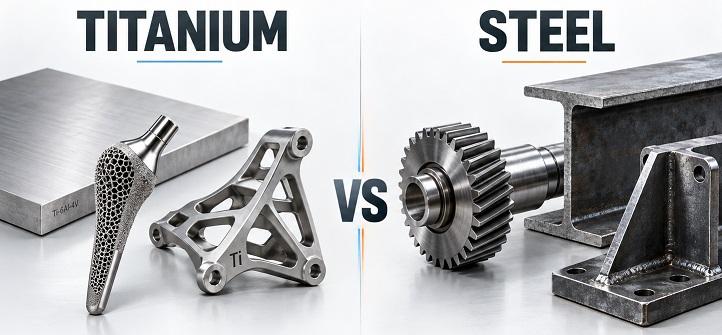
Titanium and steel are two widely used engineering materials with different combinations of mechanical, physical, thermal, electrical, and corrosion properties. This article explains the differences between titanium and steel, including their strength, weight, hardness, stiffness, corrosion resistance, thermal conductivity, electrical conductivity, magnetic properties, cost, and common applications.
What is Titanium?
Titanium is a chemical element with the symbol Ti and atomic number 22. It is a strong, relatively lightweight metal that is widely used in advanced engineering applications because of its excellent combination of strength, low density, and corrosion resistance.
Pure titanium is relatively soft compared with many steel alloys, so most industrial applications use titanium alloys. These titanium alloys combine titanium with elements such as aluminum, vanadium, and molybdenum to improve strength, hardness, heat resistance, or other properties. One of the most commonly used titanium alloys is Ti-6Al-4V, which contains approximately 6% aluminum and 4% vanadium.
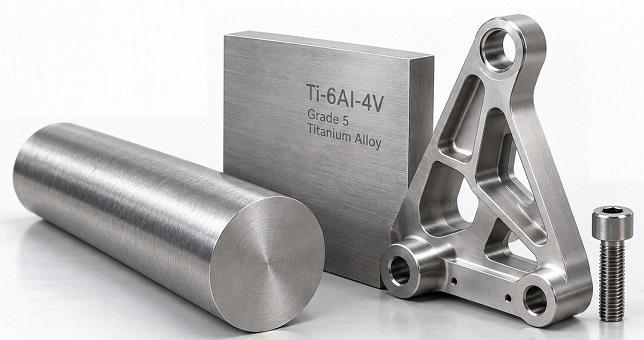
Titanium has a density of approximately 4.5 g/cm³, significantly lower than that of typical steels, which generally have a density of around 7.8 to 8.0 g/cm³. Due to its low density, titanium alloys can provide strength similar to that of some steels while reducing weight significantly. As a result, titanium alloys are widely used in aircraft components, engine parts, spacecraft structures, and other applications where weight reduction is critical.
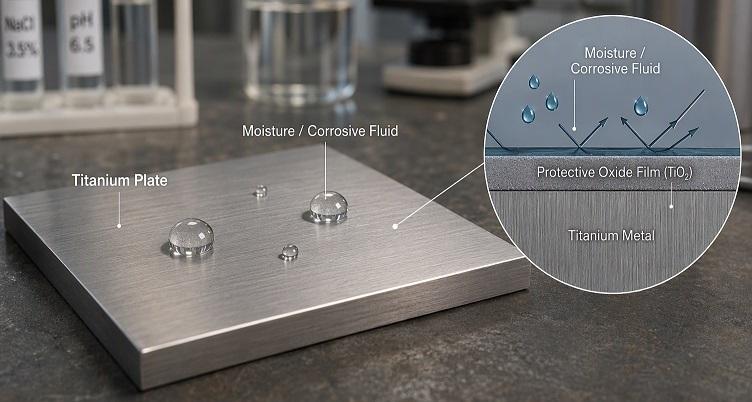
Titanium also forms a very thin and stable oxide layer when exposed to oxygen. This passive layer protects the underlying metal from many corrosive environments and gives titanium excellent corrosion resistance. Titanium is also widely used in medical applications because of its biocompatibility and resistance to corrosion in the human body. Common examples include dental implants, bone fixation devices, and artificial joints.
What is Steel?
Steel is an alloy mainly composed of iron and carbon. It is one of the most widely used engineering materials in the world because of its excellent mechanical properties, relatively low cost, and wide availability.
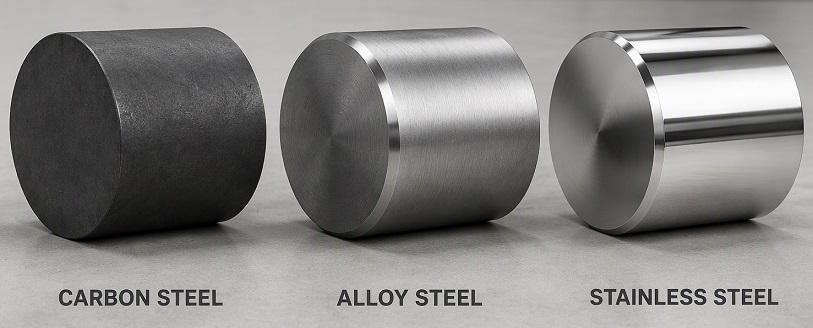
Different types of steel are created by adjusting carbon content and adding alloying elements such as chromium, nickel, manganese, molybdenum, and silicon. Common steel categories include carbon steel, alloy steel, stainless steel, and tool steel.
Carbon steel is commonly used in construction, machinery, pipelines, and automotive components because of its high strength and affordability. Stainless steel contains chromium, which provides improved corrosion resistance and makes it suitable for food processing equipment, medical devices, and chemical applications.
Compared with titanium, steel is heavier but generally easier and less expensive to manufacture, weld, and machine. It is also widely available and offers a broad range of mechanical properties, allowing different grades of steel to be selected for a wide variety of applications. Its combination of strength, durability, availability, and relatively low cost makes steel one of the most widely used engineering materials in the world.
What is the Difference Between Titanium and Steel?
Titanium and steel differ mainly in weight, strength-to-weight ratio, corrosion resistance, stiffness, cost, and manufacturing characteristics.
Titanium is approximately 40% lighter than steel while maintaining excellent strength. This makes titanium ideal for applications where reducing weight is important, such as aircraft, racing vehicles, and portable equipment.
Steel, however, remains dominant in many industries because it is cheaper, easier to process, and available in a much wider range of grades. Steel can provide extremely high strength and hardness, especially when heat treated.
The following table summarizes the general differences between titanium and steel.
| Feature | Titanium | Steel |
|---|---|---|
| Density | About 4.5 g/cm³ | About 7.85 g/cm³ for typical steel |
| Weight | Much lighter | Heavier |
| Strength | Many alloys have high strength | Ranges from low to extremely high depending on grade and treatment |
| Strength-to-weight ratio | Very high | Moderate to high depending on grade |
| Hardness | Depends on grade and processing; generally lower than hardened tool steels | Can be extremely hard, particularly tool and hardened steels |
| Stiffness | Lower | Higher |
| Corrosion resistance | Excellent | Depends strongly on the grade; stainless steel can have excellent corrosion resistance |
| Electrical conductivity | Relatively low | Generally higher than titanium, although still low compared with copper or aluminum |
| Magnetic behavior | Generally non-magnetic | Depends on the grade; many steels are magnetic |
| Cost | More expensive | Less expensive |
| Machining | More difficult to machine | Easier to manufacture and process |
| Availability | More limited | Widely available |
| Common applications | Aerospace, medical, marine, high-performance products | Construction, automotive, machinery, tools |
Mechanical Properties of Titanium vs Steel
Mechanical properties describe how a material behaves when subjected to external forces, including pulling, bending, impact, and repeated loading. These properties are among the most important factors when comparing titanium and steel for engineering applications.
Both titanium and steel can achieve high mechanical performance, but they have different advantages. Titanium provides excellent strength while maintaining a much lower weight, whereas steel generally offers higher stiffness, hardness, and easier processing.
The mechanical properties of titanium and steel vary depending on the specific alloy and manufacturing process. The following table provides typical values for commonly used engineering grades.
| Mechanical Property | Titanium | Steel |
|---|---|---|
| Tensile Strength | Approximately 900–1200 MPa | Approximately 400–1500 MPa depending on grade |
| Yield Strength | Approximately 800–1100 MPa | Approximately 250–1300 MPa depending on grade |
| Young's Modulus | About 105–120 GPa | About 190–210 GPa |
| Hardness | Varies by grade and heat treatment | Generally higher hardness options available |
| Elongation | Approximately 10–25% | Approximately 10–30% depending on grade |
| Fatigue Strength | Generally good fatigue performance | Generally good fatigue performance; varies by grade and condition |
| Fracture Toughness | Good fracture toughness in many engineering grades | Can vary widely depending on grade and condition |
Mechanical Properties of Common Titanium and Steel Grades
Titanium and steel are available in many different grades, each designed for specific performance requirements. Comparing commonly used grades provides a more practical understanding of how titanium alloys perform against different types of steel.
Ti-6Al-4V is one of the most widely used titanium alloys because of its excellent combination of strength, low density, and corrosion resistance. For steel, grades such as 304 stainless steel, 316 stainless steel, and 4140 alloy steel are commonly used in engineering applications.
| Grade | Material type | Density | Tensile strength | Yield strength | Young's modulus | Typical hardness |
|---|---|---|---|---|---|---|
| Grade 2 Titanium | Commercially pure titanium | 4.51 g/cm³ | 344–430 MPa | 275–410 MPa | 102–103 GPa | 145–200 HV |
| Ti-6Al-4V (Grade 5) | Titanium alloy | 4.42–4.43 g/cm³ | 895–1,068 MPa | 827–999 MPa | 107–122 GPa | 334–349 HV |
| AISI 1018 | Low-carbon steel | 7.87 g/cm³ | Approximately 400 MPa | Approximately 220 MPa | Approximately 200 GPa | Approximately 116 HB |
| AISI 4140 | Alloy steel | 7.85 g/cm³ | 1,020–1,140 MPa | 655–965 MPa | Approximately 205 GPa | 302–320 HB |
| 304 Stainless Steel | Austenitic stainless steel | Approximately 8.0 g/cm³ | Approximately 515 MPa | Approximately 205 MPa | Approximately 193 GPa | 70–90 HRB |
| 316 Stainless Steel | Austenitic stainless steel | Approximately 8.0 g/cm³ | Approximately 515 MPa | Approximately 205 MPa | Approximately 193 GPa | 70–90 HRB |
Tensile Strength and Yield Strength
Tensile strength represents the maximum stress a material can withstand before breaking, while yield strength indicates the stress level where permanent deformation begins.
Titanium alloys can achieve tensile strengths comparable to many steels while weighing significantly less. This makes titanium attractive for weight-sensitive structures. However, advanced high-strength steels can exceed titanium in absolute strength.
Steel has a wider range of strength levels because thousands of steel grades exist. Through alloying and heat treatment, steel can be optimized for applications requiring extremely high strength, hardness, or wear resistance.
Young's Modulus and Stiffness
Young's modulus measures a material's resistance to elastic deformation. A higher value means the material is stiffer.
Steel has nearly twice the Young's modulus of titanium, meaning steel components are generally stiffer under the same load. Titanium components may need different designs or larger dimensions when stiffness is the main requirement.
However, titanium's lower stiffness can sometimes be beneficial in applications where flexibility and vibration absorption are important.
Hardness and Wear Resistance
Hardness indicates resistance to indentation, scratching, and wear. Steel generally offers more options for high hardness through carbon content and heat treatment.
Titanium has moderate hardness, but surface treatments such as nitriding and coatings can significantly improve its wear resistance.
Fatigue Strength
Fatigue strength describes the ability of a material to withstand repeated loading cycles without failure.
Titanium performs very well in fatigue applications because of its excellent strength-to-weight ratio and corrosion resistance. Aerospace components often use titanium where long service life and reduced weight are critical.
Steel also has excellent fatigue properties, especially in automotive and industrial machinery applications where cost and durability are important.
Physical Properties of Titanium vs Steel
Physical properties describe the basic characteristics of a material, including its weight, density, and relationship between strength and mass. These properties are especially important when selecting materials for applications where weight reduction, portability, and structural efficiency are important.
The most significant physical difference between titanium and steel is density. Titanium is much lighter than steel while still maintaining excellent mechanical strength. This difference gives titanium a major advantage in aerospace, transportation, and high-performance engineering applications.
Steel, on the other hand, has a higher density but offers excellent structural stability, stiffness, and affordability. Because steel is widely available and easy to manufacture, it remains one of the most commonly used engineering materials worldwide.
| Physical Property | Titanium | Steel |
|---|---|---|
| Density | Approximately 4.5 g/cm³ | Approximately 7.8 g/cm³ |
| Specific Strength | Generally high due to low density and high strength | Varies widely by grade and strength level |
| Weight Compared with Steel | About 40% lighter | — |
| Surface Oxide Layer | Forms a stable protective titanium oxide layer | Depends on steel type; stainless steel forms a chromium oxide layer |
Density Comparison of Common Titanium and Steel Grades
Density is one of the most important differences between titanium and steel. Titanium alloys provide significant weight savings because their density is approximately 40% lower than common steels.
The following table compares the density of commonly used titanium and steel grades.
| Grade | Material Type | Density |
|---|---|---|
| Grade 2 Titanium | Commercially pure titanium | Approximately 4.51 g/cm³ |
| Ti-6Al-4V (Grade 5) | Titanium alloy | Approximately 4.43 g/cm³ |
| AISI 1018 | Low-carbon steel | Approximately 7.85 g/cm³ |
| AISI 4140 | Alloy steel | Approximately 7.85 g/cm³ |
| 304 Stainless Steel | Austenitic stainless steel | Approximately 8.00 g/cm³ |
| 316 Stainless Steel | Austenitic stainless steel | Approximately 8.00 g/cm³ |
Density and Weight Difference
Density is one of the most important differences between titanium and steel. Titanium has a density of approximately 4.5 g/cm³, while steel has a density of around 7.8 g/cm³.
This means a titanium component can be significantly lighter than a steel component with similar strength. In applications such as aircraft structures, racing bicycles, and military equipment, reducing weight can improve fuel efficiency, speed, and overall performance.
For example, replacing a steel component with titanium may reduce weight by approximately 40% while maintaining similar mechanical strength. This advantage explains why titanium is widely used in aerospace engineering.
Specific Strength
Specific strength refers to the strength-to-weight ratio of a material. It is calculated by dividing tensile strength by density.
Titanium has one of the highest specific strengths among engineering metals. Although some steels may have higher absolute tensile strength, titanium often provides better strength performance when weight is considered.
Steel remains competitive in applications where weight is not a major concern because it provides excellent strength at a lower material cost.
Thermal Properties of Titanium vs Steel
Thermal properties describe how materials respond to changes in temperature, including heat transfer, thermal expansion, heat storage, and melting behavior.
Titanium and steel have noticeably different thermal characteristics. Titanium has relatively low thermal conductivity, meaning it transfers heat more slowly than steel. Steel generally conducts heat better, although the exact value depends on the specific alloy.
These differences affect manufacturing processes, heat treatment, thermal management, and applications involving temperature changes.
| Thermal Property | Titanium | Steel |
|---|---|---|
| Thermal Conductivity | Approximately 15–25 W/m·K | Approximately 15–60 W/m·K depending on grade |
| Coefficient of Thermal Expansion (CTE) | Approximately 8–10 µm/m·K | Approximately 11–17 µm/m·K depending on grade |
| Specific Heat Capacity | Approximately 520 J/kg·K | Approximately 450–500 J/kg·K |
| Melting Temperature | Approximately 1600–1670°C depending on grade | Approximately 1370–1540°C depending on grade |
| High Temperature Performance | Varies by grade and temperature | Varies by grade and temperature |
Thermal Properties of Common Titanium and Steel Grades
Different titanium and steel grades have different thermal behaviors. Titanium generally has lower thermal conductivity than steel, while its thermal expansion is also relatively low. Melting temperature varies by alloy for both titanium and steel.
| Grade | Thermal Conductivity | Coefficient of Thermal Expansion | Melting Temperature |
|---|---|---|---|
| Grade 2 Titanium | Approximately 16 W/m·K | Approximately 8.6 µm/m·K | Approximately 1668°C |
| Ti-6Al-4V (Grade 5) | Approximately 6.7 W/m·K | 8.6–9.5 µm/m·K | Approximately 1600°C |
| AISI 1018 | Approximately 50 W/m·K | Approximately 12 µm/m·K | 1425–1540°C |
| AISI 4140 | 42–44 W/m·K | 12–13 µm/m·K | 1425–1520°C |
| 304 Stainless Steel | Approximately 16 W/m·K | Approximately 17.2 µm/m·K | 1400–1450°C |
| 316 Stainless Steel | Approximately 14 W/m·K | Approximately 16 µm/m·K | 1370–1400°C |
Thermal Conductivity
Thermal conductivity measures how efficiently a material transfers heat. Titanium has relatively low thermal conductivity compared with steel, which means heat moves through titanium more slowly.
The low thermal conductivity of titanium can be useful in applications where heat isolation is beneficial. However, it can also make machining more challenging because heat generated during cutting tends to remain concentrated near the cutting tool.
Steel generally transfers heat more efficiently, which can simplify certain manufacturing processes and improve heat dissipation in some applications.
Coefficient of Thermal Expansion (CTE)
The coefficient of thermal expansion describes how much a material expands or contracts when temperature changes.
Titanium has a lower coefficient of thermal expansion than most steels. This means titanium components experience slightly less dimensional change when exposed to temperature variations.
Lower thermal expansion can be beneficial in precision engineering applications, aerospace structures, and components exposed to changing temperatures.
Specific Heat Capacity
Specific heat capacity measures how much energy is required to increase the temperature of a material.
Titanium has a slightly higher specific heat capacity than many steels, meaning it requires more heat energy to increase its temperature by the same amount of mass.
This property can influence thermal management in engineering systems where temperature stability is important.
Melting Temperature
Titanium has a higher melting temperature than most steels. Pure titanium melts at approximately 1668°C, while common steels melt within a range of approximately 1370–1530°C depending on their composition.
Although melting temperature provides useful information about high-temperature capability, it does not directly determine operating temperature limits. Factors such as oxidation resistance, creep behavior, and alloy composition are also important.
Electrical Properties of Titanium vs Steel
Electrical properties describe how easily a material allows electric current to flow. These properties are important in electrical systems, electronic components, grounding applications, and industrial equipment.
Both titanium and steel are electrical conductors, but neither is commonly selected when high electrical conductivity is the primary requirement. Materials such as copper and aluminum are generally preferred for electrical applications.
| Electrical Property | Titanium | Steel |
|---|---|---|
| Electrical Resistivity | Approximately 0.4–1.7 µΩ·m depending on grade | Approximately 0.1–0.8 µΩ·m depending on grade |
| Electrical Conductivity | Generally low | Generally higher than titanium |
Electrical Properties of Common Titanium and Steel Grades
Titanium and steel are both electrical conductors, but they are not typically selected for applications requiring high electrical conductivity. Their electrical properties vary depending on alloy composition and material condition.
| Grade | Electrical Resistivity |
|---|---|
| Grade 2 Titanium | Approximately 0.42 µΩ·m |
| Ti-6Al-4V (Grade 5) | Approximately 1.7 µΩ·m |
| AISI 1018 | Approximately 0.15 µΩ·m |
| AISI 4140 | Varies by material condition |
| 304 Stainless Steel | Approximately 0.72 µΩ·m |
| 316 Stainless Steel | Approximately 0.74 µΩ·m |
Electrical Resistivity
Electrical resistivity measures how strongly a material resists the flow of electric current.
Titanium has higher electrical resistivity than steel, meaning it conducts electricity less effectively. This characteristic is one reason titanium is not commonly used as an electrical conductor.
Steel generally provides better electrical conductivity, although it is still significantly less conductive than copper or aluminum.
In some applications, titanium's lower electrical conductivity combined with excellent corrosion resistance can be advantageous, particularly in marine and chemical environments.
Magnetic Properties of Titanium vs Steel
Magnetic properties describe how a material responds to magnetic fields. These properties are important in industries involving sensors, medical equipment, electronics, and magnetic systems. Titanium and steel have very different magnetic behaviors.
Titanium is generally considered non-magnetic in most practical applications, making it useful in environments where low magnetic response is important.
Steel behavior depends on the alloy. Carbon steels and alloy steels are generally magnetic, while many austenitic stainless steels have very low magnetic response.
| Magnetic Property | Titanium | Steel |
|---|---|---|
| Magnetic Behavior | Generally non-magnetic | Magnetic or weakly magnetic depending on grade |
Magnetic Behavior of Common Titanium and Steel Grades
Magnetic properties vary significantly among steel grades. Titanium alloys are generally considered non-magnetic, while steel may be magnetic or non-magnetic depending on its crystal structure and alloy composition.
| Grade | Magnetic Behavior |
|---|---|
| Grade 2 Titanium | Non-magnetic |
| Ti-6Al-4V (Grade 5) | Non-magnetic |
| AISI 1018 | Magnetic |
| AISI 4140 | Magnetic |
| 304 Stainless Steel | Generally non-magnetic |
| 316 Stainless Steel | Generally non-magnetic |
Corrosion Resistance of Titanium vs Steel

Corrosion resistance describes a material's ability to withstand chemical and electrochemical degradation when exposed to moisture, salts, acids, alkalis, and other corrosive environments. It is an important consideration when selecting materials for marine, chemical processing, medical, and outdoor applications.
Titanium generally provides excellent corrosion resistance because it rapidly forms a stable, protective oxide layer on its surface. Many titanium grades maintain good corrosion resistance in seawater, atmospheric conditions, and a wide range of chemical environments.
Steel corrosion resistance varies significantly by grade. Carbon and alloy steels generally require protective coatings, surface treatments, or controlled environments to limit corrosion, while stainless steels rely on a chromium-rich passive oxide layer for corrosion resistance.
| Corrosion Property | Titanium | Steel |
|---|---|---|
| General Corrosion Resistance | Generally excellent | Varies significantly by grade |
| Protective Oxide Layer | Forms a stable titanium oxide layer | Carbon and alloy steels require protection; stainless steels form a chromium-rich passive layer |
| Resistance to Seawater | Generally excellent | Depends strongly on grade and environment |
| Resistance to Chemical Environments | Excellent in many chemical environments | Varies by alloy and chemical environment |
Corrosion Resistance of Common Titanium and Steel Grades
Corrosion resistance varies among titanium and steel grades. Titanium Grade 2 is widely used where strong corrosion resistance is required, while Ti-6Al-4V provides a combination of corrosion resistance and high mechanical strength. Among steels, 304 and 316 stainless steel generally provide better corrosion resistance than carbon and alloy steels.
The following table compares the typical corrosion behavior of commonly used titanium and steel grades.
| Grade | Material Type | Typical Corrosion Resistance |
|---|---|---|
| Grade 2 Titanium | Commercially pure titanium | Excellent |
| Ti-6Al-4V (Grade 5) | Titanium alloy | Excellent |
| AISI 1018 | Low-carbon steel | Low without protective treatment |
| AISI 4140 | Alloy steel | Low to moderate without protective treatment |
| 304 Stainless Steel | Austenitic stainless steel | Good to excellent |
| 316 Stainless Steel | Austenitic stainless steel | Excellent, especially in chloride-containing environments |
What are the Applications of Titanium and Steel?
Titanium and steel are both widely used engineering materials, but their applications are often different because of their unique properties. Titanium is mainly selected for applications where lightweight design, corrosion resistance, and high strength-to-weight ratio are important. Steel is commonly chosen when high strength, affordability, availability, and ease of manufacturing are the primary requirements.
The choice between titanium and steel depends on factors such as operating environment, required mechanical performance, production volume, budget, and expected service life.
Applications of Titanium
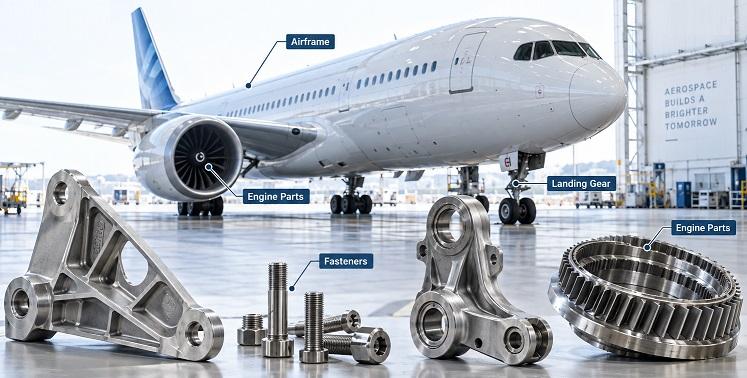
Titanium is widely used in industries that require high-performance materials with reduced weight and excellent corrosion resistance.
- Aerospace Industry: Titanium alloys are commonly used for aircraft structural components, engine parts, landing gear components, and spacecraft structures. The lightweight nature of titanium helps reduce fuel consumption while maintaining strength.
- Medical Industry: Titanium is used for dental implants, artificial joints, bone screws, and surgical instruments because it is biocompatible and resistant to corrosion inside the human body.
- Marine Applications: Titanium performs well in seawater environments due to its excellent corrosion resistance. It is used in marine components, heat exchangers, and offshore equipment.
- Automotive and Motorsport: High-performance vehicles use titanium components such as exhaust systems, suspension parts, and engine components to reduce weight.
- Chemical Processing: Titanium is used in chemical equipment exposed to aggressive chemicals because of its excellent corrosion resistance.
Applications of Steel
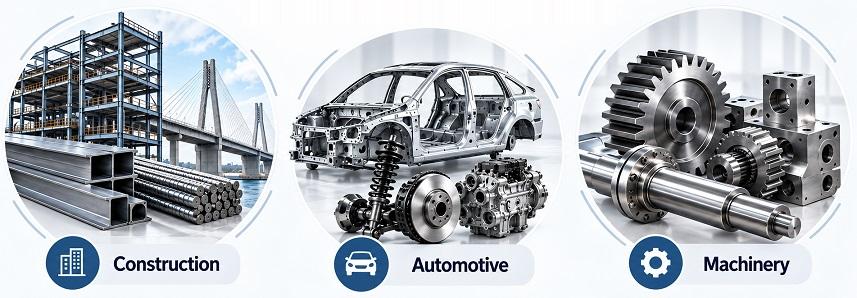
Steel is one of the most commonly used materials in the world because it provides a strong balance between performance and cost.
- Construction Industry: Steel is widely used for buildings, bridges, reinforcement bars, structural beams, and infrastructure because of its high strength and availability.
- Automotive Industry: Steel is used for vehicle frames, body panels, suspension components, and engine parts due to its strength and affordability.
- Machinery and Manufacturing: Industrial machines, tools, gears, shafts, and equipment often use steel because it can be manufactured into many different grades.
- Energy Industry: Steel is used in pipelines, power plants, storage tanks, and industrial equipment.
- Consumer Products: Stainless steel is commonly used in kitchen appliances, cookware, medical tools, and household products.
Cost of Titanium vs Steel
Cost is an important consideration when selecting titanium or steel for an engineering application. Titanium is generally more expensive than steel because of its raw material cost, energy-intensive production processes, specialized manufacturing requirements, and more demanding machining processes.
Steel is generally more economical and widely available, making it a common choice for applications where material cost and ease of manufacturing are important. Titanium can have a higher initial material cost, but its low density, high strength-to-weight ratio, and corrosion resistance may provide advantages in applications where weight reduction or long-term durability is important.
The actual cost of titanium and steel varies significantly depending on the grade, product form, quantity, supplier, manufacturing process, and market conditions. The following table summarizes the main cost factors that influence material selection.
| Cost Factor | Titanium | Steel |
|---|---|---|
| Material Cost | Generally higher | Generally lower |
| Material Availability | More limited depending on grade and product form | Widely available in many grades and forms |
| Machining Cost | Generally higher due to demanding machining requirements | Generally lower, depending on grade and condition |
| Fabrication Cost | Often higher due to specialized processing requirements | Generally lower with widely available fabrication processes |
| Long-Term Cost | Can be favorable where low weight and corrosion resistance reduce lifecycle costs | Often favorable for applications where low initial cost is the main consideration |
Cost Comparison of Common Titanium and Steel Grades
The cost of titanium and steel varies considerably among grades. Titanium Grade 2 and Ti-6Al-4V (Grade 5) generally have higher material costs than common carbon and alloy steels. Stainless steels such as 304 and 316 are typically more expensive than carbon steel, but their cost remains dependent on grade, product form, and market conditions.
The following table provides a general comparison of the relative material cost of commonly used titanium and steel grades. Actual prices can vary by supplier, product form, quantity, and market conditions.
| Grade | Material Type | Relative Material Cost |
|---|---|---|
| Grade 2 Titanium | Commercially pure titanium | High |
| Ti-6Al-4V (Grade 5) | Titanium alloy | High |
| AISI 1018 | Low-carbon steel | Low |
| AISI 4140 | Alloy steel | Low to moderate |
| 304 Stainless Steel | Austenitic stainless steel | Moderate |
| 316 Stainless Steel | Austenitic stainless steel | Moderate to high |
Manufacturing and Machinability of Titanium vs Steel
Manufacturing and machinability are important considerations when selecting titanium or steel for engineering applications. Material properties such as strength, thermal conductivity, hardness, and chemical reactivity can significantly affect cutting, forming, welding, and other manufacturing processes.
Titanium can be more demanding to machine than many common steels because of its high strength-to-weight ratio, low thermal conductivity, and tendency to generate heat at the cutting zone. Specialized tooling, appropriate cutting conditions, and effective heat management are often required to achieve efficient machining and consistent results.
Steel generally offers broader and more established manufacturing options, although machinability varies considerably among steel grades. Low-carbon steels are typically easier to machine and form, while stainless steels and high-strength alloy steels may require more specialized processing.
| Manufacturing Property | Titanium | Steel |
|---|---|---|
| Machinability | Generally more difficult to machine | Varies by grade; many common steels are relatively easy to machine |
| Cutting | Requires controlled cutting conditions and effective heat management | Generally easier to cut, depending on grade and hardness |
| Formability | Varies by grade and forming process | Generally good for low-carbon steels; varies for alloy steels |
| Weldability | Requires controlled conditions and protection from atmospheric contamination | Generally well established; varies by grade and carbon content |
| Manufacturing Cost | Generally higher due to specialized processing requirements | Generally lower with widely available manufacturing processes |
Titanium vs Steel: Which Material Should You Choose?
Choosing between titanium and steel depends on the specific requirements of the application.
- Choose titanium when weight reduction, corrosion resistance, or a high strength-to-weight ratio is a major consideration. Titanium is particularly useful in aerospace, transportation, marine, chemical processing, and other applications where low weight and long-term corrosion resistance can justify higher material and manufacturing costs.
- Choose steel when stiffness, lower cost, availability, or manufacturing efficiency is a major consideration. Steel offers a wide range of grades and is widely used in structural, automotive, machinery, construction, and general industrial applications.
The final material selection should be based on the specific grade and service conditions rather than on titanium or steel as broad material categories. Strength, temperature, corrosion environment, manufacturing process, required service life, and total cost should all be considered before selecting a material.
Conclusion
Titanium and steel are both valuable engineering materials, but they serve different purposes. Titanium provides an outstanding combination of lightweight design, high strength-to-weight ratio, corrosion resistance, and biocompatibility. These characteristics make it ideal for aerospace, medical, marine, and other high-performance applications.
Steel remains one of the most important industrial materials because of its affordability, versatility, high stiffness, and ease of manufacturing. It continues to dominate construction, automotive, machinery, and infrastructure industries.
The decision between titanium and steel depends on the specific requirements of the application. Titanium is often selected when performance and weight savings justify the higher cost, while steel remains the preferred choice when cost efficiency, availability, and manufacturing simplicity are priorities.
By understanding the differences in mechanical, physical, thermal, electrical, and magnetic properties, engineers and designers can make better material selection decisions for their projects.