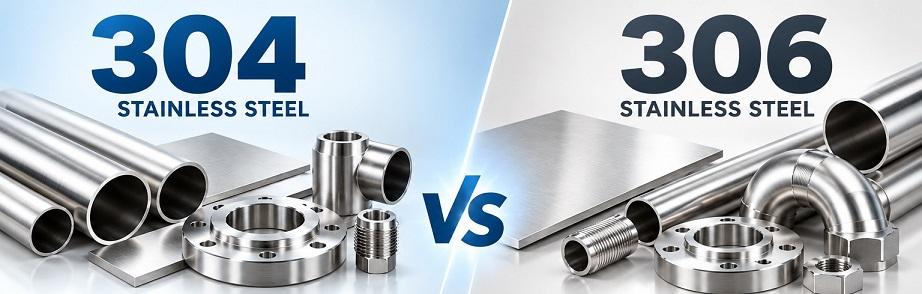
Stainless steel is one of the most widely used engineering materials because of its excellent corrosion resistance, mechanical properties, durability, and versatility. Among the many stainless steel grades available, 304 is one of the most commonly used austenitic stainless steels. However, when comparing 304 vs 306 stainless steel, it is important to understand the differences in their chemical compositions, material designations, and engineering characteristics.
304 stainless steel is a well-established commercial grade, while 306 stainless steel is a less common designation associated with the UNS S30600 material number. These two materials have different chemical compositions, particularly in their chromium, nickel, and silicon contents.
This article explains the differences between 304 and 306 stainless steel, including their chemical composition, mechanical properties, density, corrosion resistance, thermal properties, electrical properties, magnetic behavior, machinability, cost, and common applications.
What is 304 Stainless Steel?
304 stainless steel is one of the most widely used austenitic stainless steel grades in the world. It belongs to the 300 series of stainless steels and is primarily composed of iron, chromium, and nickel. It is commonly known as 18/8 stainless steel because it typically contains approximately 18% chromium and 8% nickel, although its actual composition falls within specified ranges.
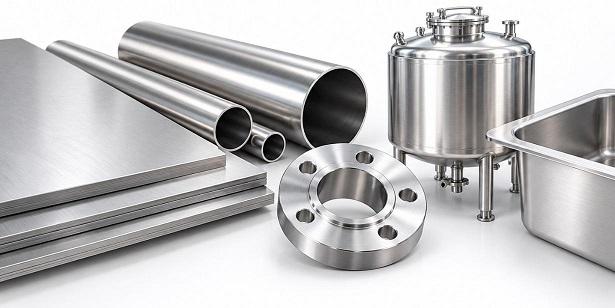
The most important characteristic of 304 stainless steel is its excellent combination of corrosion resistance, mechanical strength, formability, and weldability. These properties make it suitable for a wide variety of industrial, commercial, and household applications.
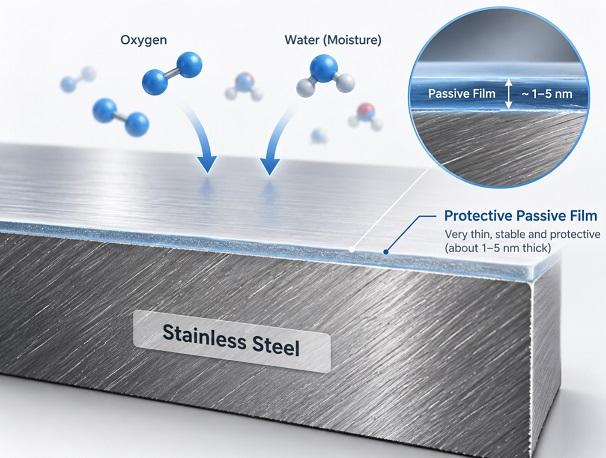
304 stainless steel generally contains 18–20% chromium, 8–10.5% nickel, and a maximum carbon content of 0.08%. Chromium creates a thin passive oxide layer on the material's surface, protecting the underlying metal from oxidation and corrosion. Nickel helps stabilize the austenitic microstructure and improves ductility and toughness.
One of the main advantages of 304 stainless steel is its versatility. It can be formed into sheets, plates, pipes, tubes, bars, and various fabricated components. It also offers good weldability and can be processed using conventional manufacturing techniques.
304 stainless steel is commonly used in food processing equipment, kitchen appliances, chemical containers, storage tanks, architectural components, automotive parts, and industrial machinery.
What is 306 Stainless Steel?
306 stainless steel is a less commonly encountered stainless steel designation compared with 304. The designation 306 is associated with UNS S30600, which appears in stainless steel composition references. This material is an austenitic chromium-nickel stainless steel with a relatively high silicon content.
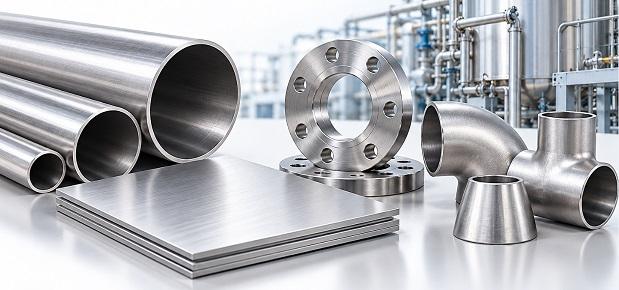
Unlike conventional 304 stainless steel, which generally contains approximately 1% silicon maximum, 306 stainless steel contains approximately 3.7–4.5% silicon. The addition of silicon gives this alloy distinctive properties, particularly in certain aggressive chemical environments. It is designed for applications where resistance to hot, concentrated acids is important.
The chemical composition of 306 stainless steel includes approximately 16.5–18.5% chromium, 14–16% nickel, and 3.7–4.5% silicon. Its carbon content is limited to approximately 0.015%, helping reduce the risk of sensitization during certain thermal processing operations.
The high silicon content distinguishes this material from conventional stainless steels such as 304 and 316. It can provide improved performance in certain concentrated nitric acid and sulfuric acid environments, depending on acid concentration, temperature, impurities, and operating conditions.
306 stainless steel is not as widely available as 304 stainless steel. It is generally used in specialized chemical processing applications rather than ordinary construction, household products, or general-purpose manufacturing.
What is the Difference Between 304 and 306 Stainless Steel?
304 and 306 stainless steel are both associated with the austenitic stainless steel family, but they have different chemical compositions and engineering characteristics.
304 stainless steel is a general-purpose material designed to provide a balance of corrosion resistance, strength, formability, weldability, and affordability. It is suitable for a wide range of applications involving atmospheric exposure, moisture, food processing, and many relatively mild chemical environments.
306 stainless steel, commonly associated with UNS S30600, is a specialized high-silicon stainless steel. Its higher silicon content and different chromium-nickel balance make it particularly useful in certain hot and concentrated acid environments.
| Feature | 304 Stainless Steel | 306 Stainless Steel (UNS S30600) |
|---|---|---|
| Material designation | AISI 304 / UNS S30400 | UNS S30600 |
| European designation | 1.4301 | 1.4361 |
| Material type | Austenitic stainless steel | High-silicon austenitic stainless steel |
| Chromium content | 18–20% | 16.5–18.5% |
| Nickel content | 8–10.5% | 14–16% |
| Silicon content | Maximum approximately 1% | 3.7–4.5% |
| Carbon content | Maximum 0.08% | Maximum 0.015% |
| Density | Approximately 7.9–8.0 g/cm³ | Approximately 7.7 g/cm³ |
| Tensile strength | Generally at least 515 MPa under common ASTM product specifications | Approximately 530–730 MPa, depending on product specification |
| Yield strength | Generally at least 205 MPa under common ASTM product specifications | Approximately 210 MPa minimum |
| Young's modulus | Approximately 193 GPa | Approximately 200 GPa |
| Corrosion resistance | Excellent in many general environments | Specialized resistance in certain concentrated acid environments |
| Magnetic properties | Generally non-magnetic when annealed | Generally non-magnetic when annealed |
| Weldability | Excellent | Requires grade-specific welding procedures |
| Machinability | Moderate to difficult | Specialized machining considerations |
| Availability | Very widely available | More limited |
| Cost | Generally lower | Generally higher |
| Common applications | Food equipment, tanks, pipes, appliances | Specialized chemical processing equipment |
The main difference is that 304 stainless steel is a versatile general-purpose stainless steel, whereas 306 stainless steel is a specialized high-silicon grade intended for particular chemical processing environments.
Chemical Composition of 304 vs 306 Stainless Steel
Chemical composition is one of the most important factors when comparing stainless steel grades. Differences in chromium, nickel, silicon, and carbon content influence corrosion resistance, mechanical behavior, weldability, and manufacturing characteristics.
304 stainless steel relies primarily on chromium and nickel to provide its austenitic structure and corrosion resistance. 306 stainless steel contains significantly more silicon and a higher nickel content, giving it a different performance profile.
The following table compares their typical specified chemical composition ranges.
| Chemical Element | 304 Stainless Steel (UNS S30400) | 306 Stainless Steel (UNS S30600) |
|---|---|---|
| Carbon (C) | ≤ 0.08% | ≤ 0.018% |
| Chromium (Cr) | 17.5–19.5% | 17.0–18.5% |
| Nickel (Ni) | 8.0–10.5% | 14.0–15.5% |
| Silicon (Si) | ≤ 0.75% | 3.7–4.3% |
| Manganese (Mn) | ≤ 2.0% | ≤ 2.0% |
| Phosphorus (P) | ≤ 0.045% | ≤ 0.020% |
| Sulfur (S) | ≤ 0.030% | ≤ 0.020% |
| Molybdenum (Mo) | Not specified as an intentional addition | ≤ 0.20% |
| Copper (Cu) | Not specified as an intentional addition | ≤ 0.50% |
Chromium Content
Chromium is the primary element responsible for stainless steel corrosion resistance.
304 stainless steel contains approximately 17.5%–19.5% chromium. This chromium reacts with oxygen to form a thin, stable passive oxide layer that protects the underlying metal from corrosion.
306 stainless steel contains approximately 17.0%–18.5% chromium. Although its chromium content is slightly lower than that of 304 in some composition ranges, its corrosion performance cannot be determined from chromium content alone.
Other alloying elements, surface condition, temperature, and the surrounding environment also influence corrosion resistance.
Nickel Content
Nickel stabilizes the austenitic structure of stainless steel and contributes to toughness, ductility, and corrosion performance.
304 stainless steel typically contains 8.0%–10.5% nickel. 306 stainless steel contains approximately 14.0%–15.5% nickel, which is significantly higher than the nickel content of 304.
This difference affects the alloy's metallurgical characteristics and may influence its performance in specific environments. However, higher nickel content does not automatically mean better corrosion resistance in every application.
Silicon Content
Silicon is one of the most important differences between these two materials. 304 stainless steel generally contains no more than 0.75% silicon, while 306 stainless steel contains approximately 3.7%–4.3%.
Silicon can improve oxidation resistance by influencing the formation and stability of protective surface oxides at elevated temperatures. This characteristic makes the silicon content of 306 stainless steel particularly important when evaluating potential high-temperature applications.
However, high silicon content can also influence hot working, welding behavior, and metallurgical characteristics. Therefore, the processing requirements of 306 stainless steel should be evaluated independently.
Mechanical Properties of 304 vs 306 Stainless Steel
Mechanical properties describe how materials respond to external forces, including tension, compression, bending, impact, and repeated loading.
Both 304 and 306 stainless steel are austenitic stainless steels with good ductility and toughness. However, their mechanical properties differ depending on chemical composition, processing methods, and material condition.
| Mechanical Property | 304 Stainless Steel | 306 Stainless Steel (UNS S30600) |
|---|---|---|
| Tensile strength | Approximately 515–750 MPa, depending on product condition | Approximately 530–730 MPa |
| Yield strength | Typically at least 205 MPa in common ASTM specifications | Approximately 210 MPa minimum |
| Young's modulus | Approximately 193 GPa | Approximately 200 GPa |
| Elongation | Typically 40% or higher for common annealed product specifications | Approximately 40% or higher, depending on product form |
| Hardness | Typically 70–90 HRB in common annealed conditions | Maximum approximately 230 HB |
| Toughness | Excellent | Good to excellent, depending on product condition |
| Fatigue performance | Good | Depends on product condition and application |
Tensile Strength and Yield Strength
Tensile strength measures the maximum stress a material can withstand before fracture. Yield strength represents the stress at which permanent deformation begins.
304 stainless steel provides good tensile strength and ductility, making it suitable for pressure vessels, pipes, storage tanks, and fabricated equipment.
306 stainless steel also provides good tensile properties. Its tensile strength is approximately 530–730 MPa, although the actual values depend on the product specification and processing condition.
Young's Modulus and Stiffness
Young's modulus measures a material's resistance to elastic deformation.
304 stainless steel has a typical Young's modulus of approximately 193 GPa, while 306 stainless steel has a typical value of approximately 200 GPa. These values are relatively close, meaning both materials provide similar elastic stiffness in many engineering applications.
Hardness and Wear Resistance
Hardness indicates resistance to indentation and localized plastic deformation. Both materials are generally supplied in annealed conditions for many applications. Their hardness can vary depending on cold working and manufacturing processes.
304 stainless steel can become significantly harder through cold working, although it cannot be hardened through conventional quench-and-temper heat treatment.
306 stainless steel also requires consideration of its specified material condition and product form. It should not automatically be considered more wear-resistant because of its higher silicon content.
For applications involving severe abrasion, specialized hardenable stainless steels or surface treatments may be more appropriate.
Fatigue Strength
Fatigue strength describes the ability of a material to withstand repeated loading without failure.
304 stainless steel offers good fatigue performance in many industrial applications. However, fatigue resistance depends on surface finish, stress concentration, component geometry, welding quality, and environmental exposure.
306 stainless steel can also be used in engineered components subjected to mechanical loading, but application-specific fatigue data should be obtained before using it in critical rotating or cyclically loaded equipment.
Physical Properties of 304 vs 306 Stainless Steel
Physical properties describe the fundamental characteristics of materials, including density, weight, and other properties that affect engineering performance.
304 and 306 stainless steel have relatively similar physical characteristics because both are iron-based austenitic stainless steels. However, their different chemical compositions produce some variations in density and other physical properties.
| Physical Property | 304 Stainless Steel | 306 Stainless Steel (UNS S30600) |
|---|---|---|
| Density | Approximately 7.9–8.0 g/cm³ | Approximately 7.7 g/cm³ |
| Material structure | Austenitic | Austenitic |
| Appearance | Silver-gray metallic surface | Silver-gray metallic surface |
| Weight | Relatively heavy | Slightly lighter |
Density and Weight Difference
Density is the mass of a material per unit volume. 304 stainless steel typically has a density of approximately 7.9–8.0 g/cm³, while 306 stainless steel has a density of approximately 7.7 g/cm³. This means 306 stainless steel may be slightly lighter than 304 stainless steel when components have identical dimensions.
However, the difference is relatively small compared with the weight difference between stainless steel and lightweight materials such as aluminum or titanium.
Thermal Properties of 304 vs 306 Stainless Steel
Thermal properties describe how materials respond to temperature changes, including heat transfer, thermal expansion, heat storage, and high-temperature exposure. Both 304 and 306 stainless steel are austenitic stainless steels, but their thermal characteristics are not identical.
304 stainless steel is widely used in equipment exposed to moderate and elevated temperatures. 306 stainless steel is used in specialized chemical processing applications where its chemical resistance is particularly important.
The following table provides a general comparison.
| Thermal Property | 304 Stainless Steel | 306 Stainless Steel (UNS S30600) |
|---|---|---|
| Thermal conductivity | Approximately 16 W/m·K | Approximately 14 W/m·K |
| Coefficient of thermal expansion | Approximately 17.2 µm/m·K | Verify by product-specific data |
| Specific heat capacity | Approximately 500 J/kg·K | Approximately 470 J/kg·K |
| Melting temperature | Approximately 1400–1450°C | Grade-specific range should be verified |
| High-temperature behavior | Good oxidation resistance under suitable conditions | Depends on temperature and chemical environment |
Thermal Conductivity
Thermal conductivity measures how efficiently a material transfers heat.
304 stainless steel has a thermal conductivity of approximately 16 W/m·K at room temperature, while 306 stainless steel has a thermal conductivity of approximately 14 W/m·K. Both materials have relatively low thermal conductivity compared with carbon steel and many non-ferrous metals.
This property makes stainless steel suitable for certain heat exchangers, processing equipment, and thermal systems where corrosion resistance is also important.
Coefficient of Thermal Expansion
The coefficient of thermal expansion measures the dimensional change of a material when its temperature increases or decreases.
304 stainless steel has a relatively high thermal expansion coefficient compared with many carbon steels. For 306 stainless steel, the appropriate thermal expansion value should be obtained from the manufacturer's technical datasheet for the required temperature range.
Thermal expansion must be considered when designing pipes, tanks, pressure equipment, and welded structures that experience repeated temperature changes.
Specific Heat Capacity
Specific heat capacity describes the amount of energy needed to increase the temperature of a unit mass of material by one degree.
304 stainless steel has a typical specific heat capacity of approximately 500 J/(kg·K), while 306 stainless steel has a typical value of approximately 470 J/(kg·K). These values are useful for thermal calculations involving heating, cooling, and temperature control in industrial equipment.
Melting Temperature and High-Temperature Performance
The melting temperature of a stainless steel depends on its chemical composition. 304 stainless steel generally has a melting range of approximately 1400–1450°C. The melting range of 306 stainless steel should be confirmed using grade-specific technical data rather than estimated from 304 stainless steel.
It is also important to understand that melting temperature does not directly determine the maximum operating temperature of a material. Oxidation resistance, creep strength, corrosion behavior, thermal cycling, and mechanical loading must also be considered.
Corrosion Resistance of 304 vs 306 Stainless Steel
Corrosion resistance is one of the most important considerations when comparing 304 and 306 stainless steel. Both materials contain chromium, which helps create a passive oxide film that protects the underlying metal from corrosion. However, their chemical compositions are designed for different service environments.
304 stainless steel provides excellent general corrosion resistance in many atmospheric, food processing, and mildly corrosive environments.
306 stainless steel is a specialized high-silicon alloy designed for certain aggressive chemical environments, particularly hot, concentrated nitric acid and sulfuric acid applications.
The following table summarizes their general corrosion characteristics.
| Corrosion Property | 304 Stainless Steel | 306 Stainless Steel (UNS S30600) |
|---|---|---|
| Atmospheric corrosion | Excellent in many environments | Generally good |
| Freshwater resistance | Good | Grade- and environment-dependent |
| General chemical resistance | Good in many mild environments | Specialized chemical resistance |
| Hot concentrated nitric acid | Requires concentration-specific evaluation | Designed for suitable service conditions |
| Hot concentrated sulfuric acid | Limited in many aggressive conditions | Specialized resistance in suitable conditions |
| Chloride resistance | Limited against pitting and crevice corrosion | Requires application-specific evaluation |
| Marine environments | Moderate; vulnerable to chloride attack | Not automatically suitable for seawater |
| Intergranular corrosion | Depends on thermal exposure and carbon content | Low-carbon composition helps reduce sensitization risk |
Electrical Properties of 304 vs 306 Stainless Steel
Electrical properties describe how easily a material allows electric current to flow.
304 and 306 stainless steel are both electrical conductors, but their electrical conductivity is relatively low compared with copper and aluminum. Their electrical behavior is influenced by alloy composition, temperature, microstructure, and material condition.
| Electrical Property | 304 Stainless Steel | 306 Stainless Steel (UNS S30600) |
|---|---|---|
| Electrical resistivity | Approximately 0.72 µΩ·m | Approximately 0.75 µΩ·m |
| Electrical conductivity | Relatively low | Relatively low |
| Electrical insulation | Not an electrical insulator | Not an electrical insulator |
Electrical Resistivity
Electrical resistivity measures how strongly a material resists the flow of electric current.
304 stainless steel has a typical electrical resistivity of approximately 0.72 µΩ·m at room temperature. 306 stainless steel has an electrical resistivity of approximately 0.75 µΩ·m. The values are relatively close, so neither material provides a significant advantage when high electrical conductivity is required.
For electrical wiring, busbars, and other applications involving efficient current transmission, copper or aluminum is generally more appropriate.
Magnetic Properties of 304 vs 306 Stainless Steel
Magnetic properties describe how a material responds to an applied magnetic field. Both 304 and 306 stainless steel belong to the austenitic stainless steel family. Austenitic stainless steels are generally non-magnetic in their fully annealed condition. However, their magnetic response can change during cold working, forming, welding, or other manufacturing operations.
304 stainless steel is generally considered non-magnetic when supplied in an annealed condition. However, cold working can cause some of the austenite to transform into martensite, which has a magnetic response. This means that formed, drawn, or heavily machined 304 stainless steel components may show some attraction to a magnet.
306 stainless steel is also an austenitic stainless steel and exhibits low magnetic response in its annealed condition. For applications involving MRI equipment, precision instruments, and sensitive magnetic systems, material testing is recommended instead of relying only on the grade designation.
Applications of 304 Stainless Steel
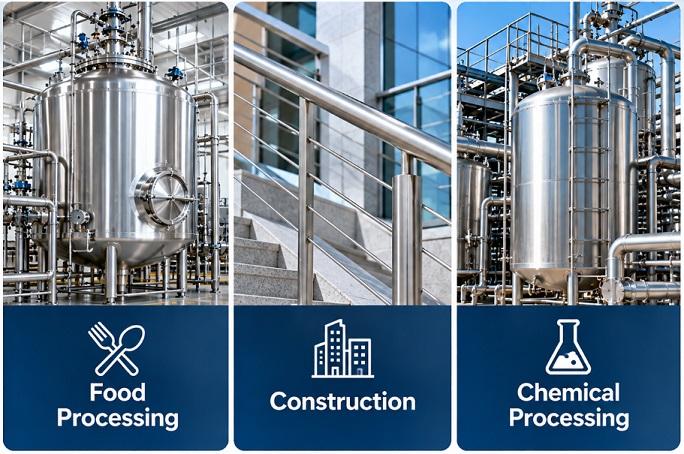
304 stainless steel is widely used in industries requiring a combination of corrosion resistance, durability, formability, and reasonable material cost. Common applications include:
- Food Processing Industry: 304 stainless steel is widely used in food preparation equipment, storage tanks, processing vessels, commercial kitchen equipment, and food contact surfaces because of its corrosion resistance and ease of cleaning.
- Construction Industry: It is used in architectural panels, handrails, decorative structures, building fittings, and exterior components.
- Automotive Industry: 304 stainless steel is used in exhaust components, trim, brackets, and selected automotive hardware.
- Chemical Processing: It is suitable for tanks, pipes, fittings, and equipment handling many relatively mild chemicals.
- Household Appliances: Kitchen sinks, cookware, refrigerators, washing machine components, and other household products commonly use 304 stainless steel.
- Medical Equipment: It is used in selected medical instruments, equipment housings, and reusable components where appropriate cleaning and corrosion resistance are required.
Applications of 306 Stainless Steel
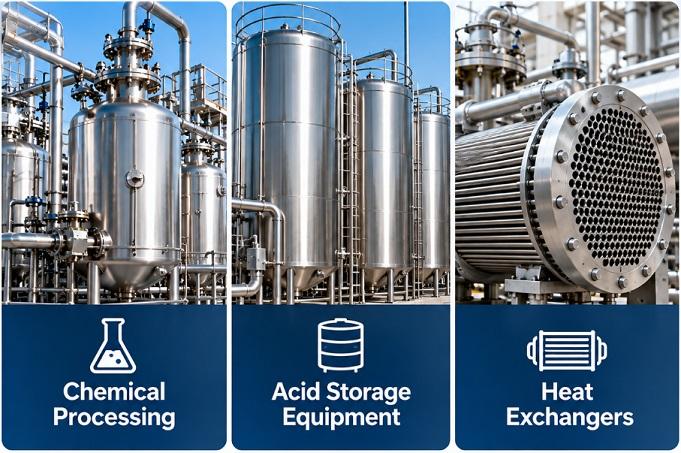
306 stainless steel is generally selected for more specialized industrial applications where its high silicon content provides useful corrosion performance. Common application areas include:
- Chemical Processing Industry: Equipment exposed to selected hot and concentrated acid environments.
- Acid Storage Equipment: Storage tanks and associated components designed for suitable concentrated acid service.
- Chemical Pipelines: Pipes and fittings used to transport certain aggressive chemical solutions.
- Industrial Reactors: Selected components in chemical reaction systems where corrosion resistance is a major requirement.
- Heat Exchangers: Specialized equipment operating in compatible chemical environments.
- Chemical Production Facilities: Components that require specialized resistance to certain nitric acid and sulfuric acid conditions.
Cost of 304 vs 306 Stainless Steel
Cost is an important consideration when selecting stainless steel for industrial and commercial applications.
304 stainless steel is generally more economical than 306 stainless steel because it is produced in much larger quantities and is widely available in many product forms.
306 stainless steel is a specialized high-silicon stainless steel. Its more specific alloy composition, limited availability, and specialized production requirements can result in higher material costs.
The actual price depends on product form, dimensions, manufacturing requirements, quantity, supplier, and market conditions.
| Cost Factor | 304 Stainless Steel | 306 Stainless Steel (UNS S30600) |
|---|---|---|
| Raw material cost | Generally lower | Generally higher |
| Availability | Very widely available | More limited |
| Sheet and plate supply | Extensive | More specialized |
| Pipe and tube supply | Widely available | Limited depending on supplier |
| Machining cost | Moderate to high | Depends on material and tooling |
| Fabrication cost | Generally economical | May require specialized procedures |
| Long-term cost | Economical for general applications | Can be favorable in suitable aggressive chemical environments |
Manufacturing and Machinability of 304 vs 306 Stainless Steel
Manufacturing and machinability are important considerations when selecting stainless steel for industrial production. The chemical composition and metallurgical structure of stainless steel can influence machining, forming, cutting, welding, and surface finishing.
304 stainless steel is relatively difficult to machine compared with many low-carbon steels. Its tendency to work harden can cause increased cutting forces, tool wear, and heat generation. To improve machining performance, manufacturers generally use sharp cutting tools, appropriate feed rates, stable workholding, and effective cooling.
306 stainless steel requires additional consideration because of its high silicon content and specialized alloy composition.
304 vs 306 Stainless Steel: Which Material Should You Choose?
Choosing between 304 and 306 stainless steel depends on the specific requirements of the application, particularly the corrosion resistance needed in the operating environment.
- Choose 304 stainless steel when general corrosion resistance, excellent formability, weldability, and cost-effectiveness are the main considerations. 304 stainless steel is widely used in food processing, household appliances, architectural components, and general industrial equipment, where its balanced properties, broad availability, and manufacturing flexibility make it a practical choice.
- Choose 306 stainless steel when enhanced corrosion resistance in specific chemical environments is a major consideration. This high-silicon austenitic stainless steel is particularly useful in suitable hot, concentrated nitric acid or sulfuric acid environments, where its specialized corrosion resistance may justify higher material costs.
The final selection should be based on the specific material specification, operating temperature, mechanical loads, corrosion environment, manufacturing process, and expected service life.