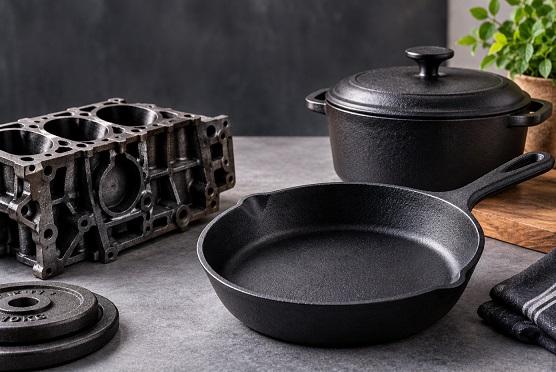
Cast iron is a widely used engineering material known for its excellent castability, compressive strength, wear resistance, and cost-effectiveness. Produced by melting iron with carbon and other alloying elements, cast iron is used in a broad range of industries, including automotive manufacturing, machinery, construction, plumbing, agriculture, and industrial equipment. This article provides a comprehensive overview of cast iron, including its types, common grades, mechanical properties, thermal characteristics, manufacturing processes, and common applications.
What Is Cast Iron?
Cast iron is an iron-carbon alloy that typically contains approximately 2.1% to 4.3% carbon, together with silicon, manganese, and smaller amounts of other elements. Unlike most steels, which generally contain less than approximately 2.1% carbon, cast iron has a relatively high carbon content that improves its melting and casting characteristics.
Cast iron is particularly valued for its excellent castability, good compressive strength, and ability to produce complex shapes with relatively low manufacturing costs. During production, molten iron is poured into a mold and allowed to solidify. This process makes it possible to manufacture components with intricate geometries, internal cavities, thick sections, and integrated structural features that may be difficult or expensive to produce through machining or forging.
The properties of cast iron depend heavily on its microstructure, particularly the form in which carbon exists. Carbon may appear as graphite flakes, graphite nodules, compacted graphite, or iron carbides. The shape, distribution, and quantity of these phases strongly influence strength, ductility, hardness, wear resistance, thermal conductivity, and machinability.
For example, gray cast iron contains graphite flakes that provide excellent vibration damping and machinability. Ductile cast iron contains approximately spherical graphite nodules that improve tensile strength and toughness. White cast iron contains substantial carbide phases, resulting in high hardness and abrasion resistance.
Cast iron is widely used for engine blocks, machine-tool bases, pump housings, pipes, brake components, industrial valves, cookware, and construction products. Its ability to fill complicated mold cavities, accommodate a wide range of section thicknesses, and provide economical near-net-shape production makes it an important engineering material.
Properties of Cast Iron
Cast iron materials are known for their distinctive combination of mechanical, thermal, and manufacturing properties. These characteristics make them valuable for components that require complex shapes, dimensional stability, wear resistance, or economical mass production.
- Excellent castability: Many cast iron grades flow well when molten and can fill complex molds, allowing manufacturers to produce intricate components with relatively low production costs.
- Good compressive strength: Cast iron generally performs well under compressive loading, making it suitable for machine bases, structural supports, housings, and other load-bearing components.
- Good wear resistance: Certain cast iron grades, especially white cast iron and specially alloyed wear-resistant grades, provide excellent resistance to abrasion and sliding wear.
- Vibration damping: Gray cast iron absorbs vibration effectively because of its graphite-flake microstructure, which makes it particularly useful for machine tools, engine blocks, and equipment foundations.
- Thermal performance: Gray cast iron generally offers useful thermal conductivity and thermal stability, making it suitable for brake rotors, cookware, and heat-related industrial components.
- Machinability: Gray cast iron is often relatively easy to machine because graphite can help reduce friction at the cutting interface.
- Dimensional stability: Properly designed and processed cast iron components can provide good dimensional stability in machine structures and industrial equipment.
Important cast iron properties include tensile strength, yield strength, compressive strength, hardness, elongation, modulus of elasticity, thermal conductivity, coefficient of thermal expansion, and melting temperature.
Cast iron typically has a density of approximately 7.0–7.3 g/cm³ and is generally ferromagnetic. Gray cast iron is relatively brittle due to its flake-shaped graphite, while ductile cast iron features spherical graphite nodules that improve strength and ductility.
Types of Cast Iron
Cast iron is commonly classified into several main categories based on carbon structure, microstructure, chemical composition, and mechanical performance. The most widely recognized types are gray cast iron, ductile cast iron, white cast iron, malleable cast iron, and compacted graphite iron. Alloyed cast irons are also used when additional wear resistance, heat resistance, or corrosion resistance is required.
| Cast Iron Classification | Carbon Structure | Main Characteristics | Typical Applications |
|---|---|---|---|
| Gray Cast Iron | Graphite flakes | Excellent vibration damping, good machinability, and good compressive strength | Engine blocks, machine bases, brake rotors, pump housings |
| Ductile Cast Iron | Graphite nodules | High tensile strength, improved ductility, and good impact resistance | Pipes, crankshafts, gears, pressure components |
| White Cast Iron | Predominantly iron carbides | Very high hardness and excellent abrasion resistance | Crusher parts, mill liners, wear plates |
| Malleable Cast Iron | Temper carbon particles | Useful toughness, machinability, and moderate ductility | Pipe fittings, brackets, agricultural hardware |
| Compacted Graphite Iron | Compacted or vermicular graphite | Balanced strength, thermal conductivity, and vibration damping | Diesel engine blocks, cylinder heads, exhaust components |
Gray Cast Iron
Gray cast iron is one of the most widely used cast iron families. It contains graphite in the form of interconnected flakes distributed throughout a metallic matrix, which commonly consists of ferrite, pearlite, or a combination of both. The graphite flakes give fractured surfaces a gray appearance and strongly influence the material's mechanical behavior.
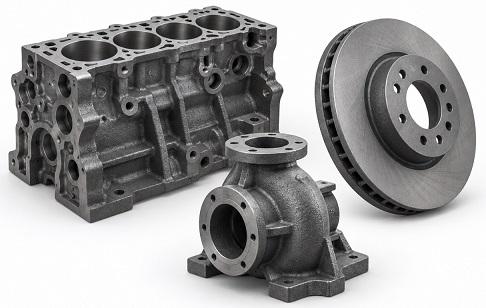
Gray iron offers excellent vibration damping, good machinability, relatively high compressive strength, and useful thermal conductivity. These properties make it particularly suitable for machine-tool beds, engine blocks, cylinder heads, brake rotors, pump housings, gear housings, and industrial equipment frames.
The graphite flakes help interrupt vibration transmission and can improve machinability by acting as internal discontinuities and assisting chip formation. However, their sharp ends also concentrate stress, reducing tensile strength, elongation, and impact toughness compared with ductile iron and many steels.
Common gray iron grades are identified by standards such as ASTM A48/A48M in the United States and EN 1561 in Europe. ASTM Class 30 and Class 40 are examples of commonly referenced gray iron strength classifications.
| Gray Iron Grade | Classification Basis | Main Characteristics | Typical Applications |
|---|---|---|---|
| ASTM A48 Class 20 | Gray iron strength class | Relatively low strength and useful castability | General housings, lightly loaded castings |
| ASTM A48 Class 30 | Gray iron strength class | Balanced strength, machinability, and damping | Machine bases, pump housings, brake components |
| ASTM A48 Class 40 | Gray iron strength class | Higher strength than lower-numbered classes | Industrial machinery, structural castings |
Ductile Cast Iron
Ductile cast iron, also known as nodular iron or spheroidal graphite iron, contains graphite particles that are approximately spherical rather than flake-shaped. Magnesium or other nodularizing additions are introduced during production to encourage the formation of these graphite nodules.
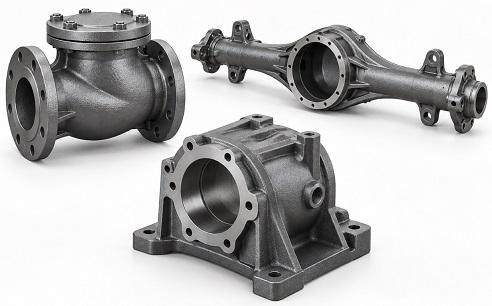
The rounded graphite structure reduces stress concentration compared with the flakes in gray iron. As a result, ductile iron generally offers higher tensile strength, greater elongation, and improved impact resistance while retaining many of the casting advantages associated with iron-carbon alloys.
Ductile iron grades are available with ferritic, pearlitic, or mixed matrices. Ferritic grades generally provide greater ductility and toughness, while pearlitic grades usually offer higher strength and hardness. Heat treatment can further modify the matrix and improve specific properties.
Common applications include water and wastewater pipes, automotive crankshafts, suspension components, pressure-containing fittings, heavy-duty gears, valve bodies, and industrial machinery components. Its combination of strength and castability makes ductile iron a practical alternative to cast steel in many designs.
| Grade Example | Standard Family | General Characteristics | Typical Applications |
|---|---|---|---|
| 65-45-12 | ASTM A536 | Good strength and relatively high elongation | Fittings, brackets, general engineering parts |
| 80-55-06 | ASTM A536 | Higher strength with moderate ductility | Automotive and industrial components |
| 100-70-03 | ASTM A536 | High strength and lower elongation | Heavy-duty mechanical components |
ASTM A536 grade numbers represent specified tensile strength, yield strength, and elongation requirements in customary units. Actual metric values and acceptance requirements should be taken from the relevant edition of the standard and the agreed material specification.
White Cast Iron
White cast iron is a hard and wear-resistant material in which much of the carbon exists as cementite or other carbide phases rather than free graphite. Its fracture surface appears white or silvery because of the carbide-rich microstructure.
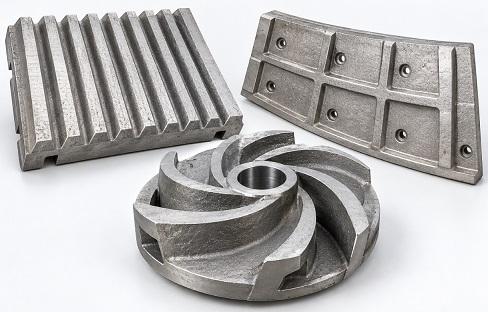
White iron can achieve very high hardness and excellent abrasion resistance. These properties make it suitable for applications involving repeated contact with abrasive particles, mineral slurries, and other materials that rapidly wear softer metals. Common uses include crusher liners, grinding mill components, slurry pump parts, wear plates, and industrial rolls.
The main limitation of conventional white cast iron is its relatively low toughness. Hard carbide structures resist material removal but can crack or fracture under impact loading. Component geometry, operating conditions, and impact severity therefore play important roles in grade selection.
Alloyed white irons can contain chromium, nickel, molybdenum, and other elements to modify carbide formation, hardenability, and wear performance. High-chromium white iron is widely used in severe abrasive service because of its hard chromium-rich carbides and potential for a strong supporting matrix.
Malleable Cast Iron
Malleable cast iron is produced by heat-treating suitable white cast iron castings to transform the carbide-rich structure into a more ductile microstructure containing temper carbon. This treatment improves toughness and allows the material to withstand greater deformation than untreated white cast iron.
Malleable cast iron is used in pipe fittings, brackets, agricultural machinery, hand-tool components, and selected automotive parts. It remains useful where relatively small castings require a combination of strength, machinability, and moderate ductility.
Compacted Graphite Iron
Compacted graphite iron, also called vermicular graphite iron, contains graphite particles with an interconnected, worm-like shape. Its properties generally fall between those of gray and ductile cast iron, depending on graphite morphology and matrix structure.
This material offers a useful combination of strength, thermal conductivity, stiffness, and thermal-fatigue resistance. It is used in selected diesel engine blocks, cylinder heads, exhaust components, and applications involving repeated thermal cycling.
Cast Iron Grades
Cast iron grades identify material classifications and specified mechanical or physical properties. The designation system varies by country and standard. Common systems include ASTM standards in the United States, EN standards in Europe, and other national specifications.
The ASTM A48 system classifies gray iron by tensile strength class, while ASTM A536 designations for ductile iron express tensile strength, yield strength, and elongation requirements. EN designations such as EN-GJL and EN-GJS distinguish lamellar graphite iron and spheroidal graphite iron, respectively.
Cast iron grades are not interchangeable across all standards. Unlike a simple material name, a grade designation provides a basis for comparing materials and specifying minimum performance requirements.
| Grade or Designation | Material Type | Key Characteristics | Typical Applications |
|---|---|---|---|
| ASTM A48 Class 20 | Gray cast iron | Relatively low strength, good damping and castability | General housings and light machine components |
| ASTM A48 Class 30 | Gray cast iron | Common general-purpose strength class | Machine bases, housings, industrial castings |
| ASTM A48 Class 40 | Gray cast iron | Higher specified tensile strength than lower classes | Heavy machine structures and selected engine components |
| ASTM A536 60-40-18 | Ductile cast iron | Moderate strength and high specified elongation | Fittings, housings, and ductile iron components |
| ASTM A536 65-45-12 | Ductile cast iron | Balanced tensile strength and ductility | Industrial machinery and general engineering parts |
| ASTM A536 80-55-06 | Ductile cast iron | Higher strength with lower specified elongation | Gears, shafts, and load-bearing castings |
| EN-GJL-250 | Gray cast iron | Common European gray iron grade with good damping | Machine tools, housings, and engine components |
| EN-GJS-400-15 | Ductile cast iron | Good combination of strength and ductility | Pipe fittings, housings, and structural castings |
| EN-GJS-500-7 | Ductile cast iron | Higher strength with moderate elongation | Automotive parts and industrial machinery |
| EN-GJS-600-3 | Ductile cast iron | Higher tensile strength with lower specified elongation | Higher-strength mechanical components and load-bearing castings |
Mechanical Properties of Cast Iron
The mechanical properties of cast iron depend on graphite morphology, matrix structure, chemical composition, casting quality, and heat treatment. Gray cast iron is generally characterized by good compressive strength and vibration damping but relatively limited tensile ductility. Ductile cast iron provides a better combination of tensile strength, elongation, and toughness.
Important mechanical properties include tensile strength, yield strength, elongation, fatigue strength, hardness, and modulus of elasticity.
| Cast Iron Type | Tensile Strength (MPa) | Elongation (%) | Hardness (HBW) | Young’s Modulus (GPa) | General Mechanical Characteristics |
|---|---|---|---|---|---|
| Gray Cast Iron | 140–300 | Usually very low | 150–260 | 70–130 | Good damping and compressive performance |
| Ductile Cast Iron | 400–800 | 2–18 or higher in selected grades | 130–300 | 160–180 | High strength and improved ductility |
| White Cast Iron | Highly grade-dependent | Very low | 350–700 or higher in selected grades | Grade-dependent | Excellent abrasion resistance |
| Malleable Cast Iron | 350–700 | 2–18, depending on grade | 130–300 | 160–180 | Useful toughness and machinability |
| Compacted Graphite Iron | 250–500 | Generally low | 150–260 | 140–170 | Balanced strength and thermal properties |
Tensile Strength
Tensile strength is the maximum engineering stress recorded during a tensile test. It is commonly expressed in megapascals (MPa) and provides a useful basis for comparing materials under controlled test conditions.
Gray cast iron typically exhibits lower tensile strength than many ductile iron grades because graphite flakes act as stress concentrators. Ductile iron can achieve substantially higher tensile strength because its spheroidal graphite morphology reduces these stress concentrations.
Tensile strength alone is not sufficient for evaluating castings. Defects such as shrinkage cavities, inclusions, and porosity can reduce the effective strength of a finished component. Section thickness and casting quality can also influence measured properties.
Yield Strength
Yield strength is the stress at which a material begins to undergo permanent deformation. For cast iron, yield strength is most useful when comparing ductile grades with specified yield strength or proof-strength requirements. Gray cast iron and white cast iron may not exhibit a clearly defined yield point, so their mechanical performance is often described using other properties, such as tensile strength, hardness, and compressive strength.
Yield strength values depend on the material grade, casting section thickness, specimen type, and testing conditions. The following table lists representative minimum yield strength requirements for common ASTM A536 ductile iron grades.
| Cast Iron Grade | Minimum Yield Strength (MPa) | Material Type |
|---|---|---|
| ASTM A536 60-40-18 | 276 | Ductile cast iron |
| ASTM A536 65-45-12 | 310 | Ductile cast iron |
| ASTM A536 80-55-06 | 379 | Ductile cast iron |
Elongation and Impact Resistance
Elongation measures how much a material stretches before fracture, expressed as a percentage of its original gauge length. It is commonly used to evaluate ductility, which describes a material's ability to undergo plastic deformation before failure.
Impact resistance describes a material's ability to withstand sudden loading without fracturing and is closely related to toughness. Gray cast iron typically exhibits low elongation and limited impact resistance because its flake-shaped graphite promotes crack initiation and propagation. Ductile cast iron generally offers greater elongation and better impact resistance due to its spherical graphite nodules.
These properties are important in automotive components, gears, agricultural machinery, and other applications involving dynamic or impact loading.
Hardness and Wear Resistance
Hardness measures a material's resistance to localized indentation and is commonly measured using Brinell (HBW), Rockwell (HRB), or Vickers (HV) methods. Cast iron hardness varies by grade and microstructure. Gray cast iron offers a good balance of hardness and machinability, while white cast iron provides higher hardness and abrasion resistance due to its carbide-rich structure.
Wear resistance depends on more than hardness alone. Graphite flakes in gray cast iron can help reduce friction under certain sliding conditions, while matrix structure, surface finish, lubrication, contact pressure, and operating temperature also influence wear performance. White cast iron is often preferred for severe abrasive environments, whereas ductile cast iron offers a useful balance of strength and toughness.
These properties make cast iron suitable for a wide range of applications, including brake components, cylinder liners, machine guideways, pump components, and mining equipment.
Young's Modulus
Young's modulus, also called the modulus of elasticity, measures the stiffness of a material in the elastic range. Gray cast iron often has an elastic modulus of approximately 90–140 GPa, while ductile iron commonly exhibits values around 160–175 GPa. Actual values depend on graphite content, matrix structure, and the grade.
The modulus of cast iron can be lower than that of many steels because graphite inclusions influence the elastic response of the matrix. This consideration is important when designing machine-tool structures, rotating components, pressure-containing parts, and assemblies that require precise dimensional control.
Thermal Properties of Cast Iron
Cast iron has important thermal characteristics that influence its use in engine components, cookware, heating equipment, brake rotors, and industrial machinery. Thermal conductivity, heat capacity, thermal expansion, and melting behavior vary with graphite morphology, matrix structure, alloying elements, and temperature.
Gray cast iron often provides relatively good thermal conductivity and thermal damping, while ductile and compacted graphite irons offer different combinations of strength and heat-transfer performance. These differences are particularly important in components exposed to repeated heating and cooling or uneven temperature distributions.
Thermal Conductivity
Thermal conductivity describes how effectively a material transfers heat. Gray cast iron generally offers useful thermal conductivity because its graphite structure can support heat transfer through the material. Ductile cast iron generally has lower thermal conductivity than comparable gray iron grades.
Typical gray cast iron conductivity may fall broadly around 35–55 W/(m·K), although individual grades and conditions can fall outside this range. This property makes gray iron suitable for brake discs, engine blocks, and selected heat-handling components.
| Cast Iron Type | Thermal Conductivity |
|---|---|
| Gray Cast Iron | 35–55 W/m·K |
| Ductile Cast Iron | 20–40 W/m·K |
| Compacted Graphite Iron | 25–45 W/m·K |
| White Cast Iron | Highly variable; generally lower than many graphite-rich gray irons |
Coefficient of Thermal Expansion
The coefficient of thermal expansion describes the dimensional change of a material as its temperature changes. Many conventional cast irons have a linear coefficient of thermal expansion of approximately 10–13 × 10⁻⁶/K near room temperature, although composition and temperature influence the actual value.
Thermal expansion is important when cast iron is assembled with steel, aluminum, ceramics, seals, or other materials. Differences in expansion can change clearances, affect sealing, produce thermal stresses, and influence dimensional accuracy during operation.
Specific Heat Capacity
Specific heat capacity measures the amount of energy required to raise the temperature of a unit mass by one degree. Many cast irons have a specific heat capacity in the approximate range of 450–550 J/(kg·K) near room temperature.
Together with density and thermal conductivity, specific heat capacity determines how quickly a component heats up or cools down. It is relevant to engine warm-up, brake temperature control, furnace components, and the design of thermal processing cycles.
Melting Temperature
Cast iron does not have one universal melting temperature. Depending on composition, many commercial cast irons melt over a range of approximately 1,150–1,250°C. Carbon content, silicon content, and other alloying elements influence the solidus and liquidus temperatures.
Melting behavior is important during furnace operation, mold filling, solidification control, and casting defect prevention. However, the maximum service temperature is not determined by melting temperature alone. Oxidation, creep, thermal fatigue, microstructural changes, and strength retention must also be considered.
Corrosion Resistance of Cast Iron
Corrosion resistance is an important consideration when cast iron is used in water distribution, drainage, industrial piping, pumps, valves, outdoor machinery, and underground infrastructure.
Ordinary cast iron can corrode in the presence of moisture and oxygen. Chlorides, acidic solutions, dissolved oxygen, elevated temperatures, and certain industrial chemicals can accelerate corrosion. Graphite may remain after the iron matrix corrodes, producing a porous residual structure known as graphitic corrosion in susceptible conditions.
Gray and ductile cast iron can provide satisfactory service in many water and industrial environments when the grade and protection system are appropriately selected. However, neither should be assumed to be universally corrosion-resistant. White cast iron is often selected for abrasion resistance rather than general corrosion protection, while high-alloy cast irons may be developed for more demanding chemical or elevated-temperature service.
In buried piping systems, corrosion behavior depends on soil resistivity, moisture, salts, stray electrical currents, and installation conditions. Ductile iron pipes may use external coatings, cement-mortar linings, polyethylene encasement, or other protective systems according to applicable specifications and service requirements.
Corrosion protection methods for cast iron include painting, powder coating, protective plating, oiling, galvanizing, internal linings, corrosion inhibitors where appropriate, and cathodic protection in compatible applications.
Cast Iron vs. Steel
Cast iron and steel are both iron-based materials, but they differ in carbon content, microstructure, manufacturing behavior, and mechanical performance. Cast iron generally contains more carbon than steel, which influences melting behavior, graphite formation, hardness, and brittleness.
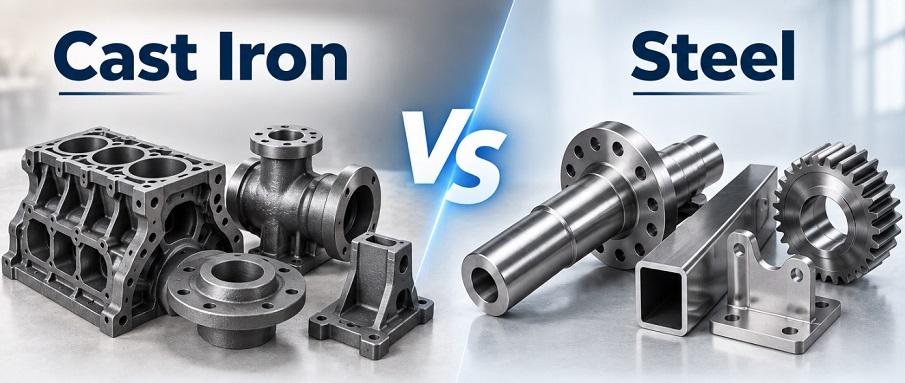
Cast iron is often preferred for complex cast shapes, vibration damping, and economical production, while steel is generally preferred when high ductility, toughness, weldability, or substantial plastic deformation is required. The best material depends on the component's design and service conditions rather than on strength alone.
| Property | Cast Iron | Steel |
|---|---|---|
| Carbon Content | Typically 2.1–4.3% | Generally below 2.1% |
| Density | 7.0–7.3 g/cm³ | 7.8–7.9 g/cm³ |
| Castability | Often excellent for complex shapes | Varies by grade and casting process |
| Tensile Behavior | Varies widely; gray iron is relatively brittle | Often greater ductility and tensile toughness |
| Compressive Strength | Generally good, especially relative to tensile behavior in gray iron | Generally good, depending on grade |
| Vibration Damping | Excellent in many gray iron grades | Usually lower than gray cast iron |
| Weldability | Often challenging and grade-dependent | Often good in suitable low-carbon grades |
| Machinability | Often good for gray iron, but varies by type | Varies considerably by composition and heat treatment |
| Common Applications | Engine blocks, machine bases, pipes, housings | Frames, shafts, pressure vessels, structural members |
Cast iron should not be considered inherently inferior to steel. It is a different material family optimized for different performance requirements. A well-designed gray iron machine base may outperform a steel alternative in vibration damping and cost, while a ductile iron pipe may provide an economical combination of strength and corrosion-control options.
Applications of Cast Iron
Cast iron is used in many industries because it can be tailored to deliver good castability, strength, wear resistance, damping, and thermal performance at a competitive cost. Its ability to produce complex near-net-shape components makes it particularly valuable for large and geometrically complicated parts.
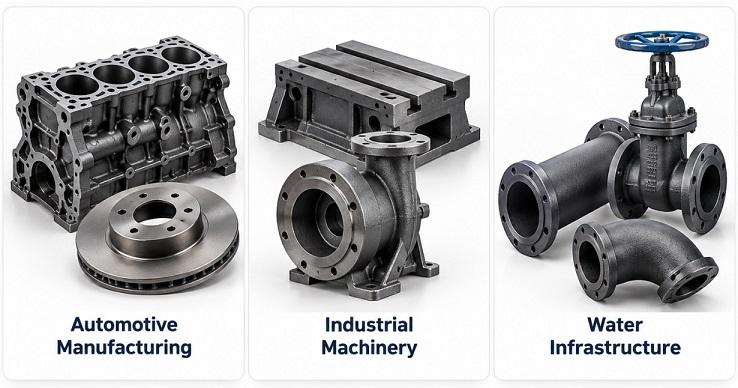
- Automotive manufacturing: Gray iron and ductile iron are used for engine blocks, cylinder liners, brake rotors, crankshafts, and selected drivetrain components.
- Industrial machinery: Machine bases, gear housings, pump bodies, compressor components, and equipment frames benefit from castability and vibration damping.
- Water infrastructure: Ductile iron pipes, fittings, and valves are widely used in water distribution, wastewater systems, and industrial piping.
- Construction: Cast iron products include drainage components, access covers, architectural hardware, and selected structural or decorative elements.
- Mining and mineral processing: Abrasion-resistant white iron is used for mill liners, slurry pump components, crusher parts, and wear plates.
- Agriculture: Cast iron components are found in machinery housings, brackets, counterweights, and selected power transmission parts.
- Energy and power generation: Suitable cast iron grades are used in pump housings, compressor components, and other machinery where their properties meet the operating requirements.
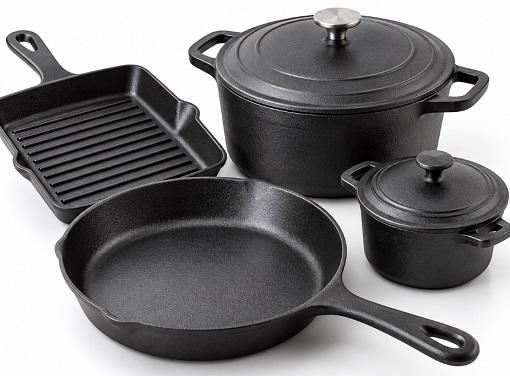
- Cookware and heating equipment: Gray cast iron is used for cookware, stoves, and selected thermal products because of its heat-storage characteristics and castability.
Manufacturing Processes for Cast Iron
Cast iron components are produced through several manufacturing processes, including sand casting, permanent-mold casting, centrifugal casting, shell molding, and specialized casting methods. These processes generally involve melting an iron-based charge, controlling its chemistry and microstructure, pouring the molten metal into a prepared mold, and allowing it to solidify. Subsequent operations may include shakeout, cleaning, heat treatment, CNC machining, surface finishing, and inspection.
Sand Casting
Sand casting is one of the most common methods for manufacturing cast iron components. A mold is formed from prepared sand, and a pattern is used to create the required cavity. Cores can be placed inside the mold to produce internal passages or hollow features.
This process is suitable for a wide range of component sizes, including large machine bases, pump housings, engine components, and industrial castings. Sand casting offers considerable design flexibility, although surface finish, dimensional accuracy, and production efficiency depend on the mold system and process controls.
CNC Machining
CNC machining is commonly used to finish cast iron components after casting. Operations may include milling, turning, drilling, boring, tapping, grinding, and precision surface finishing. Machining produces accurate interfaces, bearing surfaces, mounting holes, sealing faces, and other features that cannot be achieved economically through casting alone.
Gray cast iron is generally considered machinable because graphite flakes promote chip fragmentation and can provide some lubricating effects. However, abrasive inclusions, chilled surfaces, hard carbides, and variations in casting structure can cause tool wear or inconsistent cutting performance.
For complex precision components, a common approach is to cast the approximate shape, inspect the casting, perform any required heat treatment, and then machine critical surfaces. This reduces material removal compared with machining the entire component from a solid billet and can improve production efficiency.
Is Cast Iron Magnetic?
Yes, most types of cast iron are magnetic because iron is their primary component. Gray cast iron, ductile cast iron, white cast iron, and malleable cast iron are generally attracted to magnets.
However, the magnetic properties of cast iron can vary depending on its chemical composition and microstructure. Certain specialized alloyed cast irons may exhibit weak magnetic attraction or be nearly nonmagnetic.
In summary, most cast iron materials are magnetic, but a magnet test alone cannot reliably distinguish cast iron from other magnetic metals, such as carbon steel.
Is Cast Iron Brittle or Ductile?
Some types of cast iron are brittle, but brittleness varies significantly by grade. Gray cast iron is generally brittle in tension because graphite flakes create stress concentrations that encourage crack initiation. It can withstand useful compressive loads, but it typically exhibits limited tensile elongation before fracture.
Ductile cast iron is substantially more ductile because its graphite is present as rounded nodules. Depending on the grade, it can undergo meaningful plastic deformation before failure. Malleable cast iron also offers improved ductility and toughness compared with ordinary white cast iron.
White cast iron is typically very hard and brittle because of its carbide-rich structure. It is suitable for abrasive wear applications but generally not for components requiring substantial deformation or resistance to severe impact.
Is It Healthy to Cook on Cast Iron?
Cooking on cast iron is generally considered safe for most people when the cookware is properly maintained and used as intended. Cast iron does not require a synthetic nonstick coating to develop a naturally low-stick cooking surface, and it can be used for frying, searing, roasting, baking, and many other cooking methods.
However, cast iron can release small amounts of iron into food during cooking. The amount depends on several factors, including the food's acidity, cooking time, moisture content, and the condition of the cookware's surface.
Potential benefits and considerations include the following.
- Dietary iron contribution: Cooking in cast iron may increase the iron content of some foods. This can be useful for people who need more dietary iron, although the amount transferred is variable and should not be treated as a predictable supplement.
- Durability: Well-maintained cast iron can last for decades, reducing the need for frequent cookware replacement.
- Versatile cooking performance: It can move from stovetop to oven when the particular pan and its handle are oven-safe.
- Naturally seasoned surface: Proper seasoning creates a protective layer that helps reduce sticking and rusting.
- Potentially increased iron intake: Acidic foods cooked for long periods may absorb more iron from the pan. This is not necessarily beneficial for everyone.
People with hereditary hemochromatosis or another condition that causes iron overload should discuss their dietary iron intake with a healthcare professional. They may wish to limit avoidable sources of additional iron, including frequent cooking of acidic foods in bare cast iron.
For most people, cast iron is a practical and healthy cookware option when combined with a balanced diet and appropriate cooking practices. It should not, however, be considered a treatment for iron deficiency. Anyone with suspected anemia should seek appropriate medical evaluation rather than relying on cookware to increase iron intake.
To use cast iron safely, keep the cooking surface clean, dry the pan after washing, maintain its seasoning, and avoid using cookware that is cracked or structurally damaged.
What Shouldn't You Cook in Cast Iron?
Cast iron is versatile, but some foods and cooking techniques require additional care. The main concerns are the condition of the seasoning, the possibility of increased iron transfer, and the difficulty of cleaning certain residues.
There are few foods that are universally forbidden in cast iron. Instead, the best approach depends on whether the pan is bare, well-seasoned, or coated with enamel.
Here are some foods and situations to consider.
- Highly acidic foods in new or poorly seasoned pans: Tomatoes, vinegar-based sauces, citrus-heavy dishes, and wine-based sauces can interact with exposed iron. Long cooking times may weaken seasoning and increase iron transfer. A well-seasoned pan can handle some acidic cooking, but a stainless steel or enameled pan is often a better choice for long-simmered acidic dishes.
- Long-simmered tomato sauces: These can be particularly challenging for bare cast iron if the seasoning is thin or damaged. Enameled cast iron is generally more suitable because its glass-like coating separates the food from the underlying iron.
- Delicate fish in a poorly seasoned skillet: Fish can stick easily if the cooking surface is rough or inadequately seasoned. A properly preheated, well-seasoned pan can still work well for many fish dishes.
- Foods that require very precise temperature control: Cast iron retains heat effectively, but it also responds relatively slowly to temperature changes. Delicate sauces or dishes that require rapid cooling may be easier to manage in other cookware.
- Very wet foods added to a cold pan: Excess moisture and insufficient preheating can encourage sticking, especially when searing meat or vegetables.
- Food left in the pan for extended periods: Storing leftovers in bare cast iron is generally not recommended. Moisture and food acids can damage seasoning, and transferring food to a suitable storage container makes cleaning easier.
There is also an important distinction between bare and enameled cast iron.
Bare cast iron depends on seasoning for protection against rust and to help create a smoother cooking surface. Acidic foods are more likely to affect this protective layer.
Enameled cast iron has a glass-like coating that separates the food from the iron. It is generally better suited to tomato sauces, wine-based dishes, and other acidic recipes, provided the enamel is intact and the cookware manufacturer's instructions are followed.
Regardless of the cookware type, avoid extreme temperature changes that could cause thermal shock, particularly with enameled products. Never assume that a damaged enamel coating is safe simply because the pan remains usable for cooking.
What Is the Best Oil to Season Cast Iron?
Seasoning is the process of creating a thin, hardened layer of polymerized oil on bare cast iron. This layer helps protect the metal from moisture, reduces rust formation, and improves food release over time.
There is no single oil that is best for every user. Several common cooking oils work well when applied in a very thin layer and heated according to the cookware manufacturer's instructions.
Popular seasoning oils include:
- Canola oil: An affordable, widely available option that works well for routine seasoning.
- Grapeseed oil: Often chosen because it spreads easily and has a relatively high smoke point.
- Sunflower oil: A practical option for seasoning when an appropriate high-heat variety is available.
- Soybean oil: Common in many cooking-oil blends and suitable for building seasoning.
- Flaxseed oil: Sometimes used for seasoning, although its performance can vary, and a brittle or flaking layer may develop if the coating is not applied and heated properly.
- Vegetable oil blends: A convenient, economical choice for everyday pan maintenance.
For most home cooks, canola oil or another neutral, refined cooking oil is a practical choice. Expensive specialty oils are not necessary to maintain a good seasoning layer.
The seasoning process generally follows these steps.
- Clean the cookware: Wash the pan with warm water and a small amount of dish soap. Remove food residue, rust, or loose seasoning as needed.
- Dry it completely: Use a towel and, if necessary, briefly warm the pan to remove remaining moisture.
- Apply a very thin layer of oil: Spread a small amount over the cooking surface, sides, and other exposed areas.
- Wipe away the excess: The surface should look almost dry rather than wet or sticky. Excess oil is a common cause of uneven or tacky seasoning.
- Heat the pan: Follow the cookware manufacturer's guidance for the oven temperature and duration appropriate to the oil and pan.
- Allow it to cool safely: Let the cookware cool before handling or storing it.
- Repeat if necessary: Several thin layers can create a more uniform protective surface than one thick layer.
When oven seasoning, ensure that the cookware and its handles are oven-safe, provide adequate ventilation, and avoid heating oil beyond its safe operating conditions. Follow the manufacturer's instructions because suitable temperatures and procedures can vary.
Routine maintenance is often simpler than full reseasoning. After cooking, clean the pan, dry it thoroughly, and apply a tiny amount of oil if the surface appears dry. With regular use, the seasoning layer can become increasingly durable.