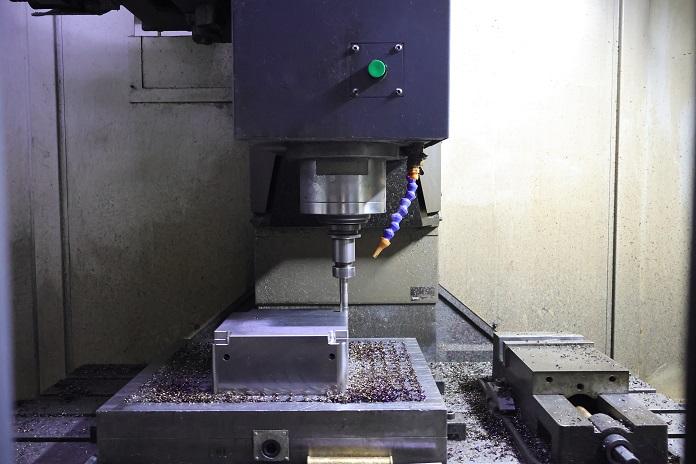
This article provides a comprehensive overview of CNC machining, explaining what it is, how CNC machines work, the different types of CNC machines, their advantages, common industrial applications, and the software and drawings used in CNC manufacturing.
What is CNC Machining?
CNC machining, short for Computer Numerical Control machining, is a manufacturing process that uses computer-controlled machines to remove material from a workpiece and create precise parts. Unlike conventional machining, where an operator manually controls many machine movements, CNC machining uses programmed instructions to control the movement of cutting tools and other machine components.
CNC machining can be used to manufacture parts from materials such as metals, plastics, wood, composites, and engineering materials. Depending on the machine configuration and cutting tools, CNC equipment can perform operations including milling, turning, drilling, boring, tapping, threading, and contouring.
A typical CNC machining process starts with a digital design. Engineers or designers create a 2D drawing or 3D CAD model that defines the dimensions, geometry, holes, curves, threads, and other features of the required component. The design is then prepared using manufacturing software and converted into machine-readable instructions, commonly referred to as G-code and M-code.
The CNC controller interprets these instructions and coordinates the movement of the machine. The cutting tool follows the programmed toolpath while the workpiece is securely held in place. This allows manufacturers to produce components with consistent dimensions and repeatable quality.
CNC machining is widely used because it combines precision, repeatability, automation, and production flexibility. It can be used for prototypes and one-off components as well as high-volume production runs.
| Feature | CNC Machining | Traditional Machining |
|---|---|---|
| Machine control | Computer-controlled according to a programmed sequence | Mainly controlled manually by the operator |
| Repeatability | High when the machine setup and program are properly controlled | Depends more heavily on operator skill and consistency |
| Complex geometry | Suitable for complex profiles and multi-axis machining | More limited for complicated geometries |
| Automation | High | Relatively low |
| Production volume | Suitable for prototypes through high-volume production | Often practical for repair, maintenance, and low-volume work |
Types of CNC Machines
CNC machines are available in many configurations, with each type designed for specific machining or cutting operations. The most suitable machine depends on the geometry of the part, material, required tolerances, production volume, and manufacturing requirements.
| Type of CNC Machine | How It Works | Common Materials | Typical Applications |
|---|---|---|---|
| CNC Milling Machine | Rotating cutting tools remove material from a workpiece | Aluminum, steel, brass, plastics | Precision mechanical parts, housings, brackets |
| CNC Lathe | The workpiece rotates while a cutting tool removes material | Steel, aluminum, brass, plastics | Shafts, bushings, pins, threaded components |
| CNC Router | A rotating cutting tool moves across the workpiece | Wood, plastics, composites, some soft metals | Panels, signs, furniture, decorative components |
| CNC Plasma Cutter | A plasma arc cuts electrically conductive materials | Mild steel, stainless steel, aluminum | Sheet metal and plate fabrication |
| CNC Laser Cutter | A focused laser beam cuts or engraves material | Metals, acrylic, wood, plastics | Sheet cutting, engraving, detailed profiles |
| CNC EDM Machine | Controlled electrical discharges remove material | Hardened conductive metals | Dies, molds, precision and intricate components |
| 5-Axis CNC Machine | The cutting tool or workpiece moves through multiple linear and rotational axes | Metals, plastics, composites | Aerospace, medical, molds, complex components |
CNC milling machines and CNC lathes are among the most common types of CNC equipment. Milling is particularly useful for parts with flat surfaces, pockets, slots, holes, and complex contours, while turning is generally preferred for cylindrical or rotational components.
More specialized CNC machines, such as EDM, laser, and plasma systems, are selected according to the material and cutting requirements. Multi-axis CNC machines provide additional flexibility and can reduce the number of setups needed when manufacturing complex parts.
How Does a CNC Machine Work?
CNC machining works by converting a digital design into a series of precise machine movements. The process involves several stages, from creating the part design to setting up the machine and inspecting the finished component.
The basic CNC machining workflow includes:
- Create the design: An engineer or designer creates a CAD model or technical drawing containing the required dimensions and geometry.
- Prepare the manufacturing process: A CAM system is used to determine cutting tools, machining operations, speeds, feeds, and toolpaths.
- Generate CNC code: The CAM software converts the toolpaths into machine instructions, usually G-code and supporting M-code commands.
- Set up the machine: The operator installs the appropriate cutting tools, secures the workpiece, sets work offsets, and loads the CNC program.
- Run the machining operation: The CNC controller executes the program and controls the movement of the machine axes and cutting tools.
- Inspect the part: The finished component is measured to verify that its dimensions and quality meet the required specifications.
CNC machines use coordinate systems to determine the position of the cutting tool. In a typical milling machine, the X, Y, and Z axes control movement in three directions. More advanced machines add rotational axes to provide additional flexibility.
The operator must also consider cutting speed, feed rate, depth of cut, tool selection, coolant, workholding, and material properties. Correctly configuring these parameters helps achieve the desired surface finish, dimensional accuracy, tool life, and machining efficiency.
Main Components of a CNC Machine
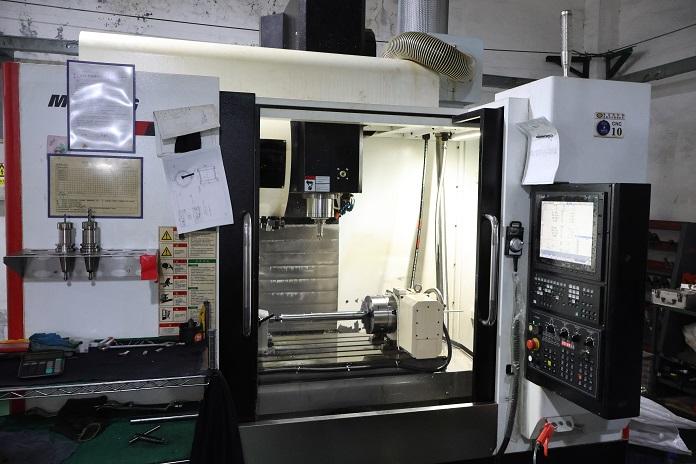
A CNC machine consists of several mechanical, electrical, and software components that work together to perform automated machining operations.
- Machine frame: Provides the structural foundation and supports the major machine components.
- Spindle: Rotates the cutting tool or workpiece at a controlled speed, depending on the machine type.
- Cutting tools: Remove material from the workpiece. Different tools are selected for drilling, milling, threading, finishing, and other operations.
- Axis drive system: Motors and mechanical components move the machine axes accurately according to programmed commands.
- CNC controller: Interprets the programmed instructions and coordinates machine movement.
- Workholding system: Holds the workpiece securely during machining. Examples include vises, chucks, clamps, and specialized fixtures.
- Coolant system: Delivers cutting fluid when required to control heat, improve tool life, and remove chips.
- Control panel: Allows the operator to load programs, adjust settings, monitor machine status, and control machine operations.
The combination of these components allows CNC machines to perform repeatable machining operations with a high level of control and consistency.
What is CNC controller
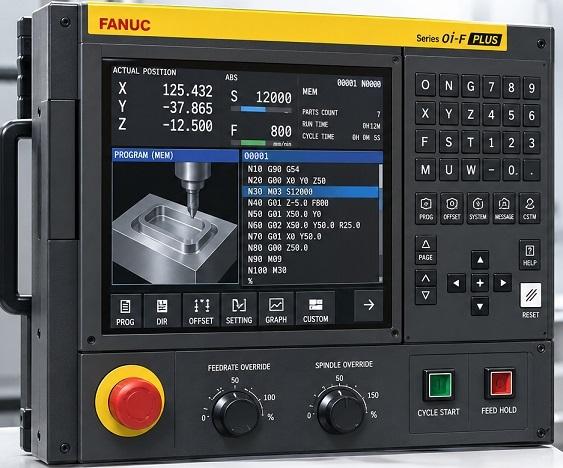
A CNC controller is the electronic control system that interprets the G-code program and converts those instructions into precise movements and operations of the CNC machine.
In simple terms: G-code tells the machine what to do, while the CNC controller tells the machine how to physically do it.
For example, when the controller receives a command such as G01 X50 Y20 F300, it processes the instruction and controls the machine's motors and other components to move the cutting tool to the specified position at the programmed feed rate.
A CNC controller typically manages:
- Axis movement — controls the X, Y, Z, and other machine axes
- Spindle speed and direction
- Feed rate
- Tool changes
- Coolant
- Machine positioning and coordinates
- Safety and machine functions
Common CNC controller manufacturers include FANUC, Siemens, Mitsubishi Electric, Haas, and Heidenhain.
What materials can be used for CNC machining?
CNC machining can process a broad range of materials. The appropriate material depends on the mechanical requirements of the finished component, operating environment, weight, corrosion resistance, electrical properties, cost, and machining characteristics.
| Material | Key Characteristics | Common CNC Applications |
|---|---|---|
| Aluminum | Lightweight, corrosion resistant, and generally easy to machine | Aerospace, automotive, electronics, housings |
| Stainless Steel | Strong and corrosion resistant, with different grades offering different properties | Medical equipment, industrial components, food-processing equipment |
| Carbon Steel | Strong, durable, and available in many grades | Mechanical components, fixtures, structural parts |
| Brass | Good machinability and useful corrosion resistance | Fittings, connectors, valves, decorative components |
| Copper | Excellent electrical and thermal conductivity | Electrical components, heat-transfer components |
| Titanium | High strength-to-weight ratio and good corrosion resistance | Aerospace, medical, and high-performance components |
| Engineering Plastics | Lightweight and available with different mechanical, thermal, and chemical properties | Housings, prototypes, insulators, machine components |
Material selection should be considered together with cutting tool selection and machining parameters. Hard or heat-sensitive materials may require specialized tooling, appropriate cutting speeds, controlled feeds, coolant, and careful chip management.
What software is used for CNC?
CNC manufacturing commonly uses several types of software. CAD software is used to design the component, while CAM software is used to plan machining operations and generate toolpaths. Additional software may be used for CNC simulation, code editing, program transfer, and manufacturing management.
| Software Category | Main Function | Typical Use |
|---|---|---|
| CAD Software | Creates 2D drawings and 3D models | Part design and engineering documentation |
| CAM Software | Generates machining strategies and toolpaths | CNC programming and manufacturing preparation |
| G-code Editor | Allows CNC programs to be reviewed and edited | Program inspection and manual optimization |
| Simulation Software | Simulates machine movements and toolpaths | Collision checking and process verification |
| DNC Software | Transfers CNC programs between computers and machine controllers | CNC program management in manufacturing environments |
Common CAD/CAM platforms include Fusion, Mastercam, SolidWorks CAM, Siemens NX, and other professional manufacturing systems. The best software depends on the machine type, complexity of the parts, production requirements, company workflow, and the user's experience.
For beginners, it is useful to understand the relationship between CAD, CAM, and CNC control. CAD defines what the part should look like, CAM determines how it can be machined, and the CNC controller executes the resulting machine instructions.
CAD Software
CAD stands for Computer-Aided Design. CAD software is used to create the 2D drawings and 3D models of a part.
For example, engineers can use CAD software to define:
- Part dimensions and geometry
- Holes and slots
- Chamfers and fillets
- Threads and other features
- Dimensional tolerances
Common CAD software includes AutoCAD, SolidWorks, CATIA, Siemens NX, and Fusion.
In simple terms: CAD defines what the part should look like.
CAM Software
CAM stands for Computer-Aided Manufacturing. CAM software uses the CAD model to plan how the part will be manufactured on a CNC machine.
CAM software helps engineers determine:
- Which cutting tools to use
- Toolpaths and cutting directions
- Cutting depth
- Feed rate
- Spindle speed
- Machining sequence
- Roughing and finishing operations
Once the machining strategy is defined, CAM software can generate G-code, which is then sent to the CNC machine.
Common CAM software includes Mastercam, Autodesk Fusion, Siemens NX CAM, SolidCAM, hyperMILL, PowerMill, and ESPRIT CAM.
In simple terms: CAM defines how the part should be machined.
What are CNC drawings?
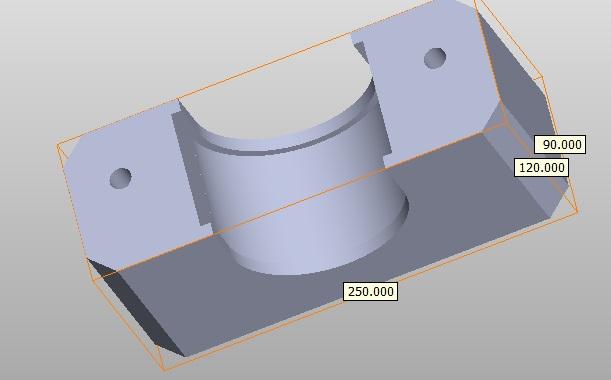
CNC drawings are technical drawings or digital design documents that provide the information needed to manufacture a component using CNC equipment. They communicate the part's dimensions, geometry, tolerances, material requirements, surface finishes, and other manufacturing specifications.
A CNC drawing may include:
- Overall dimensions: Defines the length, width, height, diameter, or other major dimensions of the component.
- Hole information: Specifies hole locations, diameters, depths, thread sizes, and countersinks or counterbores when required.
- Tolerances: Defines the acceptable dimensional variation for important features.
- Material specifications: Identifies the material that should be used to manufacture the part.
- Surface finish: Indicates the required roughness or finishing requirements for specific surfaces.
- Geometric tolerances: Defines requirements for characteristics such as position, flatness, perpendicularity, parallelism, and concentricity.
CNC drawings can be supplied as traditional 2D technical drawings or combined with 3D CAD models. The machinist or CNC programmer uses this information to determine how the part should be positioned, which tools should be selected, and how the machining operations should be performed.
A clear CNC drawing is important because manufacturing errors can occur when dimensions, tolerances, or material specifications are unclear. Good technical documentation helps designers, programmers, machinists, and inspectors work from the same requirements.
What is G-code in CNC machining?
G-code is a programming language commonly used to control CNC machines. It contains instructions that tell the machine where and how the cutting tool should move and can also control machining-related functions.
A CNC program may contain commands for rapid movement, linear cutting, circular interpolation, spindle speed, feed rate, tool changes, coolant, and program sequencing.
For example, a G-code command can instruct a machine to move to a specific coordinate at a particular feed rate. Other commands can start or stop the spindle, activate coolant, or select a different cutting tool.
Although CNC programmers can write G-code manually, modern manufacturing often relies on CAM software to generate programs automatically. Experienced machinists may still inspect and modify generated code to optimize the process or make machine-specific adjustments.
G-code example
G-code tells the CNC machine where to move, how fast to move, and what operations to perform.
Simple example:
G21          ; Use millimeters
G90          ; Absolute positioning
G00 X0 Y0    ; Rapid move to X0, Y0
G01 X50 Y0 F200 ; Cut to X50 at feed rate 200
G01 X50 Y30     ; Cut to X50, Y30
M05          ; Stop spindle
M30          ; End program
Here are some common commands:
| Code | Meaning | Application | Notes |
|---|---|---|---|
G00
|
Rapid positioning | Milling & Lathe | — |
G01
|
Linear cutting move | Milling & Lathe | — |
G02
|
Clockwise arc | Milling & Lathe | — |
G03
|
Counterclockwise arc | Milling & Lathe | — |
G20
|
Inches | Milling & Lathe | — |
G21
|
Millimeters | Milling & Lathe | — |
G90
|
Absolute coordinates | Milling & Lathe | Function may differ on some lathe controls |
G91
|
Incremental coordinates | Milling & Lathe | — |
F
|
Feed rate | Milling & Lathe | Unit and mode may vary by controller |
S
|
Spindle speed | Milling & Lathe | Unit and range are machine-dependent |
M03
|
Start the spindle clockwise | Milling & Lathe | — |
M05
|
Stop the spindle | Milling & Lathe | — |
M30
|
End and reset the program | Milling & Lathe | Reset behavior may vary by controller |
Think of it as a set of precise instructions that converts a CAD/CAM design into physical movements of the CNC machine.
For example, G01 X50 Y20 F300 essentially means: move in a straight line to X=50, Y=20 at a feed rate of 300.
One important detail: G-code varies somewhat between CNC controllers (Fanuc, Haas, Siemens, LinuxCNC, etc.), so the exact meaning or available commands can differ.
How to Choose the Right CNC Machine?
Choosing a CNC machine requires consideration of the parts that will be manufactured and the expected production requirements. There is no single CNC machine that is ideal for every application.
Important factors to consider include:
- Part geometry: Complex three-dimensional parts may require 4-axis or 5-axis machining, while simpler components may only need 3-axis equipment.
- Material: Hard metals and difficult-to-machine materials may require machines with greater rigidity, spindle power, and specialized tooling.
- Part size: The machine's working envelope must be large enough to accommodate the workpiece and required tool movements.
- Production volume: High-volume manufacturing may benefit from automation, automatic tool changers, pallet systems, or robotic loading.
- Accuracy requirements: Components with tight tolerances may require machines with high rigidity, precision positioning, and suitable inspection equipment.
- Budget: Machine cost is only one part of the total investment. Tooling, software, maintenance, installation, training, and workholding should also be considered.
Manufacturers should evaluate the complete production process rather than selecting a machine based solely on its maximum specifications. The right machine is one that can reliably meet the required quality, productivity, and cost targets.
Advantages of CNC Machining
CNC machining offers several advantages over many traditional manufacturing methods. These benefits have made CNC technology an important part of modern manufacturing.
- High Precision: CNC machines can follow programmed coordinates accurately, making them suitable for components that require tight dimensional tolerances.
- Excellent Repeatability: Once a program has been properly developed and the machine is correctly set up, the same machining process can be repeated to produce consistent parts.
- Automation: CNC machines can perform many machining operations automatically, reducing the amount of manual intervention required.
- Complex Geometries: Multi-axis CNC machines can manufacture curves, contours, pockets, angled surfaces, and other complex features that may be difficult to produce manually.
- Improved Productivity: Automated machining can operate continuously for extended periods, helping manufacturers increase production efficiency.
- Reduced Human Error: CNC programs provide precise instructions for machine movement, reducing errors associated with manually controlling every machining operation.
- Flexible Production: Manufacturers can modify CNC programs and tooling arrangements to produce different parts without completely redesigning the manufacturing equipment.
- Consistent Quality: Automated toolpaths and controlled machining parameters help maintain consistent quality across production batches.
Despite these benefits, CNC machining also requires an initial investment in equipment, tooling, software, programming, and operator training. Proper process planning is therefore important to achieve the best balance between machining quality and production cost.
Applications of CNC Machining in Various Industries
CNC machining is used across a wide range of industries because it can manufacture components with different geometries, materials, dimensions, and tolerance requirements.
| Industry | Common CNC Applications | Typical Components |
|---|---|---|
| Aerospace | Precision structural and mechanical components | Brackets, housings, aircraft components, engine parts |
| Automotive | Production parts, prototypes, molds, and custom components | Engine parts, transmission components, shafts, brackets |
| Medical | Precision medical and surgical components | Surgical instruments, orthopedic components, equipment parts |
| Electronics | Enclosures, heat-management parts, and precision hardware | Housings, heat sinks, mounting components, connectors |
| Industrial Machinery | Mechanical components and replacement parts | Gears, shafts, fixtures, brackets, machine components |
| Robotics | Precision structural and motion-related components | Robot joints, mounting plates, arms, housings |
| Energy | Components for energy-generation and industrial systems | Valves, pump components, turbine parts, fittings |
CNC machining is particularly valuable when an industry requires accurate dimensions, reliable repeatability, complex shapes, or customized components. It can support both rapid prototyping and production manufacturing.
CNC Machining Process: From Design to Finished Part
Producing a CNC-machined component involves more than simply placing a block of material into a machine. A successful manufacturing process requires coordination between design, programming, machining, inspection, and finishing.
- Part design: The component is designed using CAD software according to its functional requirements.
- Design review: The design is checked for dimensions, tolerances, material requirements, and manufacturability.
- Process planning: The manufacturer determines the machine, workholding method, cutting tools, machining sequence, and required operations.
- CAM programming: Toolpaths are generated based on the CAD model and manufacturing strategy.
- Program verification: The CNC program can be simulated and reviewed to identify potential collisions or machining problems.
- Machine setup: The workpiece and cutting tools are installed, and offsets are established.
- Machining: The CNC machine removes material according to the programmed toolpaths.
- Inspection: Critical dimensions and features are measured to confirm that the finished part meets specifications.
- Finishing: Additional processes such as deburring, polishing, anodizing, coating, or other surface treatments may be performed when required.
Careful planning at each stage can improve machining efficiency, reduce material waste, extend tool life, and minimize the risk of producing defective parts.
Is CNC difficult to learn?
CNC machining can be challenging to learn, but beginners can develop the necessary skills through structured training and hands-on practice. The difficulty depends on the level of CNC work being learned.
Someone starting with basic CNC operation generally needs to understand machine safety, coordinate systems, tool identification, workholding, offsets, basic measurement, and machine controls. More advanced roles may require knowledge of CAD/CAM software, G-code programming, cutting parameters, tooling, GD&T, process planning, and CNC troubleshooting.
A practical learning path can include:
- Learn machining fundamentals: Understand cutting tools, workpieces, speeds, feeds, and basic machining operations.
- Learn CNC coordinates: Become familiar with X, Y, and Z axes, work offsets, machine coordinates, and tool offsets.
- Learn basic G-code: Understand common movement, spindle, feed, tool-change, and program-control commands.
- Practice CAD: Learn how to interpret and create simple technical models and drawings.
- Learn CAM: Practice creating toolpaths and simulating machining operations.
- Gain hands-on experience: Work with experienced machinists and gradually take responsibility for machine setup and operation.
Safety should always be a priority when learning CNC machining. Beginners should receive appropriate machine-specific training before operating industrial equipment independently.
Is it worth becoming a CNC machinist?
Becoming a CNC machinist can be a worthwhile career choice for people who enjoy manufacturing, engineering, mechanical systems, problem-solving, and hands-on technical work. CNC machinists help convert engineering designs into physical components and play an important role in modern manufacturing.
CNC machinists may be responsible for setting up machines, selecting and installing tools, loading programs, setting work and tool offsets, monitoring machining operations, measuring finished parts, and making adjustments when necessary.
With additional experience and training, CNC machinists can move into specialized positions such as CNC programmer, setup technician, manufacturing technician, quality technician, CNC supervisor, or other manufacturing-related roles.
| Skill | Why It Matters | Potential Career Benefit |
|---|---|---|
| CNC Machine Operation | Provides the foundation for safely operating production equipment. | Essential for CNC machinist positions. |
| Machine Setup | Enables tools, workpieces, offsets, and programs to be prepared correctly. | Supports more advanced manufacturing responsibilities. |
| G-code Programming | Helps machinists understand and modify CNC programs. | Useful for CNC programming and process optimization roles. |
| CAD/CAM | Connects digital part design with CNC manufacturing. | Opens opportunities in programming and digital manufacturing. |
| Precision Measurement | Helps verify that finished parts meet specifications. | Valuable for quality control and inspection-related roles. |
| Troubleshooting | Helps identify machine, tooling, programming, and process problems. | Supports higher-level technical responsibilities. |
CNC manufacturing is also evolving as manufacturers adopt robotics, automated inspection, digital production systems, and increasingly sophisticated multi-axis machines. Developing both practical machining skills and digital manufacturing knowledge can therefore be valuable for people pursuing a long-term career in manufacturing.
Conclusion
CNC machining is a versatile manufacturing technology that uses computer-controlled equipment to produce precise and repeatable components. From basic 3-axis milling machines to sophisticated multi-axis machining centers, CNC technology can support a wide variety of manufacturing requirements.
The CNC machining process combines digital design, CAM programming, machine setup, cutting tools, automated machine movements, and quality inspection. Its ability to produce complex geometries with consistent results makes it valuable in industries including aerospace, automotive, medical, electronics, robotics, energy, and industrial machinery.
Learning CNC machining requires an understanding of both practical machining principles and digital manufacturing technologies. Beginners can start with machine safety, technical drawings, coordinate systems, basic G-code, and simple machining operations before progressing to CAD/CAM programming and advanced multi-axis manufacturing.
As manufacturing continues to adopt automation, robotics, digital inspection, and smart factory technologies, CNC machining is likely to remain an important foundation of modern production. Whether you are a manufacturer selecting CNC equipment, a designer learning how to create machinable parts, or someone considering a career as a CNC machinist, understanding the fundamentals of CNC machining is an important first step.