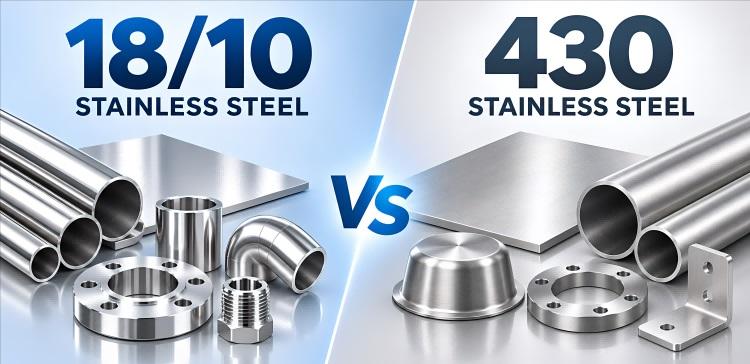
18/10 and 430 stainless steel are two commonly used stainless steel materials with different chemical compositions, mechanical properties, corrosion resistance, magnetic characteristics, and manufacturing costs. Both materials contain chromium, which helps protect them against corrosion, but they differ significantly in nickel content and metallurgical structure. This article explains the differences between 18/10 and 430 stainless steel, including their chemical composition, strength, hardness, density, corrosion resistance, thermal properties, magnetic properties, cost, machinability, and common applications.
What Is 18/10 Stainless Steel?
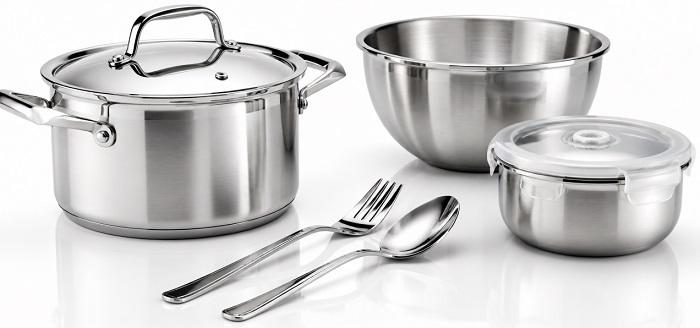
18/10 stainless steel is a chromium-nickel stainless steel commonly used in kitchenware, cookware, cutlery, food processing equipment, and household appliances. The name 18/10 refers to its approximate chemical composition: 18% chromium and 10% nickel by weight.
18/10 stainless steel generally belongs to the austenitic stainless steel family and is commonly associated with AISI 304 stainless steel. Standard 304 stainless steel typically contains approximately 18–20% chromium and 8–10.5% nickel, although the exact chemical composition depends on the applicable material specification.
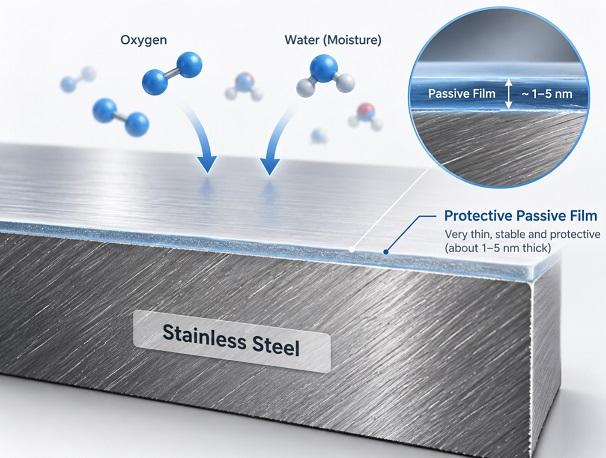
Chromium is responsible for forming a thin, protective oxide layer on the steel surface, which helps prevent rust and corrosion. Nickel stabilizes the austenitic structure and improves toughness, ductility, and corrosion resistance. The combination of chromium and nickel gives 18/10 stainless steel an excellent balance of durability, appearance, and resistance to everyday kitchen environments.
One of the most important characteristics of 18/10 stainless steel is its excellent resistance to corrosion from water, moisture, and many common food ingredients. It also has good formability and weldability, making it suitable for manufacturing complex kitchen products and industrial components.
18/10 stainless steel is generally non-magnetic in its annealed condition. This characteristic is related to its austenitic crystal structure. However, some cold-worked areas may exhibit weak magnetic attraction.
Because of its combination of corrosion resistance, attractive appearance, and good mechanical performance, 18/10 stainless steel is widely used for premium cutlery, cooking utensils, mixing bowls, sinks, food containers, and cookware surfaces.
What Is 430 Stainless Steel?
430 stainless steel is a ferritic stainless steel containing approximately 16–18% chromium and little or no intentionally added nickel. It belongs to the AISI 400 series and is commonly identified by the material designation AISI 430 or EN 1.4016.
Unlike 18/10 stainless steel, 430 stainless steel has a ferritic microstructure. Its relatively high chromium content provides useful corrosion resistance, while the absence of significant nickel content makes it generally more economical than many austenitic stainless steels.
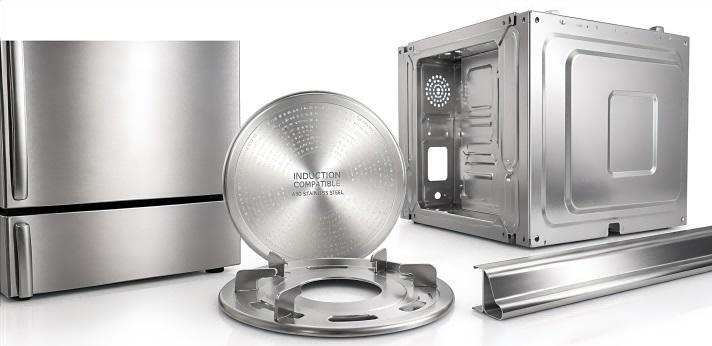
430 stainless steel is magnetic because of its ferritic crystal structure. This property makes it particularly useful in applications where magnetic attraction is required, including induction-compatible cookware bases, refrigerator panels, and household appliance components.
Another important characteristic of 430 stainless steel is its good resistance to oxidation and corrosion in relatively mild environments. It performs well in indoor applications and many household environments, although it is generally less resistant to aggressive chloride-containing environments than 18/10 stainless steel.
430 stainless steel also offers good formability, moderate strength, and useful thermal conductivity. It is commonly processed through rolling, stamping, bending, and other conventional sheet-metal manufacturing operations.
Typical applications include kitchen appliance panels, refrigerator components, dishwasher interiors, decorative trim, automotive components, sinks, cookware bases, and general household products.
What Is the Difference Between 18/10 and 430 Stainless Steel?
18/10 and 430 stainless steel differ mainly in nickel content, metallurgical structure, corrosion resistance, magnetic behavior, and material cost.
18/10 stainless steel contains approximately 10% nickel and belongs to the austenitic stainless steel family. It generally provides better corrosion resistance, especially in environments involving moisture, food acids, and certain cleaning chemicals. Its non-magnetic characteristics also make it suitable for applications where magnetic response is undesirable.
430 stainless steel contains little or no intentionally added nickel and belongs to the ferritic stainless steel family. It is magnetic, generally less expensive, and offers good performance in many indoor and household applications. However, 430 stainless steel is generally more susceptible to staining and localized corrosion when exposed to aggressive chloride environments, prolonged moisture, or harsh cleaning conditions.
The following table summarizes the main differences between 18/10 and 430 stainless steel.
| Feature | 18/10 Stainless Steel | 430 Stainless Steel |
|---|---|---|
| Material family | Austenitic stainless steel | Ferritic stainless steel |
| Common designation | 18/10, commonly associated with 304 | AISI 430 / EN 1.4016 |
| Chromium content | Approximately 18–20% | Approximately 16–18% |
| Nickel content | Approximately 8–10.5% for typical 304 grades | Generally no intentional nickel addition |
| Magnetic behavior | Generally non-magnetic when annealed | Magnetic |
| Corrosion resistance | Generally excellent in common household environments | Good in mild environments |
| Resistance to chlorides | Generally better | Generally lower |
| Density | Approximately 7.9 g/cm³ | Approximately 7.7 g/cm³ |
| Strength | Generally higher tensile strength options | Moderate strength |
| Formability | Excellent | Good |
| Weldability | Generally excellent | More limited, depending on section thickness and welding conditions |
| Thermal conductivity | Relatively low | Generally higher |
| Cost | Generally higher | Generally lower |
| Common applications | Cutlery, cookware, food equipment, sinks | Appliance panels, cookware bases, decorative components |
Chemical Composition of 18/10 vs 430 Stainless Steel
Chemical composition is one of the most important differences between 18/10 and 430 stainless steel. The amount of chromium, nickel, carbon, and other alloying elements determines the material's corrosion resistance, mechanical properties, magnetic behavior, and manufacturing characteristics.
18/10 stainless steel contains significantly more nickel than 430 stainless steel. Nickel stabilizes the austenitic structure, improves toughness, and contributes to corrosion resistance. In contrast, 430 stainless steel relies primarily on chromium for its stainless properties and maintains a ferritic structure.
The following table compares the typical chemical composition of commonly used 18/10-associated 304 stainless steel and AISI 430 stainless steel.
| Chemical Element | 304 Stainless Steel (Typical 18/10 Family) | 430 Stainless Steel |
|---|---|---|
| Chromium (Cr) | 18.0–20.0% | 16.0–18.0% |
| Nickel (Ni) | 8.0–10.5% | Generally no intentional addition |
| Carbon (C) | Maximum 0.08% | Maximum 0.12% for common AISI 430 specifications |
| Manganese (Mn) | Maximum 2.0% | Maximum 1.0% |
| Silicon (Si) | Maximum 0.75% | Maximum 1.0% |
| Phosphorus (P) | Maximum 0.045% | Maximum 0.040% |
| Sulfur (S) | Maximum 0.030% | Maximum 0.030% |
| Iron (Fe) | Balance | Balance |
Chromium Content
Chromium is the primary element responsible for the corrosion resistance of stainless steel. When exposed to oxygen, chromium forms a thin and stable chromium-rich oxide film on the material surface. This protective layer helps prevent further oxidation and can reform when the surface is slightly damaged, provided suitable conditions are present.
Both 18/10 and 430 stainless steel contain substantial amounts of chromium. However, 18/10-associated 304 stainless steel generally contains approximately 18–20% chromium, while 430 stainless steel contains approximately 16–18%.
The higher chromium content of 304, combined with nickel, contributes to its generally better corrosion performance in many everyday environments.
Nickel Content
Nickel is a major alloying element in 18/10 stainless steel. It helps stabilize the austenitic microstructure, improves toughness, and supports good formability and corrosion resistance.
430 stainless steel generally does not contain an intentional nickel addition. This reduces its dependence on nickel as a raw material and helps lower production costs.
The difference in nickel content is also responsible for an important distinction in magnetic behavior. Austenitic 18/10 stainless steel is generally non-magnetic, while ferritic 430 stainless steel is magnetic.
Mechanical Properties of 18/10 vs 430 Stainless Steel
Mechanical properties describe how materials behave when subjected to external forces, including tension, compression, bending, impact, and repeated loading. These characteristics are important when selecting stainless steel for cookware, kitchen equipment, industrial components, and structural applications.
Both 18/10 and 430 stainless steel provide useful mechanical performance. However, their different microstructures and chemical compositions result in different strength, hardness, ductility, and forming characteristics.
18/10 stainless steel generally offers higher tensile strength and excellent ductility, while 430 stainless steel provides moderate strength and good formability for many sheet-metal applications.
| Mechanical Property | 18/10 Stainless Steel (304) | 430 Stainless Steel |
|---|---|---|
| Tensile strength | Approximately 515–620 MPa | Approximately 450–600 MPa |
| Yield strength | Approximately 205–290 MPa | Approximately 205–310 MPa |
| Young's modulus | Approximately 193 GPa | Approximately 200 GPa |
| Elongation | Approximately 40–50% | Approximately 22–25% |
| Hardness | Typically up to approximately 215 HB in common specifications | Typically around 75–85 HRB |
| Work hardening | Relatively high | Generally lower |
| Ductility | Excellent | Good |
Tensile Strength and Yield Strength
Tensile strength represents the maximum stress a material can withstand before breaking, while yield strength indicates the stress at which permanent deformation begins.
18/10 stainless steel generally provides good tensile strength and toughness. Its austenitic structure allows it to undergo considerable plastic deformation before fracture, making it suitable for products that require deep drawing, bending, and forming.
430 stainless steel also provides useful tensile and yield strength for household appliances and general sheet-metal products. However, its lower ductility can limit its suitability for certain demanding forming operations.
Hardness and Wear Resistance
Hardness measures a material's resistance to indentation, scratching, and localized deformation. Both materials offer useful hardness for everyday applications, although their actual values depend on manufacturing conditions, surface finishing, and cold working.
18/10 stainless steel can become significantly harder through cold working. This characteristic is useful when producing durable cutlery, kitchen utensils, and other components that experience repeated contact and handling.
430 stainless steel also provides adequate hardness for appliance panels, decorative components, and cookware bases. However, neither material should automatically be considered a high-wear tool steel.
Ductility and Formability
Ductility describes how much a material can deform before fracture. It is particularly important in manufacturing processes such as deep drawing, stamping, bending, and rolling.
18/10 stainless steel generally has excellent ductility, making it suitable for complex shapes such as deep-drawn pots, bowls, sinks, and food containers.
430 stainless steel has good formability for many conventional sheet-metal applications. However, it generally offers less elongation than 304 stainless steel, so forming operations must be selected according to the material's thickness and condition.
Physical Properties of 18/10 vs 430 Stainless Steel
Physical properties describe the basic characteristics of materials, including density, weight, and dimensional behavior. These properties influence product design, transportation, manufacturing efficiency, and material selection.
The density difference between 18/10 and 430 stainless steel is relatively small. Both materials are iron-based stainless steels and have densities close to 8 g/cm³. Therefore, neither material provides a major weight advantage over the other when components have identical dimensions.
| Physical Property | 18/10 Stainless Steel | 430 Stainless Steel |
|---|---|---|
| Density | Approximately 7.9–8.0 g/cm³ | Approximately 7.7 g/cm³ |
| Crystal structure | Austenitic | Ferritic |
| Weight | Slightly heavier | Slightly lighter |
| Surface appearance | Bright and attractive when polished | Bright or matte depending on finish |
Density and Weight Difference
Density measures the mass of a material per unit volume. The density of 18/10 stainless steel is approximately 7.9–8.0 g/cm³, while 430 stainless steel is approximately 7.7 g/cm³.
This means 430 stainless steel is slightly lighter than 18/10 stainless steel when comparing components with the same volume.
However, the difference is relatively small compared with the differences between materials such as aluminum, titanium, and steel. In most kitchenware and appliance applications, material thickness, product geometry, and structural design have a greater influence on the final product weight.
Surface Appearance and Finish
18/10 stainless steel is commonly used for premium kitchenware because it can achieve an attractive, bright, and highly polished surface. Its nickel content also contributes to its appearance and resistance to certain types of staining.
430 stainless steel can also achieve attractive polished and brushed finishes. It is widely used for decorative panels, appliance surfaces, and kitchen components where appearance and affordability are both important.
The final appearance of either material depends strongly on surface preparation, polishing, brushing, coating, and finishing processes rather than chemical composition alone.
Thermal Properties of 18/10 vs 430 Stainless Steel
Thermal properties describe how materials respond to temperature changes, including heat transfer, thermal expansion, and heat storage. These characteristics are important in cookware, food processing equipment, household appliances, and industrial thermal systems.
430 stainless steel generally has higher thermal conductivity than 18/10 stainless steel. This means it can transfer heat more efficiently through the material. However, neither material conducts heat as efficiently as copper or aluminum.
| Thermal Property | 18/10 Stainless Steel (304) | 430 Stainless Steel |
|---|---|---|
| Thermal conductivity | Approximately 16 W/m·K | Approximately 25 W/m·K |
| Coefficient of thermal expansion | Approximately 17.2 µm/m·K | Approximately 10–11 µm/m·K |
| Specific heat capacity | Approximately 500 J/kg·K | Approximately 460–500 J/kg·K |
| Melting temperature | Approximately 1400–1450°C | Approximately 1425–1510°C |
Thermal Conductivity
Thermal conductivity measures how efficiently a material transfers heat. A higher thermal conductivity means heat can move through the material more easily.
430 stainless steel generally has higher thermal conductivity than 304 stainless steel. This makes it useful in applications where heat transfer through the stainless steel layer is an important consideration.
18/10 stainless steel has relatively low thermal conductivity. For this reason, stainless steel cookware often incorporates aluminum or copper layers to improve heat distribution and reduce localized hot spots.
It is important to understand that thermal conductivity alone does not determine cookware performance. The thickness of the material, the construction of the cookware base, and the presence of additional conductive layers also have significant effects.
Coefficient of Thermal Expansion
The coefficient of thermal expansion measures how much a material expands or contracts when its temperature changes.
18/10 stainless steel has a relatively high coefficient of thermal expansion, typically around 17.2 µm/m·K. In comparison, 430 stainless steel generally has a lower value of approximately 10–11 µm/m·K.
This means 430 stainless steel generally experiences less dimensional expansion than 18/10 stainless steel under the same temperature change.
Lower thermal expansion can be beneficial in applications involving repeated heating and cooling, especially where dimensional stability is important.
Melting Temperature
18/10-associated 304 stainless steel generally has a melting range of approximately 1400–1450°C. AISI 430 stainless steel typically has a melting range of approximately 1425–1510°C.
The actual melting temperature depends on chemical composition and material specifications. Furthermore, melting temperature does not directly determine the maximum operating temperature of a finished product. Oxidation resistance, mechanical strength at elevated temperatures, and service conditions must also be considered.
Corrosion Resistance of 18/10 vs 430 Stainless Steel
Corrosion resistance describes a material's ability to withstand chemical and electrochemical degradation when exposed to moisture, oxygen, salts, acids, cleaning chemicals, and other environmental factors.
Both 18/10 and 430 stainless steel are corrosion-resistant materials because they contain chromium, which forms a protective oxide layer on the surface.
18/10 stainless steel generally provides better corrosion resistance than 430 stainless steel, particularly in environments involving moisture, food acids, and chloride exposure.
The nickel content of 18/10 stainless steel helps stabilize its austenitic structure and contributes to its overall corrosion performance. Its relatively high chromium content also supports the formation of a protective passive film.
430 stainless steel offers good corrosion resistance in many indoor and household environments. However, it is generally more vulnerable to pitting, staining, and corrosion when exposed to salt, chlorides, and aggressive cleaning chemicals.
| Corrosion Property | 18/10 Stainless Steel | 430 Stainless Steel |
|---|---|---|
| General corrosion resistance | Excellent in many everyday environments | Good in mild environments |
| Resistance to moisture | Very good | Good |
| Resistance to food acids | Generally very good | More limited |
| Resistance to saltwater | Limited in severe marine environments | Generally poor in prolonged exposure |
| Resistance to chlorides | Better than 430, but still susceptible to pitting | Generally lower |
| Resistance to household cleaning chemicals | Generally good, depending on chemical | Depends strongly on chemical and concentration |
| Protective oxide layer | Chromium-rich passive layer | Chromium-rich passive layer |
Corrosion Resistance in Kitchen Environments
Kitchen products are frequently exposed to water, food acids, salt, detergents, and changing temperatures. These conditions make corrosion resistance an important consideration when selecting stainless steel.
18/10 stainless steel is widely used for cutlery, cookware, food containers, and kitchen utensils because it generally maintains its appearance and corrosion resistance under normal kitchen conditions.
430 stainless steel is also commonly used in kitchens, especially for appliance panels, refrigerator components, and cookware bases. However, prolonged contact with salty or acidic substances should be avoided where possible.
Electrical Properties of 18/10 vs 430 Stainless Steel
Electrical properties describe how easily a material allows electric current to flow. These properties are important in electrical equipment, household appliances, grounding components, and industrial systems.
Both 18/10 and 430 stainless steel are electrical conductors, but their electrical resistivity differs because of their chemical compositions and metallurgical structures.
| Electrical Property | 18/10 Stainless Steel (304) | 430 Stainless Steel |
|---|---|---|
| Electrical resistivity | Approximately 0.72 µΩ·m | Approximately 0.60 µΩ·m |
| Electrical conductivity | Relatively low | Relatively low |
Electrical Resistivity
Electrical resistivity measures how strongly a material resists the flow of electric current. Materials with higher electrical resistivity conduct electricity less effectively.
18/10 stainless steel generally has higher electrical resistivity than 430 stainless steel. Consequently, 430 stainless steel can provide slightly better electrical conductivity under comparable conditions.
However, both materials have considerably higher electrical resistivity than copper and aluminum. Therefore, neither is normally selected for applications requiring highly efficient electrical conduction.
The electrical properties of stainless steel may still be useful in equipment housings, appliance structures, and industrial components where corrosion resistance and mechanical durability are more important than maximum conductivity.
Magnetic Properties of 18/10 vs 430 Stainless Steel
Magnetic properties are one of the most noticeable differences between 18/10 and 430 stainless steel. These characteristics are determined primarily by their metallurgical structures and alloy compositions.
18/10 stainless steel is generally non-magnetic, while 430 stainless steel is magnetic. This difference is particularly important in cookware, household appliances, electrical equipment, and applications involving magnetic separation.
18/10 stainless steel is generally austenitic. Its high nickel content helps stabilize the face-centered cubic crystal structure, which gives it its characteristic low magnetic response. However, 18/10 stainless steel is not guaranteed to be completely non-magnetic in every condition. Cold working, bending, stamping, and other manufacturing processes can introduce some magnetic response in certain areas.
430 stainless steel belongs to the ferritic stainless steel family. Its body-centered cubic crystal structure gives it ferromagnetic properties, meaning it can be attracted to magnets. This characteristic is particularly useful for induction-compatible cookware bases and appliance components that require magnetic interaction.
A simple magnet test can provide a useful preliminary indication of whether a stainless steel product contains ferritic or austenitic material. However, magnetism alone cannot reliably identify a precise stainless steel grade or verify its chemical composition.
Applications of 18/10 Stainless Steel
18/10 stainless steel is commonly used in products requiring a combination of corrosion resistance, toughness, and attractive surface finishes.
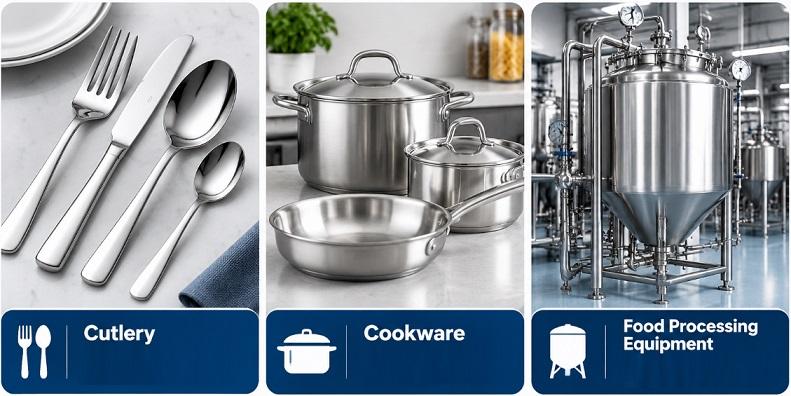
- Cutlery: Forks, spoons, knives, and other tableware products often use 18/10 stainless steel because of its corrosion resistance, durability, and polished appearance.
- Cookware: Stainless steel pots, pans, saucepans, and cooking utensils frequently use 18/10 stainless steel for food-contact surfaces.
- Food Processing Equipment: Tanks, containers, mixing equipment, and food preparation surfaces use 304-family stainless steel because of its corrosion resistance and cleanability.
- Kitchen Sinks: Premium kitchen sinks and washing equipment commonly use 18/10-associated stainless steel grades.
- Medical and Laboratory Equipment: Certain containers, work surfaces, and equipment housings use austenitic stainless steel because of its durability and resistance to many cleaning environments.
- Food Service Equipment: Commercial kitchen utensils, serving equipment, and food storage products use 18/10 stainless steel for repeated use and cleaning.
Applications of 430 Stainless Steel
430 stainless steel is commonly used in applications where magnetic behavior, moderate corrosion resistance, and economical material costs are important.
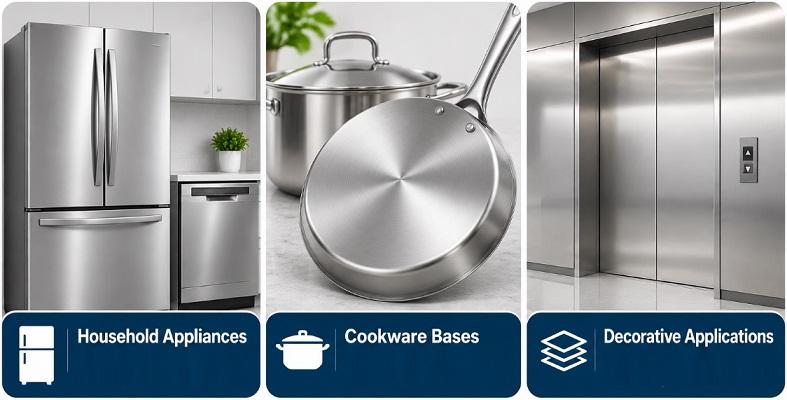
- Household Appliances: Refrigerator doors, dishwasher panels, washing machine components, and appliance housings commonly use 430 stainless steel.
- Cookware Bases: Magnetic 430 stainless steel is widely used in the exterior layers or bases of induction-compatible cookware.
- Kitchen Equipment: Certain kitchen panels, appliance trim, and household equipment components use 430 stainless steel.
- Automotive Components: Some exhaust system components, decorative trim, and automotive parts use ferritic stainless steel grades.
- Decorative Applications: Polished and brushed 430 stainless steel is used for interior panels, architectural trim, and decorative surfaces.
- Industrial Equipment: Certain tanks, housings, and general industrial components use 430 stainless steel where environmental conditions are suitable.
Cost of 18/10 vs 430 Stainless Steel
Cost is an important factor when selecting stainless steel for cookware, kitchenware, appliances, and industrial manufacturing. Although both materials offer useful corrosion resistance and mechanical performance, their raw material costs and manufacturing economics are different.
18/10 stainless steel is generally more expensive than 430 stainless steel because of its higher nickel content. Nickel is an important alloying element in austenitic stainless steel, and fluctuations in nickel prices can influence the cost of 304-family materials.
430 stainless steel generally has a lower raw material cost because it does not require a significant nickel addition. This makes it attractive for large-volume manufacturing, appliance components, decorative panels, and products where extreme corrosion resistance is unnecessary.
| Cost Factor | 18/10 Stainless Steel | 430 Stainless Steel |
|---|---|---|
| Raw material cost | Generally higher | Generally lower |
| Nickel price exposure | Higher | Lower |
| Material availability | Widely available | Widely available |
| Forming cost | Can be higher because of work hardening | Depends on forming requirements |
| Welding cost | Generally established and economical | May require additional process control |
| Maintenance cost | Potentially lower in more corrosive environments | Depends on environmental exposure |
| Overall product cost | Generally higher | Generally lower |
Manufacturing and Machinability of 18/10 vs 430 Stainless Steel
Manufacturing and machinability are important considerations when selecting 18/10 or 430 stainless steel. Their different microstructures affect forming behavior, machining performance, welding requirements, and surface finishing.
18/10 stainless steel generally offers excellent weldability and formability but tends to work harden significantly during machining and cold forming. 430 stainless steel generally has lower work-hardening behavior, although its welding performance and forming limits require attention.
| Manufacturing Property | 18/10 Stainless Steel | 430 Stainless Steel |
|---|---|---|
| Machinability | Moderate to difficult because of work hardening | Generally moderate |
| Formability | Excellent | Good |
| Deep drawing | Excellent for suitable grades and conditions | More limited depending on product design |
| Weldability | Generally excellent | More limited, especially in thicker sections |
| Cold working | Strong work-hardening tendency | Generally lower work hardening |
| Surface finishing | Excellent polishing capability | Good polishing and brushing capability |
| Manufacturing cost | Depends on forming and machining requirements | Generally economical for suitable applications |
Machining
18/10 stainless steel can be relatively challenging to machine because it work hardens during cutting. Inappropriate cutting conditions may cause excessive tool wear, surface damage, and poor dimensional accuracy.
430 stainless steel generally has lower work-hardening behavior and can be easier to machine under suitable conditions. However, machining performance depends on the material condition, tooling, cutting parameters, and required surface finish.
Forming and Stamping
18/10 stainless steel has excellent ductility and is widely used for deep drawing and complex forming operations. It is suitable for manufacturing cookware, kitchen sinks, bowls, and other products requiring substantial plastic deformation.
430 stainless steel is also suitable for stamping, bending, and rolling. However, its lower ductility may limit certain complex forming operations compared with 304 stainless steel.
Welding
18/10-associated 304 stainless steel generally has excellent weldability and can be joined using common stainless steel welding processes.
430 stainless steel can also be welded, but welding requires greater attention to heat input, grain growth, and potential embrittlement, particularly in thicker sections. Appropriate welding procedures and, where necessary, post-weld treatments should be selected according to the application.
18/10 vs 430 Stainless Steel for Cookware
Cookware is one of the most common applications where consumers compare 18/10 and 430 stainless steel. Both materials can be used in cookware manufacturing, but they often perform different functions within a finished product.
18/10 stainless steel is commonly used for the interior cooking surface, while 430 stainless steel is frequently used for the exterior induction-compatible base.
This combination allows cookware manufacturers to take advantage of the corrosion resistance and appearance of 18/10 stainless steel while using the magnetic properties of 430 stainless steel to achieve compatibility with induction cooktops.
18/10 for Cooking Surface
The cooking surface of a stainless steel pan is exposed to water, oils, salt, acidic ingredients, and repeated cleaning.
18/10 stainless steel is commonly selected because it offers good corrosion resistance, durability, and a smooth surface that can be cleaned easily. It is also suitable for manufacturing pots, pans, saucepans, and other cookware products with complex shapes.
430 for Induction Cookware
Induction cooktops generate heat through electromagnetic induction. To work effectively, cookware generally requires a suitable magnetic material in its base.
430 stainless steel is magnetic, making it suitable for induction-compatible cookware bases. By incorporating a 430 stainless steel exterior layer, manufacturers can make cookware compatible with induction heating while maintaining a different material on the food-contact surface.
A cookware product made entirely from 18/10 stainless steel may not work efficiently on an induction cooktop unless it includes a suitable magnetic base or additional magnetic layer.
18/10 vs 430 Stainless Steel: Which Material Should You Choose?
Choosing between 18/10 and 430 stainless steel depends on the specific requirements of the product, including corrosion resistance, magnetic properties, manufacturing processes, appearance, and budget.
- Choose 18/10 stainless steel when corrosion resistance, durability, food-contact performance, and an attractive surface finish are major considerations. It is particularly suitable for premium cookware, cutlery, kitchen sinks, food processing equipment, and products exposed to frequent washing.
- Choose 430 stainless steel when lower material cost, magnetic properties, and good performance in relatively mild environments are the main requirements. It is particularly suitable for appliance panels, induction cookware bases, decorative components, and general household equipment.
The final material selection should be based on the actual service environment and applicable material specifications rather than simply comparing the numbers 18/10 and 430. Product thickness, surface finish, manufacturing quality, and maintenance requirements also influence long-term performance.