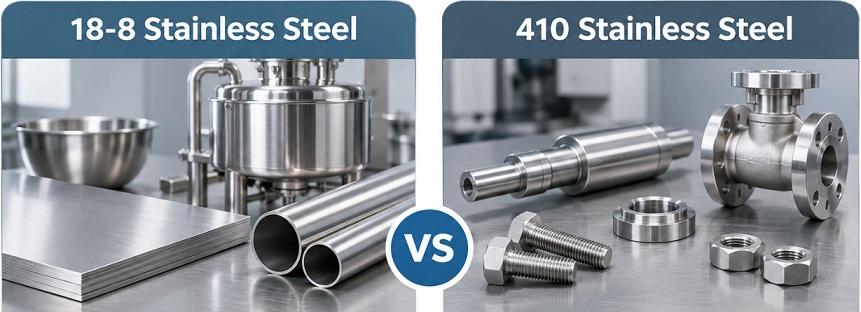
18-8 stainless steel and 410 stainless steel are two commonly used stainless steel materials with different combinations of chemical composition, mechanical properties, physical characteristics, corrosion resistance, and manufacturing performance. Although both materials contain chromium and are designed to resist corrosion, they belong to different stainless steel families and are suitable for different engineering applications.
This article explains the differences between 18-8 and 410 stainless steel, including their chemical composition, mechanical properties, density, corrosion resistance, thermal conductivity, electrical properties, magnetic properties, cost, machinability, heat treatment, and common applications.
What Is 18-8 Stainless Steel?
18-8 stainless steel is a general designation for stainless steel containing approximately 18% chromium and 8% nickel. It is commonly associated with Type 304 stainless steel, one of the most widely used austenitic stainless steel grades in industrial manufacturing.
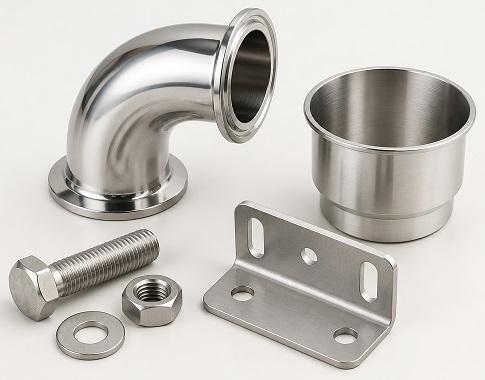
The chromium content provides corrosion resistance by forming a thin, protective chromium oxide film on the material surface. Nickel helps stabilize the austenitic microstructure, improving ductility, toughness, formability, and corrosion resistance in many environments.
Typical Type 304 stainless steel contains approximately 18–20% chromium and 8–10.5% nickel, with iron making up the balance. Other elements, including carbon, manganese, silicon, phosphorus, and sulfur, are also present in controlled quantities.
One of the most important characteristics of 18-8 stainless steel is its excellent combination of corrosion resistance, formability, weldability, and general-purpose mechanical performance. Unlike martensitic stainless steels, conventional 18-8 stainless steel cannot be significantly hardened through conventional quenching and tempering. Its strength can, however, be increased through cold working.
Because of its versatility, 18-8 stainless steel is widely used in kitchen equipment, food processing machinery, chemical processing equipment, architectural components, fasteners, automotive parts, and household products. Common products include stainless steel bolts, nuts, screws, washers, pipes, tubes, sheets, plates, kitchen utensils, and industrial equipment.
What Is 410 Stainless Steel?
410 stainless steel is a martensitic stainless steel containing approximately 11.5–13.5% chromium and up to 0.15% carbon. It is designed to provide a combination of corrosion resistance, high strength, hardness, and wear resistance.
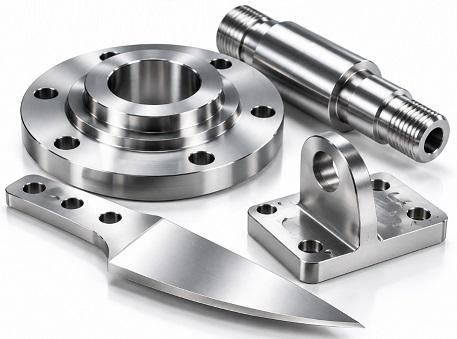
Unlike 18-8 stainless steel, 410 does not contain a substantial amount of nickel. Its higher carbon content and martensitic microstructure allow it to be hardened through heat treatment, including quenching and tempering.
The ability to achieve high hardness and mechanical strength through heat treatment is one of the most important advantages of 410 stainless steel. This makes it suitable for applications requiring resistance to mechanical stress, abrasion, and repeated contact. 410 stainless steel is commonly used in cutlery, knives, pump shafts, valves, turbine components, mechanical parts, fasteners, and industrial equipment.
Although 410 stainless steel provides good corrosion resistance in mild environments, its corrosion resistance is generally lower than that of 18-8 stainless steel. This is mainly because 410 contains less chromium and does not benefit from the same austenitic alloy composition as Type 304.
410 stainless steel is also magnetic in both annealed and hardened conditions, making it suitable for applications where magnetic behavior is acceptable or required.
What Is the Difference Between 18-8 and 410 Stainless Steel?
18-8 and 410 stainless steel differ mainly in their chemical composition, microstructure, hardness, heat treatment response, corrosion resistance, magnetic behavior, and manufacturing characteristics.
18-8 stainless steel is an austenitic stainless steel that offers excellent general corrosion resistance, good ductility, and outstanding formability. It is commonly selected for applications requiring resistance to moisture, food-related environments, and many industrial chemicals.
410 stainless steel is a martensitic stainless steel that can be hardened through heat treatment. It generally provides higher hardness and wear resistance than annealed 18-8 stainless steel, making it suitable for mechanical components and cutting applications.
However, 410 generally has lower corrosion resistance than 18-8 stainless steel, especially in chloride-containing environments and other aggressive conditions.
The following table summarizes the main differences between these two materials.
| Feature | 18-8 Stainless Steel | 410 Stainless Steel |
|---|---|---|
| Common Grade | Generally Type 304 | Type 410 |
| Stainless Steel Family | Austenitic | Martensitic |
| Chromium Content | Approximately 18–20% | Approximately 11.5–13.5% |
| Nickel Content | Approximately 8–10.5% | Generally low, with a maximum around 0.75% in common specifications |
| Carbon Content | Generally 0.08% maximum for conventional Type 304 | Up to approximately 0.15% |
| Density | Approximately 8.0 g/cm³ | Approximately 7.75 g/cm³ |
| Strength | Good strength in the annealed condition | Can achieve high strength through heat treatment |
| Hardness | Moderate in the annealed condition | Can achieve high hardness after hardening |
| Stiffness | Approximately 193 GPa | Approximately 200 GPa |
| Corrosion Resistance | Generally excellent | Good in mild environments |
| Heat Treatment | Cannot be hardened by conventional quenching and tempering | Can be hardened by quenching and tempering |
| Magnetic Behavior | Generally non-magnetic in the annealed condition | Magnetic |
| Formability | Excellent | Moderate, depending on condition |
| Weldability | Generally excellent | More difficult and often requires preheating and post-weld heat treatment |
| Machinability | Moderate; work hardening can be challenging | Varies with hardness and heat treatment condition |
| Cost | Generally moderate to high | Generally moderate |
| Common Applications | Kitchen equipment, fasteners, food processing, chemical equipment | Knives, valves, shafts, pumps, mechanical components |
The most important distinction is that 18-8 stainless steel prioritizes corrosion resistance and formability, while 410 stainless steel prioritizes hardness, strength, and wear resistance. The appropriate material depends on the operating environment and the mechanical requirements of the component.
Chemical Composition of 18-8 vs 410 Stainless Steel
Chemical composition is one of the main factors responsible for the differences between 18-8 and 410 stainless steel. The proportions of chromium, nickel, carbon, and other alloying elements determine the material's microstructure and influence its strength, corrosion resistance, hardness, and manufacturing performance.
18-8 stainless steel contains a relatively high amount of chromium and nickel. These elements help stabilize the austenitic structure and provide excellent general corrosion resistance.
410 stainless steel contains less chromium and substantially less nickel, but has a higher carbon content. Its composition allows the material to develop a martensitic structure during appropriate heat treatment.
| Chemical Element | 18-8 / Type 304 | 410 Stainless Steel |
|---|---|---|
| Chromium (Cr) | 18.0–20.0% | 11.5–13.5% |
| Nickel (Ni) | 8.0–10.5% | Generally 0.75% maximum |
| Carbon (C) | 0.08% maximum | 0.15% maximum |
| Manganese (Mn) | 2.0% maximum | 1.0% maximum in common specifications |
| Silicon (Si) | 1.0% maximum | 1.0% maximum |
| Phosphorus (P) | 0.045% maximum | 0.040% maximum |
| Sulfur (S) | 0.030% maximum | 0.030% maximum |
| Iron (Fe) | Balance | Balance |
Chromium Content
Chromium is essential for stainless steel because it helps form a passive oxide layer that protects the material from corrosion.
18-8 stainless steel contains approximately 18–20% chromium, providing excellent resistance to many atmospheric, food-related, and industrial environments.
410 stainless steel contains approximately 11.5–13.5% chromium. This amount is sufficient to provide useful corrosion resistance, but its protection is generally less effective than that of 18-8 stainless steel in aggressive environments.
Nickel Content
Nickel is an important alloying element in austenitic stainless steels. It helps stabilize the austenitic microstructure and improves ductility, toughness, and formability.
The relatively high nickel content in 18-8 stainless steel is one reason it performs well in applications involving bending, drawing, forming, and welding.
410 stainless steel contains much less nickel. Its martensitic structure is primarily associated with its chromium and carbon content and its heat treatment history.
Carbon Content
Carbon significantly influences the hardness and heat treatment response of stainless steel.
18-8 stainless steel has a relatively low carbon content, which helps maintain its ductility and weldability. However, it cannot be hardened through conventional quenching and tempering.
410 stainless steel contains more carbon, allowing it to transform into a harder martensitic structure during heat treatment. This characteristic makes 410 more suitable for applications requiring high hardness and wear resistance.
Mechanical Properties of 18-8 vs 410 Stainless Steel
Mechanical properties describe how a material behaves when subjected to external forces, including tension, compression, bending, impact, and repeated loading.
Both 18-8 and 410 stainless steel provide useful mechanical performance, but their characteristics are different because of their distinct microstructures.
18-8 stainless steel provides good strength and excellent ductility, while 410 stainless steel can achieve higher hardness and strength through heat treatment.
The mechanical properties of 410 stainless steel vary considerably depending on whether it is annealed, quenched, or tempered. Therefore, comparisons should always consider the material condition.
| Mechanical Property | 18-8 / Type 304 | 410 Stainless Steel |
|---|---|---|
| Tensile Strength | 515–655 MPa, depending on specification and condition | 450–570 MPa for common annealed product specifications; can exceed 1,000 MPa after suitable heat treatment |
| Yield Strength | 205–290 MPa | 205–310 MPa in common annealed product specifications; varies after heat treatment |
| Young's Modulus | Approximately 193 GPa | Approximately 200 GPa |
| Hardness | Generally up to approximately 92 HRB for common annealed specifications | Can reach approximately 38–45 HRC after suitable heat treatment, depending on condition |
| Elongation | Generally around 40% minimum for common specifications | Approximately 20% minimum in common annealed product specifications |
| Fatigue Performance | Good, depending on surface condition and loading | Good in properly designed and heat-treated components |
| Wear Resistance | Moderate | Generally higher after hardening |
Tensile Strength and Yield Strength
Tensile strength represents the maximum stress a material can withstand before breaking, while yield strength describes the stress at which permanent deformation begins.
18-8 stainless steel provides good tensile strength in its annealed condition and can achieve higher strength through cold working. This makes it suitable for structural components, fasteners, and formed products.
410 stainless steel can achieve significantly higher mechanical strength after suitable hardening and tempering. This makes it useful for shafts, valves, mechanical components, and parts exposed to substantial contact stresses.
However, higher strength does not automatically mean better performance in every application. Material toughness, ductility, fatigue behavior, corrosion resistance, and operating conditions must also be considered.
Young's Modulus and Stiffness
Young's modulus measures the resistance of a material to elastic deformation. A higher modulus indicates greater stiffness under the same loading conditions and geometry.
18-8 stainless steel has a typical Young's modulus of approximately 193 GPa, while 410 stainless steel has a modulus of approximately 200 GPa. The stiffness of these two stainless steel materials is relatively similar, with 410 stainless steel having a slightly higher typical elastic modulus. In practical applications, the difference is usually less significant than differences in yield strength, hardness, and heat treatment condition.
Hardness and Wear Resistance
Hardness measures a material's resistance to indentation, scratching, and localized deformation. Wear resistance describes its ability to resist material loss caused by friction or repeated contact.
Annealed 18-8 stainless steel has moderate hardness and is not designed primarily for applications requiring high surface hardness. Cold working can increase its hardness, but it does not provide the same conventional hardening response as martensitic stainless steel.
410 stainless steel can achieve substantially higher hardness through quenching and tempering. This improves its suitability for knives, cutting components, valves, shafts, and other mechanical parts exposed to friction and wear.
Fatigue Strength
Fatigue strength describes a material's ability to withstand repeated loading cycles without developing cracks or eventually failing.
18-8 stainless steel performs well in many cyclic loading applications because of its ductility and toughness. It is frequently used in springs, fasteners, and formed components, although the appropriate grade and cold-worked condition must be selected for spring applications.
410 stainless steel can also provide good fatigue performance when properly heat treated and designed. Its higher strength can be beneficial in mechanical components, but excessive hardness may reduce toughness under certain loading conditions.
Physical Properties of 18-8 vs 410 Stainless Steel
Physical properties describe the basic characteristics of materials, including density, weight, and other properties that influence their behavior in engineering applications.
18-8 and 410 stainless steel have relatively similar densities because both are primarily iron-based alloys. However, their different alloy compositions produce small differences in density and other physical properties.
| Physical Property | 18-8 / Type 304 | 410 Stainless Steel |
|---|---|---|
| Density | Approximately 8.0 g/cm³ | Approximately 7.75 g/cm³ |
| Crystal Structure | Austenitic | Martensitic when hardened |
Density
Density is the mass of a material per unit volume. It is commonly expressed in grams per cubic centimeter (g/cm³).
18-8 stainless steel has a typical density of approximately 8.0 g/cm³, while 410 stainless steel has a density of approximately 7.75 g/cm³. This means that 410 stainless steel is slightly lighter than 18-8 stainless steel when comparing components with the same volume. However, the difference is relatively small and is rarely the primary reason for selecting one grade over the other.
For most engineering applications, the mechanical and corrosion properties of the material are much more important than this small density difference.
Thermal Properties of 18-8 vs 410 Stainless Steel
Thermal properties describe how materials respond to temperature changes, including heat transfer, thermal expansion, specific heat capacity, and melting temperature. 18-8 and 410 stainless steel have different thermal characteristics because of their alloy compositions and microstructures.
410 stainless steel generally has higher thermal conductivity than 18-8 stainless steel, while 18-8 stainless steel has a higher coefficient of thermal expansion. These differences can influence heat dissipation, thermal distortion, machining, and equipment design.
| Thermal Property | 18-8 / Type 304 | 410 Stainless Steel |
|---|---|---|
| Thermal Conductivity | Approximately 16.2 W/m·K at 100°C | Approximately 24.9 W/m·K at 100°C |
| Coefficient of Thermal Expansion | Approximately 17.2 µm/m·K at 0–100°C | Approximately 10.5 µm/m·K at 20–200°C |
| Specific Heat Capacity | Approximately 500 J/kg·K | Approximately 460 J/kg·K |
| Melting Temperature | Approximately 1400–1450°C | Approximately 1480–1530°C |
| High-Temperature Performance | Good oxidation resistance under suitable conditions | Good scaling resistance in selected applications |
Thermal Conductivity
Thermal conductivity measures how efficiently a material transfers heat.
18-8 stainless steel has relatively low thermal conductivity compared with carbon steel and many other engineering metals. Its typical thermal conductivity is approximately 16.2 W/m·K at 100°C. 410 stainless steel has a higher typical thermal conductivity of approximately 24.9 W/m·K at the same reference temperature.
This means 410 stainless steel generally transfers heat more efficiently than 18-8 stainless steel. This characteristic can be useful in mechanical components and equipment where heat dissipation is important.
However, neither grade is normally selected as a primary heat-transfer material when high thermal conductivity is essential. Copper and aluminum are generally more suitable for those applications.
Coefficient of Thermal Expansion
The coefficient of thermal expansion describes how much a material expands or contracts when its temperature changes.
18-8 stainless steel has a relatively high thermal expansion coefficient of approximately 17.2 µm/m·K over the 0–100°C temperature range. 410 stainless steel has a lower thermal expansion coefficient, typically around 10.5 µm/m·K over a 20–200°C reference range.
410 stainless steel generally experiences less thermal expansion than 18-8 stainless steel under comparable temperature changes. This difference can be important in precision components, assemblies involving different materials, and equipment exposed to repeated temperature fluctuations.
Specific Heat Capacity
Specific heat capacity measures the amount of energy required to increase the temperature of a unit mass of material by one degree.
18-8 stainless steel has a typical specific heat capacity of approximately 500 J/kg·K, while 410 stainless steel has a typical value of approximately 460 J/kg·K. This means 18-8 stainless steel generally requires slightly more heat energy per unit mass to achieve the same temperature increase.
Specific heat capacity is relevant when evaluating thermal response, heating and cooling cycles, and the energy requirements of industrial equipment.
Melting Temperature
The melting temperature is the temperature range at which a material changes from a solid to a liquid.
18-8 stainless steel generally has a melting range of approximately 1400–1450°C. 410 stainless steel typically has a melting range of approximately 1480–1530°C. 410 stainless steel therefore generally has a higher melting range than conventional 18-8 stainless steel.
However, melting temperature should not be used as the only indicator of high-temperature performance. Oxidation resistance, creep strength, thermal cycling, and mechanical stability at operating temperature must also be considered.
Corrosion Resistance of 18-8 vs 410 Stainless Steel
Corrosion resistance is one of the most important factors when comparing 18-8 and 410 stainless steel.
Both materials contain chromium, which forms a protective passive oxide layer on the surface. This layer helps prevent further oxidation and slows corrosion in many environments.
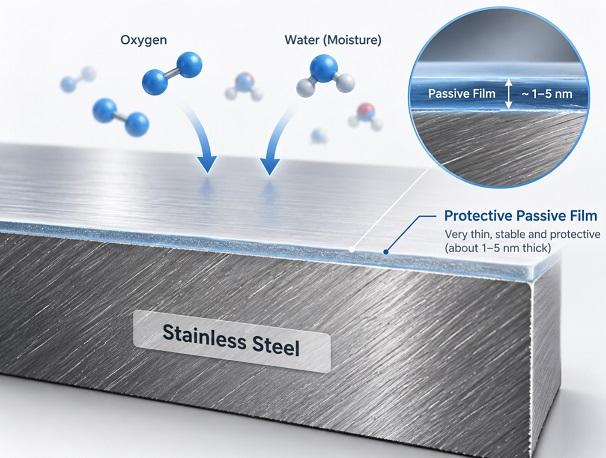
18-8 stainless steel generally provides significantly better corrosion resistance than 410 stainless steel. Its higher chromium content and nickel-stabilized austenitic structure make it suitable for a wider range of atmospheric, food-processing, and industrial environments.
410 stainless steel provides good corrosion resistance in mild environments, but it is more susceptible to corrosion when exposed to aggressive chemicals, high chloride concentrations, and prolonged moisture.
| Corrosion Property | 18-8 / Type 304 | 410 Stainless Steel |
|---|---|---|
| General Corrosion Resistance | Excellent in many general environments | Good in mild environments |
| Chromium Content | Approximately 18–20% | Approximately 11.5–13.5% |
| Atmospheric Corrosion | Excellent | Good |
| Freshwater Resistance | Generally excellent | Generally good |
| Seawater Resistance | Limited in prolonged chloride exposure | Generally poor in aggressive seawater environments |
| Acid Resistance | Good in many mild environments; depends on acid type and concentration | More limited and environment-dependent |
| Food Processing Applications | Widely used | Suitable for selected applications |
| Chloride Resistance | Susceptible to pitting and crevice corrosion | Generally less resistant |
Electrical Properties of 18-8 vs 410 Stainless Steel
Electrical properties describe how easily materials conduct electric current. These characteristics are important in electrical equipment, industrial machinery, grounding systems, and applications involving electrical resistance.
Both 18-8 and 410 stainless steel are electrical conductors, but neither provides the high conductivity of copper or aluminum. 410 stainless steel generally has lower electrical resistivity and therefore higher electrical conductivity than 18-8 stainless steel.
| Electrical Property | 18-8 / Type 304 | 410 Stainless Steel |
|---|---|---|
| Electrical Resistivity | Approximately 0.72 µΩ·m | 0.56–0.57 µΩ·m |
| Electrical Conductivity | Relatively low | Generally higher than 304 |
Electrical Resistivity
Electrical resistivity measures how strongly a material resists the flow of electric current.
18-8 stainless steel has a typical electrical resistivity of approximately 0.72 µΩ·m, while 410 stainless steel generally has a lower value of approximately 0.56–0.57 µΩ·m.
As a result, 410 stainless steel generally conducts electricity better than 18-8 stainless steel. Nevertheless, the difference does not make 410 a preferred replacement for copper or aluminum in electrical conductors. Both materials have substantially higher electrical resistance than conventional conductive metals.
When electrical performance is important, engineers should evaluate the exact alloy, temperature, surface condition, and electrical contact requirements.
Magnetic Properties of 18-8 vs 410 Stainless Steel
Magnetic properties describe how a material responds to an external magnetic field. They are important in applications involving motors, sensors, medical equipment, electronic devices, and magnetic separation systems. One of the most noticeable differences between 18-8 and 410 stainless steel is their magnetic behavior.
18-8 stainless steel is an austenitic material and is generally non-magnetic in its fully annealed condition. However, cold working, deformation, and certain manufacturing processes can introduce some magnetic response.
410 stainless steel is a martensitic material and is magnetic in both annealed and hardened conditions.
Heat Treatment of 18-8 vs 410 Stainless Steel
Heat treatment is another major difference between 18-8 and 410 stainless steel. It affects hardness, strength, toughness, dimensional stability, and manufacturing performance.
410 stainless steel can be hardened through conventional quenching and tempering, while 18-8 stainless steel cannot be hardened using the same process. This difference is mainly related to their microstructures and chemical compositions.
| Heat Treatment Property | 18-8 / Type 304 | 410 Stainless Steel |
|---|---|---|
| Quench Hardening | Not suitable for conventional hardening | Suitable |
| Tempering | Not used for conventional martensitic hardening | Commonly used after quenching |
| Annealing | Used to restore ductility and reduce work hardening | Used to soften the material and improve machinability |
| Cold Working | Can significantly increase strength | Possible, depending on condition and process |
| Maximum Hardness | Limited compared with hardened martensitic grades | Can achieve high hardness after suitable treatment |
Heat Treatment of 18-8 Stainless Steel
18-8 stainless steel is an austenitic stainless steel that cannot be hardened through conventional quenching and tempering.
Instead, it is commonly strengthened through cold working. Processes such as rolling, drawing, bending, and forming can increase its yield strength and hardness.
Solution annealing is often used to restore ductility and reduce the effects of cold working. Depending on the product and specification, solution annealing is typically performed at high temperatures followed by rapid cooling.
This treatment helps dissolve unwanted precipitates and restore a more uniform austenitic structure.
Heat Treatment of 410 Stainless Steel
410 stainless steel can be hardened through heating to an appropriate austenitizing temperature, followed by quenching and tempering.
The quenching process transforms the material into a harder martensitic structure, increasing its strength and hardness. Tempering is then used to adjust the hardness, toughness, and residual stresses to meet the requirements of the application.
Typical hardening temperatures are approximately 925–1010°C, although the exact process depends on the product form, material specification, and desired mechanical properties.
Proper tempering is important because maximum hardness does not always provide the best overall mechanical performance. Components requiring impact resistance or toughness may need a different tempering condition from components designed primarily for wear resistance.
Applications of 18-8 Stainless Steel
18-8 stainless steel is widely used in industries where corrosion resistance and ease of manufacturing are important.
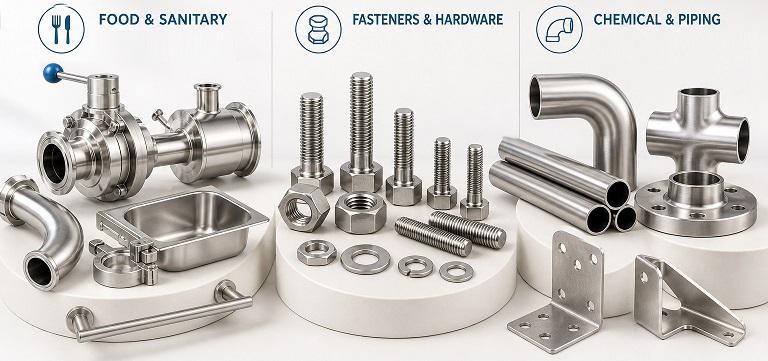
- Food Processing Industry: 18-8 stainless steel is used in food preparation equipment, storage tanks, conveyors, kitchen appliances, and food processing machinery because of its corrosion resistance and cleanability.
- Kitchen Equipment: Common products include cookware, sinks, utensils, cutlery components, countertops, and household appliances.
- Fasteners: 18-8 stainless steel bolts, nuts, screws, and washers are commonly used in general construction, machinery, furniture, and outdoor equipment.
- Chemical Processing: It is used in tanks, piping, fittings, and equipment exposed to many moderately corrosive chemicals.
- Automotive Industry: 18-8 stainless steel is used in trim, exhaust-related components, brackets, fasteners, and other corrosion-resistant parts.
- Architecture and Construction: It is used in handrails, decorative components, building fittings, panels, and structural accessories.
- Medical and Pharmaceutical Equipment: Its corrosion resistance, cleanability, and fabrication characteristics make it useful for selected instruments, equipment, and processing systems.
Applications of 410 Stainless Steel
410 stainless steel is widely used in applications where hardness, strength, and wear resistance are important.
- Cutlery and Knives: 410 stainless steel can be hardened to provide useful cutting-edge retention and mechanical strength for selected knife and blade applications.
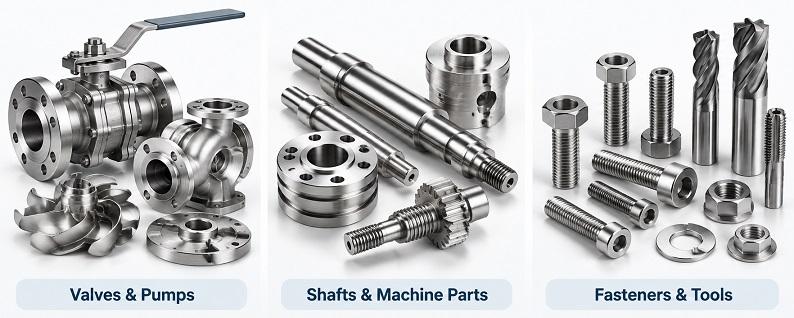
- Valves: It is used in valve components where mechanical strength and moderate corrosion resistance are required.
- Pumps and Shafts: Its heat-treatable properties make it suitable for pump shafts, mechanical shafts, and other rotating components.
- Industrial Machinery: It is used in mechanical components exposed to contact stress, friction, and moderate wear.
- Automotive Components: Selected automotive parts use 410 stainless steel where strength and heat resistance are required.
- Power Generation: It is used in certain turbine components, blades, and other equipment requiring strength and oxidation resistance.
- Petrochemical Equipment: It can be used for selected valves, fittings, and mechanical components under suitable operating conditions.
- Fasteners: Heat-treated 410 stainless steel fasteners are used where greater hardness and strength are needed than conventional 18-8 fasteners can provide.
Cost of 18-8 vs 410 Stainless Steel
Cost is an important consideration when selecting 18-8 or 410 stainless steel for engineering and manufacturing applications.
18-8 stainless steel generally has a higher alloying cost because of its relatively high nickel and chromium content. Nickel prices can fluctuate significantly, influencing the market price of austenitic stainless steel.
410 stainless steel generally contains less nickel and has a lower alloying cost. However, the final cost depends on product form, manufacturing requirements, heat treatment, supplier, quantity, and market conditions.
410 stainless steel can be more economical when high hardness and strength are required, while 18-8 stainless steel may provide better overall value in applications where corrosion resistance and fabrication performance are important.
| Cost Factor | 18-8 Stainless Steel | 410 Stainless Steel |
|---|---|---|
| Raw Material Cost | Generally moderate to high | Generally moderate |
| Chromium Content | Higher | Lower |
| Nickel Content | Relatively high | Low |
| Machining Cost | Depends on work hardening and component geometry | Depends on hardness and heat treatment condition |
| Heat Treatment Cost | Generally lower for conventional fabrication | Can be higher when hardening and tempering are required |
| Welding Cost | Generally lower due to established welding procedures | Potentially higher because of additional process controls |
| Maintenance Cost | Often lower in corrosive environments | May be higher where corrosion protection is required |
| Long-Term Cost | Can be favorable in corrosion-sensitive applications | Can be favorable in wear-resistant mechanical applications |
Raw material price alone does not determine the total manufacturing cost. Heat treatment, machining, finishing, welding, quality inspection, and maintenance can all influence the final cost of a component.
Manufacturing and Machinability of 18-8 vs 410 Stainless Steel
Manufacturing and machinability are important considerations when selecting stainless steel for industrial applications. Material composition, hardness, thermal conductivity, and work hardening behavior can influence cutting, drilling, forming, welding, and other fabrication operations.
18-8 stainless steel can be challenging to machine because it tends to work harden during cutting. If cutting conditions are not properly controlled, the material can become harder near the machined surface, increasing tool wear and reducing machining efficiency.
410 stainless steel has different machining characteristics depending on its heat treatment condition. Annealed material is generally easier to machine than hardened material, while high-hardness conditions may require more specialized tooling and grinding processes.
For both materials, machining performance depends on the product form, cutting tool, machine rigidity, lubrication, and material hardness.
| Manufacturing Property | 18-8 / Type 304 | 410 Stainless Steel |
|---|---|---|
| Machinability | Moderate; work hardening can complicate machining | Varies with hardness and condition |
| Formability | Excellent | Moderate in suitable conditions |
| Weldability | Generally excellent | More difficult; preheating and post-weld treatment may be necessary |
| Drilling | Requires control of work hardening and cutting heat | Depends on hardness and heat treatment condition |
| Grinding | Commonly used for finishing | Important for hardened components and surface finishing |
| Cold Forming | Excellent | More limited, depending on condition |
| Heat Treatment Requirements | Generally simpler | Often required for target hardness and strength |
| Fabrication Cost | Depends on forming and machining requirements | Can increase when hardening and tempering are required |
18-8 vs 410 Stainless Steel: Which Material Should You Choose?
Choosing between 18-8 and 410 stainless steel depends on the specific mechanical, physical, chemical, and manufacturing requirements of the application.
- Choose 18-8 stainless steel when corrosion resistance, ease of fabrication, or general-purpose durability is a major consideration. With its high chromium and nickel content, 18-8 stainless steel offers good resistance to rust and corrosion, making it particularly suitable for food processing equipment, kitchen appliances, fasteners, marine environments, and general industrial applications.
- Choose 410 stainless steel when higher hardness, wear resistance, or heat-treatable strength is a major consideration. As a martensitic stainless steel, 410 can be hardened through heat treatment and offers good mechanical strength and moderate corrosion resistance. It is commonly used in cutlery, valves, pumps, shafts, fasteners, and mechanical components exposed to wear.
The final material selection should consider the specific grade, material condition, component geometry, operating temperature, corrosion environment, manufacturing process, expected service life, and total production cost.