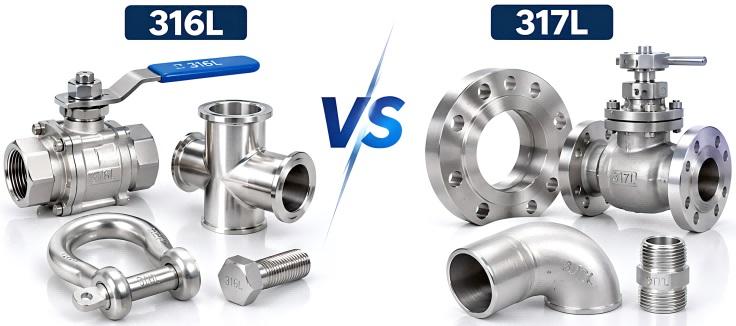
316L and 317L are two widely used molybdenum-bearing austenitic stainless steels with excellent corrosion resistance, good mechanical properties, and reliable weldability. Both materials are commonly used in chemical processing, marine equipment, pharmaceutical manufacturing, food processing, and other industrial applications. However, they have different chemical compositions and performance characteristics, particularly in environments involving chlorides, acids, and other corrosive substances.
This article explains the differences between 316L and 317L stainless steel, including their chemical composition, strength, hardness, stiffness, density, corrosion resistance, thermal properties, electrical conductivity, magnetic properties, weldability, machinability, cost, and common applications.
What Is 316L Stainless Steel?
316L stainless steel is a low-carbon, molybdenum-containing austenitic stainless steel. It belongs to the 300 series of stainless steels and is widely recognized for its excellent corrosion resistance, good formability, and outstanding weldability.
The designation 316L refers to Type 316 stainless steel with a lower carbon content. The letter L stands for low carbon, indicating that its maximum carbon content is generally limited to 0.030%. This lower carbon content helps reduce chromium carbide precipitation during welding and other high-temperature operations, improving resistance to intergranular corrosion.
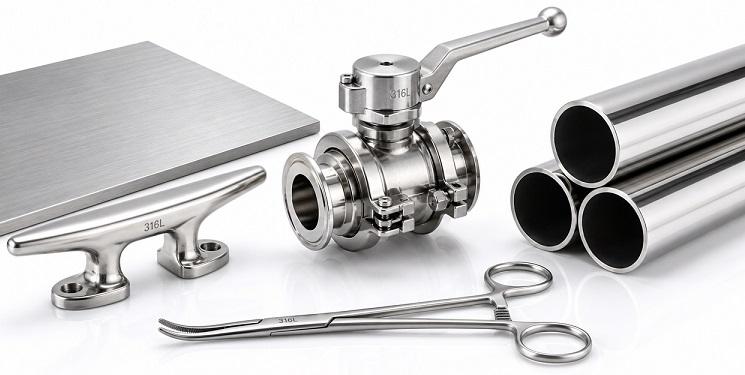
316L stainless steel typically contains 16–18% chromium, 10–14% nickel, and 2–3% molybdenum. Chromium creates a protective passive oxide layer on the material surface, while molybdenum improves resistance to pitting and crevice corrosion, particularly in chloride-containing environments.
Compared with 304 stainless steel, 316L offers better corrosion resistance in many marine and chemical environments. Its combination of corrosion resistance, low carbon content, and good fabrication characteristics makes it a popular material for industrial equipment, medical instruments, chemical storage tanks, pipelines, and food processing machinery.
Another important advantage of 316L is its availability in different product forms, including sheets, plates, bars, pipes, tubes, fittings, and forgings. This versatility makes it suitable for a wide range of manufacturing and engineering applications.
What Is 317L Stainless Steel?
317L stainless steel is a low-carbon, molybdenum-rich austenitic stainless steel developed for applications requiring higher corrosion resistance than conventional 316L stainless steel.
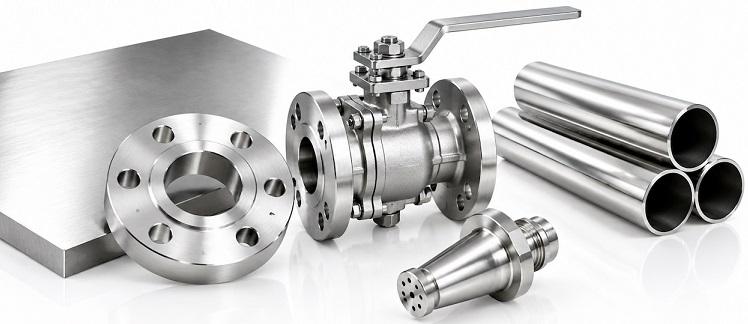
Like 316L, 317L contains chromium and nickel as its primary alloying elements. However, it generally contains 18–20% chromium, 11–15% nickel, and 3–4% molybdenum. The higher molybdenum content is the main reason why 317L offers improved resistance to pitting corrosion, crevice corrosion, and certain aggressive chemical environments.
The L designation also indicates a maximum carbon content of approximately 0.030%. This helps minimize sensitization and intergranular corrosion during welding, making 317L particularly suitable for fabricated equipment exposed to corrosive chemicals.
317L is commonly used in chemical processing equipment, pulp and paper manufacturing, petrochemical facilities, pharmaceutical production, and industrial heat exchangers. It is especially useful in applications where 316L does not provide sufficient corrosion resistance but a more highly alloyed stainless steel may be unnecessary.
Although 317L generally offers better corrosion resistance than 316L, it is usually more expensive and may have more limited availability. Therefore, the decision between these two materials should consider the operating environment, required service life, fabrication requirements, and overall project budget.
What Is the Difference Between 316L and 317L Stainless Steel?
The primary difference between 316L and 317L stainless steel is their chemical composition, particularly their chromium, nickel, and molybdenum contents.
316L contains approximately 2–3% molybdenum, while 317L contains approximately 3–4%. This higher molybdenum content gives 317L better resistance to localized corrosion, especially pitting and crevice corrosion in certain chloride-containing environments.
Both materials have low carbon content, similar austenitic microstructures, good weldability, and excellent general-purpose corrosion resistance. However, 317L is generally preferred when more demanding chemical environments require additional corrosion protection.
The following table summarizes the main differences between 316L and 317L stainless steel.
| Feature | 316L Stainless Steel | 317L Stainless Steel |
|---|---|---|
| Material Type | Austenitic stainless steel | Austenitic stainless steel |
| UNS Designation | S31603 | S31703 |
| Carbon Content | Maximum 0.030% | Maximum 0.030% |
| Chromium Content | 16–18% | 18–20% |
| Nickel Content | 10–14% | 11–15% |
| Molybdenum Content | 2–3% | 3–4% |
| Density | Approximately 8.0 g/cm³ | Approximately 8.0 g/cm³ |
| Tensile Strength | Minimum 485 MPa | Minimum 515 MPa |
| Yield Strength | Minimum 170 MPa | Minimum 205 MPa |
| Hardness | Maximum 217 HB | Maximum 217 HB |
| Corrosion Resistance | Excellent | Generally higher than 316L |
| Pitting Resistance | Good to excellent | Generally better than 316L |
| Weldability | Excellent | Excellent |
| Magnetic Behavior | Generally non-magnetic when annealed | Generally non-magnetic when annealed |
| Cost | Generally lower | Generally higher |
| Common Applications | Food processing, marine equipment, medical devices, chemical equipment | Chemical processing, pulp and paper equipment, petrochemical facilities |
Chemical Composition of 316L vs 317L Stainless Steel
Chemical composition is one of the most important differences between 316L and 317L stainless steel. Although both materials belong to the same austenitic stainless steel family, their different alloying element contents affect corrosion resistance, mechanical performance, and manufacturing characteristics.
The most significant compositional difference is that 317L contains more chromium, nickel, and molybdenum than 316L. These additional alloying elements generally improve its resistance to aggressive environments, particularly those involving localized corrosion.
The following table compares the typical chemical composition requirements of 316L and 317L stainless steel.
| Element | 316L Stainless Steel | 317L Stainless Steel |
|---|---|---|
| Carbon (C) | Maximum 0.030% | Maximum 0.030% |
| Chromium (Cr) | 16–18% | 18–20% |
| Nickel (Ni) | 10–14% | 11–15% |
| Molybdenum (Mo) | 2–3% | 3–4% |
| Manganese (Mn) | Maximum 2.00% | Maximum 2.00% |
| Silicon (Si) | Maximum 0.75% | Maximum 0.75% |
| Phosphorus (P) | Maximum 0.045% | Maximum 0.045% |
| Sulfur (S) | Maximum 0.030% | Maximum 0.030% |
| Nitrogen (N) | Maximum 0.10% | Maximum 0.10% |
| Iron (Fe) | Balance | Balance |
Chromium Content
Chromium is an essential alloying element in stainless steel because it helps form a thin, protective chromium-rich oxide layer on the material surface.
316L typically contains 16–18% chromium, while 317L contains 18–20%. The higher chromium content of 317L contributes to improved resistance to oxidation and corrosion in many environments.
Nickel Content
Nickel helps stabilize the austenitic microstructure of stainless steel and contributes to its toughness, ductility, and corrosion resistance.
316L generally contains 10–14% nickel, whereas 317L contains 11–15%. Both grades maintain good ductility and formability, making them suitable for manufacturing complex components and fabricated equipment.
Molybdenum Content
Molybdenum is particularly important when comparing 316L and 317L because it significantly improves resistance to pitting and crevice corrosion.
316L contains approximately 2–3% molybdenum, while 317L contains approximately 3–4%. This higher molybdenum content provides 317L with better resistance to localized corrosion in many chloride-containing and chemical environments. Therefore, 317L is often selected for applications where conventional 316L stainless steel may experience localized corrosion or require more frequent maintenance.
Mechanical Properties of 316L vs 317L Stainless Steel
Mechanical properties describe how a material responds to external forces, including tension, compression, bending, impact, and repeated loading. These properties are important when selecting stainless steel for pressure vessels, industrial pipelines, structural components, and machinery.
Both 316L and 317L provide good mechanical properties and are suitable for a wide range of industrial applications. However, 317L generally has slightly higher minimum tensile and yield strength requirements under common ASTM A240 product specifications.
The following table compares representative minimum mechanical properties for annealed plate, sheet, and strip.
| Mechanical Property | 316L Stainless Steel | 317L Stainless Steel |
|---|---|---|
| Tensile Strength | Minimum 485 MPa | Minimum 515 MPa |
| Yield Strength (0.2%) | Minimum 170 MPa | Minimum 205 MPa |
| Elongation | Minimum 40% | Minimum 40% |
| Hardness | Maximum 217 HB | Maximum 217 HB |
| Young's Modulus | Approximately 193–200 GPa | Approximately 193–200 GPa |
Tensile Strength and Yield Strength
Tensile strength represents the maximum tensile stress a material can withstand before fracture, while yield strength indicates the stress level at which permanent deformation begins.
316L stainless steel generally has a minimum tensile strength of 485 MPa and a minimum yield strength of 170 MPa for common ASTM A240 flat products. In comparison, 317L generally has minimum tensile and yield strengths of 515 MPa and 205 MPa, respectively.
These differences mean that 317L may provide a mechanical strength advantage under the relevant product specifications. However, the actual strength of a finished component depends on its manufacturing process, thickness, cold working, and heat treatment.
Young's Modulus and Stiffness
Young's modulus measures a material's resistance to elastic deformation. A higher value indicates greater stiffness under the same loading conditions.
316L and 317L have very similar Young's modulus values, generally around 193–200 GPa at room temperature. Therefore, neither material provides a significant stiffness advantage over the other in typical engineering applications.
When stiffness is a major design requirement, engineers should consider component geometry, thickness, loading conditions, and structural design rather than selecting between 316L and 317L based solely on their material grades.
Hardness and Wear Resistance
Hardness describes a material's resistance to indentation, scratching, and localized deformation.
Both 316L and 317L are relatively soft compared with hardened martensitic stainless steels and tool steels. Their typical maximum hardness requirement for common annealed flat products is approximately 217 HB.
Neither material is designed primarily for high wear resistance. Applications involving severe abrasion, sliding contact, or repeated surface damage may require surface treatments, protective coatings, or alternative stainless steel grades.
Physical Properties of 316L vs 317L Stainless Steel
Physical properties describe the basic characteristics of a material, including density, weight, and other physical behaviors. These properties are important in equipment design, manufacturing, transportation, and thermal management.
316L and 317L have very similar physical properties because they share a similar austenitic stainless steel structure and alloy composition. Their density is approximately 8.0 g/cm³, meaning they have almost identical weight for components of the same dimensions.
Density and Weight Difference
Density measures the mass of a material per unit volume. Both 316L and 317L have densities close to 8.0 g/cm³.
This means there is no significant weight difference between these two stainless steel grades when components have the same dimensions and product form. For example, a 316L plate and a 317L plate with identical dimensions will have approximately the same weight. Therefore, weight reduction is generally not a major reason to select one grade over the other.
Dimensional Stability
Both materials have similar thermal expansion characteristics and elastic properties. This makes them suitable for precision-engineered equipment where dimensional stability is important.
However, dimensional changes during manufacturing can still occur due to welding distortion, cold forming, machining stress, and temperature variations. Appropriate manufacturing controls are necessary to maintain dimensional accuracy.
Thermal Properties of 316L vs 317L Stainless Steel
Thermal properties describe how a material responds to temperature changes, including heat transfer, thermal expansion, heat storage, and melting behavior.
316L and 317L have similar thermal characteristics because they belong to the same family of molybdenum-containing austenitic stainless steels. Both materials have relatively low thermal conductivity compared with carbon steel and many other engineering metals.
| Thermal Property | 316L Stainless Steel | 317L Stainless Steel |
|---|---|---|
| Thermal Conductivity | Approximately 14–16 W/m·K | Approximately 14–16 W/m·K |
| Coefficient of Thermal Expansion | Approximately 16–17 µm/m·K | Approximately 16–17 µm/m·K |
| Specific Heat Capacity | Approximately 450–500 J/kg·K | Approximately 450–500 J/kg·K |
| Melting Range | Approximately 1370–1400°C | Approximately 1370–1400°C |
Thermal Conductivity
Thermal conductivity measures how efficiently a material transfers heat.
316L and 317L generally have thermal conductivity values around 14–16 W/m·K at commonly referenced temperatures. This is relatively low compared with carbon steel, which typically has significantly higher thermal conductivity.
Their relatively low thermal conductivity can affect welding, machining, and heat transfer equipment design. Heat may accumulate near a welding or machining area, making appropriate temperature control important during manufacturing.
Coefficient of Thermal Expansion
The coefficient of thermal expansion describes how much a material expands or contracts when its temperature changes.
Both 316L and 317L generally have thermal expansion coefficients around 16–17 µm/m·K over commonly referenced temperature ranges. Because their thermal expansion characteristics are similar, neither grade provides a major advantage over the other in applications involving repeated temperature changes.
Specific Heat Capacity
Specific heat capacity measures the amount of energy required to increase the temperature of a material by one degree.
Both materials generally have specific heat capacities around 450–500 J/kg·K, depending on temperature and material composition. Their similar heat storage characteristics make them suitable for many of the same industrial thermal applications, including heat exchangers, processing vessels, and piping systems.
Melting Temperature
316L and 317L have relatively high melting temperatures compared with many common engineering metals. Their melting ranges are approximately 1370–1400°C, although actual values vary with chemical composition.
A higher melting temperature does not automatically mean a material is suitable for continuous high-temperature operation. Factors such as oxidation resistance, creep strength, thermal cycling, and corrosion at elevated temperatures must also be considered.
Corrosion Resistance of 316L vs 317L Stainless Steel
Corrosion resistance is one of the most important considerations when comparing 316L and 317L stainless steel. Both materials offer excellent corrosion resistance because they contain chromium, nickel, and molybdenum. However, 317L generally provides better resistance to localized corrosion due to its higher chromium and molybdenum contents.
The protective chromium-rich oxide layer helps prevent general corrosion, while molybdenum improves resistance to pitting and crevice corrosion in chloride-containing environments.
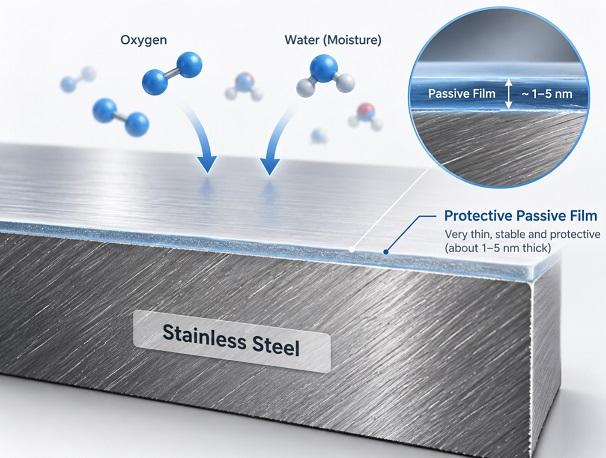
317L is generally the better choice when additional resistance to pitting and crevice corrosion is required. However, neither grade is immune to corrosion under all environmental conditions.
| Corrosion Property | 316L Stainless Steel | 317L Stainless Steel |
|---|---|---|
| General Corrosion Resistance | Excellent | Generally better |
| Pitting Corrosion Resistance | Good to excellent | Generally higher |
| Crevice Corrosion Resistance | Good, depending on conditions | Generally higher |
| Chloride Resistance | Good, but susceptible to localized corrosion | Improved, but still susceptible under severe conditions |
| Acid Resistance | Good in many environments | Generally better in certain aggressive chemical environments |
| Intergranular Corrosion Resistance | Good due to low carbon content | Good due to low carbon content |
Pitting Corrosion
Pitting corrosion is a localized form of corrosion that creates small holes or cavities on a metal surface. It commonly occurs in environments containing chloride ions, such as seawater, salt solutions, and certain industrial chemicals.
Molybdenum improves the ability of stainless steel to resist pitting corrosion. Since 317L contains approximately 3–4% molybdenum compared with 2–3% in 316L, it generally provides better pitting resistance.
One way to compare the pitting resistance of stainless steels is through the Pitting Resistance Equivalent Number (PREN). A commonly used simplified formula is:
PREN = %Cr + 3.3 × %Mo + 16 × %N
Using representative alloy compositions, 317L generally has a higher PREN than 316L. However, PREN is only a comparative screening tool and does not guarantee corrosion performance in every service environment.
Crevice Corrosion
Crevice corrosion occurs in narrow gaps where corrosive solutions become trapped and oxygen availability is limited. Common locations include gasket interfaces, bolted connections, overlapping plates, and deposits on equipment surfaces.
317L generally offers better resistance to crevice corrosion than 316L because of its higher molybdenum content.
However, good equipment design remains essential. Eliminating stagnant areas, minimizing narrow gaps, and maintaining clean surfaces can significantly reduce the risk of crevice corrosion in both materials.
Chloride Corrosion
Chloride-containing environments are particularly challenging for austenitic stainless steels because chloride ions can damage the protective passive film and initiate localized corrosion.
316L performs well in many industrial and marine applications, but it may experience pitting or crevice corrosion in warm, concentrated chloride solutions. 317L offers improved resistance under many of these conditions. Nevertheless, it should not automatically be considered suitable for every seawater or high-chloride application. More highly alloyed stainless steels, duplex stainless steels, or titanium may be required for severe service conditions.
Intergranular Corrosion
Intergranular corrosion occurs when corrosion attacks the grain boundaries of a material. It can develop when chromium carbides precipitate along grain boundaries during exposure to certain temperature ranges.
Both 316L and 317L have a maximum carbon content of approximately 0.030%. This low carbon content reduces the risk of chromium carbide precipitation and improves resistance to intergranular corrosion after welding. For this reason, both grades are commonly used in welded industrial equipment where corrosion resistance and fabrication reliability are important.
Electrical Properties of 316L vs 317L Stainless Steel
Electrical properties describe how easily a material allows electric current to flow. These properties are important in electrical equipment, electronic components, grounding systems, and industrial machinery.
316L and 317L are both electrical conductors, but their electrical conductivity is relatively low compared with copper and aluminum. Neither material is normally selected as a primary electrical conductor.
The electrical properties of these two grades are generally similar, although exact values vary with temperature, chemical composition, and material condition.
| Electrical Property | 316L Stainless Steel | 317L Stainless Steel |
|---|---|---|
| Electrical Resistivity | Approximately 0.70–0.80 µΩ·m | Approximately 0.75–0.85 µΩ·m |
| Electrical Conductivity | Relatively low | Relatively low |
Electrical Resistivity
Electrical resistivity measures how strongly a material resists the flow of electric current.
Both 316L and 317L have relatively high electrical resistivity compared with conventional electrical conductor materials. Their electrical performance is generally comparable, and differences in conductivity are not usually the deciding factor in material selection.
In industrial equipment, these stainless steels are selected primarily for their corrosion resistance, mechanical performance, and fabrication characteristics rather than their electrical properties.
Magnetic Properties of 316L vs 317L Stainless Steel
Magnetic properties describe how a material responds to an applied magnetic field. These characteristics are important in medical equipment, electronic instruments, sensors, and applications where magnetic interference must be minimized.
Both 316L and 317L are generally non-magnetic in the annealed condition because they have an austenitic crystal structure.
However, austenitic stainless steels are not necessarily completely non-magnetic under all conditions. Cold working, forming, machining, and welding can cause some transformation of the austenitic microstructure, resulting in a measurable magnetic response.
For applications requiring very low magnetic permeability, the actual finished component should be tested rather than assuming that all 316L or 317L products are completely non-magnetic.
Applications of 316L Stainless Steel
316L is one of the most widely used stainless steel grades because of its combination of corrosion resistance, weldability, availability, and relatively economical cost.
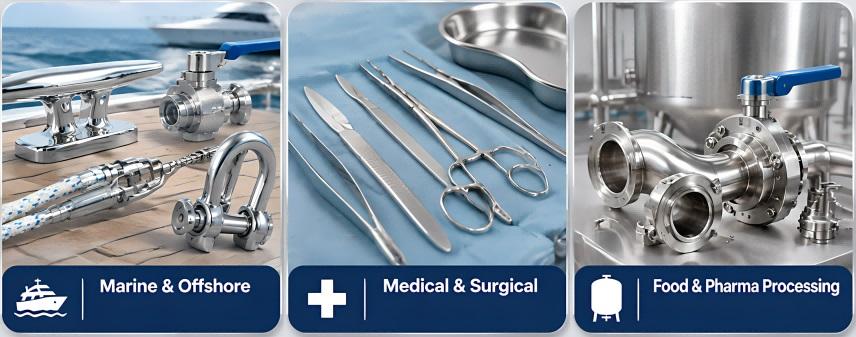
- Food Processing Industry: 316L is used in food processing equipment, storage tanks, mixing vessels, piping systems, and sanitary components because of its corrosion resistance and suitability for hygienic applications.
- Medical Industry: 316L is widely used in medical instruments, surgical equipment, and certain implant applications because of its corrosion resistance and biocompatibility when appropriately manufactured and specified.
- Marine Industry: 316L is used in marine fittings, pumps, valves, piping, and offshore equipment where resistance to atmospheric and marine corrosion is important.
- Chemical Processing: 316L is used in chemical storage tanks, process vessels, pipelines, and industrial equipment exposed to many moderately corrosive chemicals.
- Pharmaceutical Industry: 316L is commonly used in pharmaceutical processing equipment, sanitary piping, mixing tanks, and storage vessels where corrosion resistance and cleanability are essential.
- Construction and Architecture: 316L is used in architectural components, exterior fittings, handrails, and decorative structures exposed to demanding environmental conditions.
Applications of 317L Stainless Steel
317L is mainly used in applications requiring improved corrosion resistance compared with conventional 316L stainless steel.
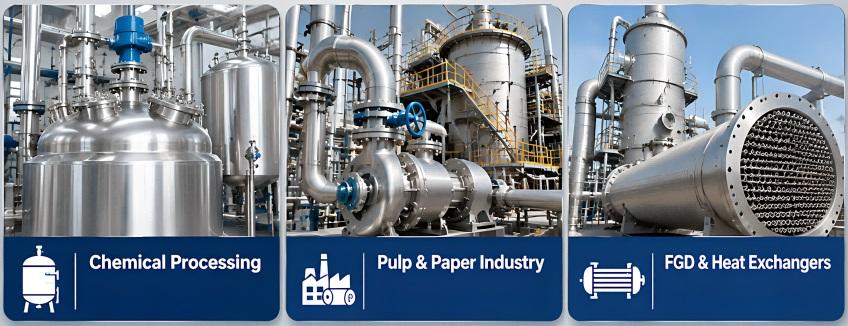
- Chemical Processing Industry: 317L is used in chemical reactors, storage tanks, heat exchangers, and process equipment exposed to aggressive chemical solutions.
- Pulp and Paper Industry: 317L is used in pulp processing equipment, chemical recovery systems, and other components exposed to corrosive process chemicals.
- Petrochemical Industry: 317L is used in selected petrochemical equipment, process piping, and industrial vessels where improved corrosion resistance is beneficial.
- Flue Gas Desulfurization Equipment: 317L can be used in certain flue gas treatment systems where equipment is exposed to corrosive condensates and chemical solutions.
- Industrial Heat Exchangers: 317L is used in selected heat exchanger components exposed to corrosive fluids, particularly where 316L may not provide sufficient localized corrosion resistance.
- Pharmaceutical and Chemical Manufacturing: 317L is suitable for specialized processing equipment requiring a combination of corrosion resistance, weldability, and durability.
Cost of 316L vs 317L Stainless Steel
Cost is an important consideration when choosing between 316L and 317L stainless steel. Although both materials belong to the same family of austenitic stainless steels, 317L generally has a higher material cost because of its increased alloying element content.
317L is generally more expensive than 316L because it contains higher amounts of chromium, nickel, and molybdenum. Molybdenum is particularly important because its price and availability can influence the overall cost of molybdenum-bearing stainless steels.
316L is widely available in different product forms and dimensions, making it a cost-effective choice for many industrial applications. Its established supply chain also makes sourcing and manufacturing relatively straightforward.
317L may involve higher initial material costs and more limited availability. However, its improved corrosion resistance may reduce maintenance requirements, equipment replacement frequency, and lifecycle costs in certain aggressive environments.
| Cost Factor | 316L Stainless Steel | 317L Stainless Steel |
|---|---|---|
| Raw Material Cost | Generally lower | Generally higher |
| Alloying Element Cost | Lower molybdenum content | Higher molybdenum content |
| Material Availability | Widely available | More limited in some product forms |
| Machining Cost | Moderate to high | Moderate to high |
| Fabrication Cost | Generally economical | Generally similar, but material cost is higher |
| Maintenance Cost | Depends on the corrosion environment | May be lower where additional corrosion resistance extends service life |
| Long-Term Cost | Cost-effective for many general applications | Potentially favorable in more aggressive environments |
Manufacturing and Machinability of 316L vs 317L Stainless Steel
Manufacturing and machinability are important factors when selecting stainless steel for industrial components. Both 316L and 317L offer good formability and weldability, but their relatively high alloy content and work-hardening characteristics can make machining more challenging than machining low-carbon steel.
316L is widely used in fabrication because it can be cut, formed, welded, and machined using established manufacturing processes. 317L has similar manufacturing characteristics, although its higher alloy content may influence cutting behavior and tooling requirements.
| Manufacturing Property | 316L Stainless Steel | 317L Stainless Steel |
|---|---|---|
| Machinability | Moderate to difficult | Moderate to difficult |
| Weldability | Excellent | Excellent |
| Formability | Excellent | Excellent |
| Cold Working | Good | Good |
| Hot Working | Good with appropriate temperature control | Good with appropriate temperature control |
| Heat Treatment | Solution annealing | Solution annealing |
| Work Hardening | Significant | Significant |
Machining
Both 316L and 317L are more difficult to machine than many common carbon steels because of their work-hardening tendency, relatively low thermal conductivity, and toughness.
During machining, heat can accumulate near the cutting zone, while excessive deformation can cause the material surface to harden. Appropriate tooling, cutting conditions, machine rigidity, and coolant application are important for maintaining machining efficiency and surface quality.
317L may require similar or slightly adjusted machining conditions depending on its actual composition and material condition. Machining performance should be evaluated using the specific product and manufacturing requirements.
Welding
Both materials offer excellent weldability because of their low carbon content and austenitic microstructure. The low carbon content helps minimize chromium carbide precipitation during welding, reducing the risk of intergranular corrosion in the heat-affected zone.
Common welding methods include gas tungsten arc welding (GTAW), gas metal arc welding (GMAW), and shielded metal arc welding (SMAW). Appropriate filler materials and welding procedures should be selected according to the applicable standards and service conditions.
For 317L applications, matching or compatible higher-alloy filler metals may be required to maintain the desired corrosion resistance of the welded joint.
Forming
316L and 317L both have good ductility and formability, allowing them to be manufactured into complex components through bending, rolling, drawing, and other forming processes.
However, both materials work-harden during cold forming. This can increase forming forces and may require intermediate annealing for more demanding manufacturing operations.
316L vs 317L Stainless Steel: Which Material Should You Choose?
Choosing between 316L and 317L stainless steel depends on the corrosion environment, mechanical requirements, manufacturing process, material availability, and total project cost.
Although 317L generally offers better corrosion resistance, this does not mean it is always the better material. In many industrial applications, 316L provides sufficient performance at a lower cost.
- Choose 316L when general corrosion resistance, good weldability, wide availability, and cost efficiency are the main priorities. It is suitable for food processing equipment, pharmaceutical machinery, marine fittings, sanitary pipelines, storage tanks, and many chemical processing applications.
- Choose 317L when improved resistance to pitting, crevice corrosion, and aggressive chemical environments is required. It is particularly useful in chemical processing equipment, pulp and paper facilities, petrochemical systems, and specialized industrial heat exchangers.
Before making a final decision, engineers should evaluate the exact chemical composition of the process fluid, chloride concentration, operating temperature, pH value, flow conditions, and potential exposure to deposits or stagnant solutions.
For critical applications, laboratory corrosion testing and consultation with a qualified materials engineer are recommended. More highly alloyed stainless steels may be necessary when neither 316L nor 317L provides sufficient corrosion resistance.