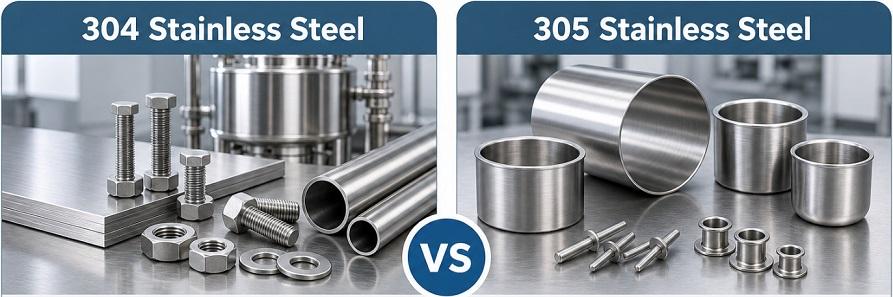
304 and 305 stainless steel are two widely used austenitic stainless steel grades with similar chemical compositions, mechanical properties, and corrosion resistance. Both materials contain chromium and nickel, which provide excellent resistance to corrosion, good formability, and durability in a wide range of industrial environments. However, differences in nickel content, work-hardening behavior, cold-forming performance, and manufacturing characteristics make them suitable for different applications.
This article explains the differences between 304 and 305 stainless steel, including their chemical composition, mechanical properties, physical properties, corrosion resistance, thermal properties, electrical properties, magnetic behavior, cost, machinability, and common applications.
What Is 304 Stainless Steel?
304 stainless steel is one of the most widely used austenitic stainless steel grades. It is primarily composed of iron, chromium, and nickel, typically containing approximately 18–20% chromium and 8–10.5% nickel. It is commonly identified as UNS S30400 and is often referred to as 18/8 stainless steel because of its approximate chromium and nickel content.
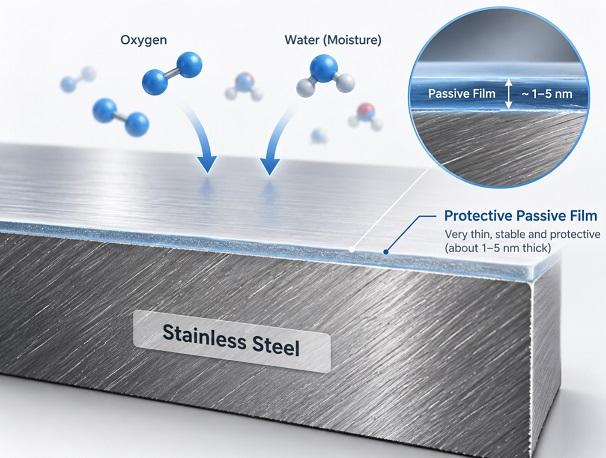
304 stainless steel is known for its excellent combination of corrosion resistance, strength, formability, weldability, and relatively low cost. The chromium content allows the material to form a thin, protective chromium-rich oxide layer when exposed to oxygen. This passive layer protects the underlying metal from many common corrosive environments.
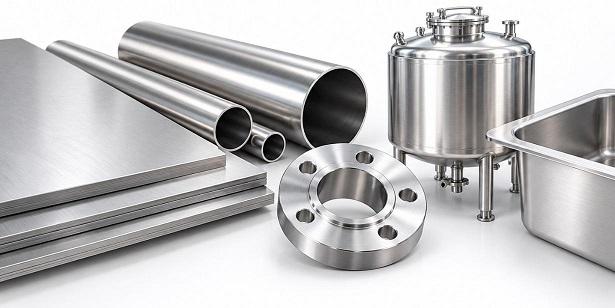
Because of its versatility, 304 stainless steel is widely used in food processing equipment, kitchen appliances, chemical processing equipment, storage tanks, architectural components, automotive parts, and industrial machinery. It is also available in various product forms, including sheets, plates, coils, bars, tubes, and wires.
One important characteristic of 304 stainless steel is its ability to undergo cold working. Processes such as bending, stamping, drawing, and rolling can increase its strength and hardness. However, 304 stainless steel has a relatively high work-hardening rate compared with some other austenitic stainless steel grades.
This characteristic is beneficial when increased strength is required through cold deformation, but it can make severe forming operations more challenging. During deep drawing or extensive cold forming, additional processing steps or intermediate annealing may be required to restore ductility.
304 stainless steel is generally non-magnetic in its fully annealed condition. However, cold working can cause some austenite to transform into martensite, resulting in a degree of magnetic response.
What Is 305 Stainless Steel?
305 stainless steel is an austenitic chromium-nickel stainless steel designed primarily for applications requiring excellent ductility and severe cold-forming performance. It is identified by UNS S30500 and typically contains approximately 17–19% chromium and 10.5–13% nickel.
Compared with 304 stainless steel, 305 stainless steel contains a higher nickel content. This increased nickel content helps stabilize the austenitic structure and reduces the tendency of the material to work-harden during cold deformation.
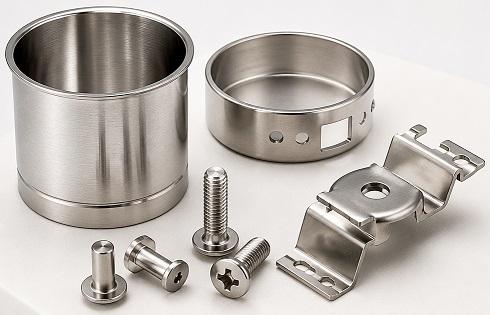
The lower work-hardening rate makes 305 stainless steel particularly suitable for deep drawing, spinning, and other forming operations that require significant deformation without frequent intermediate annealing. It can be used to manufacture complex shapes, deep containers, thin-walled components, and other products that are difficult to produce from more rapidly work-hardening materials.
305 stainless steel also provides good corrosion resistance, generally comparable to 304 stainless steel in many ordinary environments. Its combination of corrosion resistance and excellent cold-forming characteristics makes it useful in electronics, household products, food processing equipment, and precision metal components.
Another important characteristic of 305 stainless steel is its relatively low magnetic response. It is generally non-magnetic in the annealed condition and tends to retain its non-magnetic characteristics better than 304 stainless steel after substantial cold working.
However, 305 stainless steel is not necessarily a better replacement for 304 in every application. Its main advantage is improved cold-forming performance rather than significantly higher strength or universally better corrosion resistance. The correct selection depends on the manufacturing process, service environment, mechanical requirements, and overall production cost.
What Is the Difference Between 304 and 305 Stainless Steel?
The main difference between 304 and 305 stainless steel is their chemical composition, particularly their nickel content. Although both grades belong to the austenitic stainless steel family, 305 stainless steel contains more nickel, which improves austenite stability and reduces work hardening during cold forming.
304 stainless steel is a general-purpose stainless steel that provides a good balance of corrosion resistance, strength, fabrication performance, and cost. It is suitable for a wide range of applications involving conventional forming, welding, and general industrial manufacturing.
305 stainless steel is more specialized. Its lower work-hardening rate allows it to undergo more extensive deformation during deep drawing and spinning operations. This can reduce manufacturing difficulties and help produce complex components with fewer intermediate annealing operations.
The following table summarizes the general differences between 304 and 305 stainless steel.
| Feature | 304 Stainless Steel | 305 Stainless Steel |
|---|---|---|
| UNS Designation | S30400 | S30500 |
| Material Type | Austenitic stainless steel | Austenitic stainless steel |
| Chromium Content | 18–20% | 17–19% |
| Nickel Content | 8–10.5% | 10.5–13% |
| Carbon Content | 0.08% maximum | 0.12% maximum |
| Density | Approximately 8.0 g/cm³ | Approximately 8.0 g/cm³ |
| Tensile Strength | Minimum 515 MPa | Minimum 515 MPa |
| Yield Strength | Minimum 205 MPa | Minimum 205 MPa |
| Hardness | Maximum 201 HB | Maximum 183 HB |
| Work Hardening | Relatively high | Relatively low |
| Cold Formability | Good | Excellent for severe forming |
| Deep Drawing | Good, depending on geometry and condition | Excellent |
| Corrosion Resistance | Good to excellent in many environments | Generally comparable to 304 |
| Magnetic Behavior | Generally non-magnetic when annealed; may become magnetic after cold working | Generally non-magnetic; lower magnetic response after cold working |
| Weldability | Excellent | Generally good with appropriate procedures |
| Machinability | Relatively difficult | Relatively difficult |
| Cost | Generally lower | Generally higher |
| Common Applications | Kitchen equipment, tanks, pipes, machinery, and architecture | Deep-drawn parts, spun components, eyelets, and precision containers |
Chemical Composition of 304 vs 305 Stainless Steel
Chemical composition is one of the most important differences between 304 and 305 stainless steel. Both grades contain chromium and nickel as their primary alloying elements, but their different proportions influence austenite stability, work hardening, corrosion performance, and forming characteristics.
304 stainless steel typically contains 18–20% chromium and 8–10.5% nickel. Chromium provides corrosion resistance by forming a passive oxide layer, while nickel stabilizes the austenitic microstructure and improves toughness and ductility.
305 stainless steel typically contains 17–19% chromium and 10.5–13% nickel. The higher nickel content makes the austenitic structure more stable during cold deformation. Consequently, the material experiences less strain-induced transformation and generally has a lower work-hardening rate than 304 stainless steel.
| Element | 304 Stainless Steel | 305 Stainless Steel |
|---|---|---|
| Carbon (C) | 0.08% maximum | 0.12% maximum |
| Chromium (Cr) | 18.00–20.00% | 17.00–19.00% |
| Nickel (Ni) | 8.00–10.50% | 10.50–13.00% |
| Manganese (Mn) | 2.00% maximum | 2.00% maximum |
| Silicon (Si) | 0.75% maximum | 1.00% maximum |
| Phosphorus (P) | 0.045% maximum | 0.045% maximum |
| Sulfur (S) | 0.030% maximum | 0.030% maximum |
| Iron (Fe) | Balance | Balance |
Nickel Content
Nickel plays an important role in determining the microstructure and cold-working behavior of austenitic stainless steel. It helps stabilize austenite, which is the face-centered cubic crystal structure responsible for many of the material's desirable properties.
304 stainless steel has a lower nickel content than 305 stainless steel. Under severe cold deformation, some of its austenitic structure can transform into martensite. This transformation increases hardness and strength but also increases magnetic response and reduces the material's remaining ductility.
305 stainless steel contains more nickel, which improves austenite stability and reduces the tendency for this transformation to occur during cold working. As a result, it can generally withstand more severe forming operations before work hardening becomes a major manufacturing limitation.
This difference is particularly important when manufacturing products with deep cavities, narrow radii, or complex geometries. For ordinary sheet-metal fabrication, however, 304 stainless steel may provide sufficient formability at a lower material cost.
Mechanical Properties of 304 vs 305 Stainless Steel
Mechanical properties describe how materials respond to external forces, including tension, compression, bending, impact, and repeated loading. These properties are essential when selecting stainless steel for structural components, industrial machinery, containers, and precision-formed products.
Both 304 and 305 stainless steel provide good strength, ductility, and toughness. Their minimum specified tensile and yield strengths are similar in common annealed sheet and plate specifications. However, their work-hardening behavior differs considerably.
304 stainless steel generally develops strength and hardness more rapidly during cold deformation. This can be beneficial when increased strength is desired through cold working, but it can also make severe forming operations more demanding.
305 stainless steel has a lower work-hardening rate, allowing greater deformation before the material becomes excessively hard. This makes it particularly useful for deep drawing and metal spinning.
| Mechanical Property | 304 Stainless Steel | 305 Stainless Steel |
|---|---|---|
| Tensile Strength | Minimum 515 MPa | Minimum 515 MPa |
| Yield Strength | Minimum 205 MPa | Minimum 205 MPa |
| Elongation | Minimum 40% | Minimum 40% |
| Brinell Hardness | Maximum 201 HB | Maximum 183 HB |
| Rockwell B Hardness | Maximum 92 HRB | Maximum 88 HRB |
| Young's Modulus | Approximately 193 GPa | Approximately 193 GPa |
| Work-Hardening Rate | Higher | Lower |
| Ductility | Good | Excellent for severe cold forming |
Tensile Strength and Yield Strength
Tensile strength represents the maximum tensile stress a material can withstand before fracture. Yield strength indicates the stress at which permanent deformation begins.
304 and 305 stainless steel have similar minimum tensile and yield strength requirements under common ASTM A240 specifications for annealed sheet and plate. Both grades typically require a minimum tensile strength of approximately 515 MPa and a minimum yield strength of approximately 205 MPa.
However, these values do not mean that the two materials behave identically during manufacturing. Their different work-hardening characteristics influence the strength and hardness achieved after cold rolling, drawing, stamping, and other deformation processes.
304 stainless steel may develop higher strength more rapidly during cold working, while 305 stainless steel generally retains its ductility for longer during severe forming operations.
Young's Modulus and Stiffness
Young's modulus measures a material's resistance to elastic deformation. A higher modulus indicates greater stiffness under the same loading conditions and component geometry.
304 and 305 stainless steel have very similar elastic moduli, generally around 193 GPa at room temperature. Therefore, there is no significant practical stiffness advantage for either grade when comparing components with identical dimensions and material conditions.
In engineering design, the stiffness of a component is influenced not only by its material but also by its thickness, cross-sectional geometry, support conditions, and loading arrangement. Therefore, the selection between 304 and 305 should not normally be based on Young's modulus alone.
Hardness and Wear Resistance
Hardness describes a material's resistance to indentation, scratching, and localized plastic deformation. It can influence wear behavior, surface durability, and manufacturing performance.
Under common annealed ASTM A240 requirements, 304 stainless steel has a maximum Brinell hardness of approximately 201 HB, while 305 stainless steel has a lower maximum value of approximately 183 HB.
These specification limits indicate that 305 stainless steel is generally supplied with a lower maximum hardness requirement. However, actual hardness depends on cold working, heat treatment, thickness, and product condition.
Neither grade is specifically designed for high-wear applications. When exceptional abrasion resistance or high surface hardness is required, hardened martensitic stainless steels or specialized wear-resistant alloys may be more appropriate.
Work Hardening and Cold Deformation
Work hardening occurs when a metal becomes stronger and harder as a result of plastic deformation. It is an important characteristic of austenitic stainless steels and directly affects forming operations.
304 stainless steel has a relatively high work-hardening rate. During deep drawing or repeated forming operations, its hardness can increase significantly, potentially requiring intermediate annealing to restore ductility.
305 stainless steel has a lower work-hardening rate because of its higher nickel content and more stable austenitic structure. This allows it to withstand more severe cold deformation before excessive hardening occurs.
For manufacturers producing deep-drawn containers, thin-walled components, eyelets, and spun metal products, this difference can improve forming consistency and reduce manufacturing interruptions.
Physical Properties of 304 vs 305 Stainless Steel
Physical properties describe the basic characteristics of a material, including its weight, density, and relationship between strength and mass. These properties are important when selecting stainless steel for applications involving transportation, structural design, and precision manufacturing.
Because 304 and 305 stainless steel belong to the same austenitic stainless steel family, their physical properties are generally very similar. Their density is approximately 8.0 g/cm³, meaning that components with the same dimensions will have almost identical weight.
The main differences between these grades are related to their chemical composition and forming behavior rather than major differences in density or stiffness.
| Physical Property | 304 Stainless Steel | 305 Stainless Steel |
|---|---|---|
| Density | Approximately 8.0 g/cm³ | Approximately 8.0 g/cm³ |
| Crystal Structure | Face-centered cubic (FCC) | Face-centered cubic (FCC) |
| Specific Weight | Approximately 78.5 kN/m³ | Approximately 78.5 kN/m³ |
| Appearance | Silver-gray metallic surface | Silver-gray metallic surface |
| General Weight Difference | Negligible | Negligible |
Thermal Properties of 304 vs 305 Stainless Steel
Thermal properties describe how materials respond to temperature changes, including heat transfer, thermal expansion, heat storage, and melting behavior. These characteristics are important in food processing equipment, industrial containers, heat exchangers, and manufacturing systems.
304 and 305 stainless steel have similar thermal characteristics because both belong to the austenitic chromium-nickel stainless steel family. Differences in alloy composition can result in small variations in individual values, but neither grade provides a major thermal performance advantage in ordinary applications.
| Thermal Property | 304 Stainless Steel | 305 Stainless Steel |
|---|---|---|
| Thermal Conductivity | Approximately 16 W/m·K | Approximately 16 W/m·K |
| Coefficient of Thermal Expansion | Approximately 17.2 µm/m·K | Approximately 16–17 µm/m·K |
| Specific Heat Capacity | Approximately 500 J/kg·K | Approximately 500 J/kg·K |
| Melting Range | Approximately 1400–1450°C | Approximately 1399–1421°C |
Thermal Conductivity
Thermal conductivity measures how efficiently a material transfers heat. Austenitic stainless steels generally have relatively low thermal conductivity compared with carbon steel, copper, and aluminum.
304 stainless steel has a typical thermal conductivity of approximately 16 W/m·K at room temperature. 305 stainless steel has a similar value, although exact results depend on composition and measurement conditions.
Because the two grades have comparable thermal conductivity, neither is generally preferred over the other solely for heat-transfer performance. If efficient thermal transfer is the main requirement, copper or aluminum may be more suitable materials.
Coefficient of Thermal Expansion
The coefficient of thermal expansion describes how much a material expands or contracts when its temperature changes.
304 stainless steel has a relatively high coefficient of thermal expansion compared with many carbon steels. Its typical value is approximately 17.2 µm/m·K over a commonly referenced temperature range. 305 stainless steel has a broadly similar thermal expansion characteristic. The small differences between the grades are generally less important than the effects of component geometry, temperature variation, and assembly design.
For precision components exposed to temperature changes, engineers should use the appropriate temperature-dependent material data rather than assuming that both grades have identical expansion behavior.
Specific Heat Capacity
Specific heat capacity measures the amount of thermal energy required to raise the temperature of a unit mass of material by one degree.
Both 304 and 305 stainless steel have specific heat capacities of approximately 500 J/kg·K near room temperature. This means their heat-storage characteristics are very similar under comparable conditions. For most industrial applications, the difference in specific heat capacity between these grades is not a major material selection factor.
Melting Temperature
304 stainless steel has a typical melting range of approximately 1400–1450°C. 305 stainless steel has a melting range of approximately 1399–1421°C. These values are alloy-dependent and should be treated as approximate reference data rather than guaranteed operating temperature limits.
The actual high-temperature performance of stainless steel also depends on oxidation resistance, creep strength, thermal cycling, mechanical loading, and exposure time. Therefore, melting temperature alone should not determine whether a material is suitable for high-temperature service.
Corrosion Resistance of 304 vs 305 Stainless Steel
Corrosion resistance describes a material's ability to withstand chemical and electrochemical degradation when exposed to moisture, oxygen, salts, acids, alkalis, and other corrosive environments.
Both 304 and 305 stainless steel provide good corrosion resistance because they contain substantial amounts of chromium. Chromium reacts with oxygen to form a thin, protective passive layer on the metal surface. This layer helps prevent further corrosion and can reform when the surface is exposed to oxygen after minor damage.
304 stainless steel is widely used in food processing, household equipment, architectural structures, and industrial environments because it provides reliable corrosion resistance in many atmospheric and mildly corrosive conditions.
305 stainless steel has similar general corrosion resistance to 304 stainless steel. Although it contains more nickel, its chromium content is slightly lower. Therefore, its higher nickel content should not automatically be interpreted as superior corrosion resistance.
Neither grade contains the substantial molybdenum addition found in 316 stainless steel. As a result, both can be susceptible to pitting and crevice corrosion in chloride-rich environments, particularly when exposed to seawater or concentrated salt solutions.
| Corrosion Property | 304 Stainless Steel | 305 Stainless Steel |
|---|---|---|
| General Atmospheric Corrosion | Good to excellent | Generally comparable to 304 |
| Protective Oxide Layer | Chromium-rich passive layer | Chromium-rich passive layer |
| Fresh Water Resistance | Generally good | Generally good |
| Seawater Resistance | Limited in many conditions | Generally similar limitations |
| Chloride Resistance | Susceptible to pitting and crevice corrosion | Susceptible to pitting and crevice corrosion |
| Mild Organic Acid Resistance | Generally good, depending on concentration and temperature | Generally comparable to 304 |
| Industrial Chemical Resistance | Depends on chemical composition and exposure conditions | Depends on chemical composition and exposure conditions |
Electrical Properties of 304 vs 305 Stainless Steel
Electrical properties describe how easily a material allows electric current to flow. They are important in electronic equipment, electrical enclosures, industrial components, grounding systems, and applications involving electrical resistance.
Both 304 and 305 stainless steel are electrical conductors, but their electrical conductivity is relatively low compared with copper and aluminum. Their electrical behavior is influenced by alloy composition, temperature, and material condition.
| Electrical Property | 304 Stainless Steel | 305 Stainless Steel |
|---|---|---|
| Electrical Resistivity | Approximately 0.72 µΩ·m | Approximately 0.74 µΩ·m |
| Electrical Conductivity | Relatively low | Relatively low |
| Electrical Behavior | Conductive metallic material | Conductive metallic material |
Electrical Resistivity
Electrical resistivity measures how strongly a material resists the flow of electric current. A higher resistivity means that less current flows through the material under the same electrical conditions and geometry.
304 stainless steel typically has an electrical resistivity of approximately 0.72 µΩ·m at room temperature. 305 stainless steel has a similar resistivity, commonly reported at approximately 0.74 µΩ·m. The values are relatively close, so the difference between the two grades is generally not important for ordinary electrical applications.
Neither material is an ideal choice when high electrical conductivity is required. Copper and aluminum are generally preferred for electrical cables, busbars, and other current-carrying components.
Magnetic Properties of 304 vs 305 Stainless Steel
Magnetic properties describe how a material responds to an applied magnetic field. They are important in medical equipment, electronic devices, precision instruments, sensors, and applications where magnetic interference must be minimized.
Both 304 and 305 stainless steel are austenitic stainless steels and are generally non-magnetic in their fully annealed condition. Their face-centered cubic crystal structure produces a relatively low magnetic response compared with ferritic and martensitic stainless steels.
However, cold working can change their magnetic behavior. During deformation, some austenite in 304 stainless steel can transform into martensite, increasing its magnetic response.
305 stainless steel has a higher nickel content, which helps stabilize its austenitic structure. Consequently, it generally exhibits a lower tendency to develop magnetic properties during cold working. This characteristic makes 305 stainless steel useful in certain precision components and applications where low magnetic response is desirable even after substantial cold forming.
Applications of 304 Stainless Steel
304 stainless steel is one of the most commonly used stainless steel grades because of its versatility and balance of mechanical and corrosion properties.
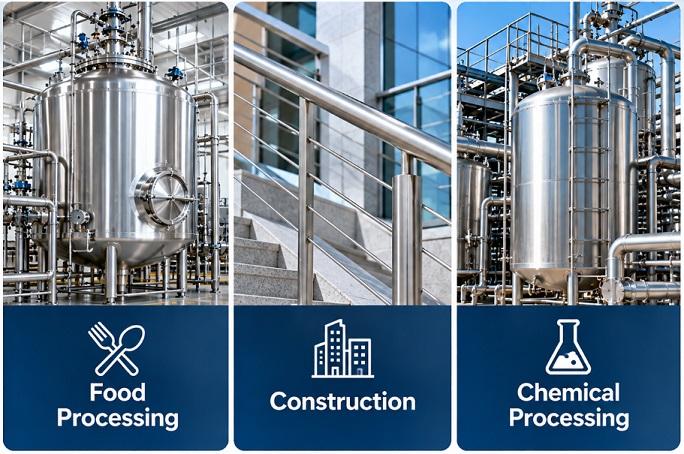
- Food and Beverage Industry: 304 stainless steel is widely used in food processing equipment, storage tanks, commercial kitchen equipment, sinks, food preparation surfaces, and beverage containers. Its corrosion resistance and ease of cleaning make it suitable for many sanitary applications.
- Kitchen Appliances and Cookware: Refrigerators, ovens, dishwashers, cookware, utensils, and kitchen sinks commonly use 304 stainless steel because of its durability, attractive appearance, and resistance to ordinary household corrosion.
- Construction and Architecture: 304 stainless steel is used in architectural panels, handrails, decorative components, structural accessories, and building fixtures. It provides a durable metallic finish and good resistance to atmospheric corrosion.
- Chemical Processing: Tanks, pipes, valves, storage vessels, and process equipment may use 304 stainless steel when the chemical environment is compatible with its corrosion resistance.
- Automotive Industry: Exhaust components, trim, brackets, fasteners, and other automotive parts can use 304 stainless steel where corrosion resistance and fabrication flexibility are important.
- Industrial Machinery: Machine covers, equipment housings, conveyor components, brackets, and general-purpose fabricated parts frequently use 304 stainless steel.
Applications of 305 Stainless Steel
305 stainless steel is mainly selected for applications where excellent ductility, low work hardening, and reliable cold-forming performance are important.
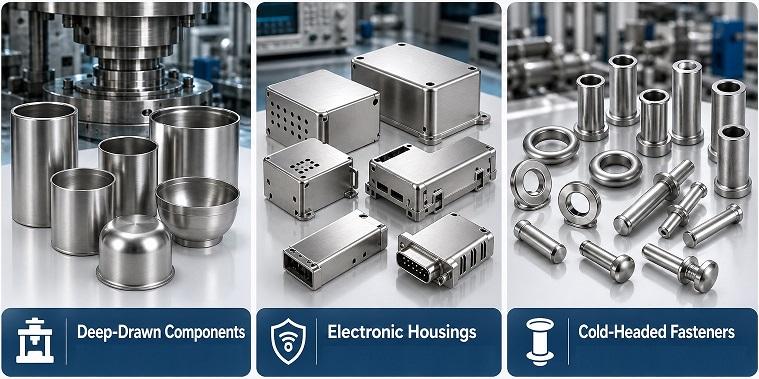
- Deep-Drawn Components: 305 stainless steel is suitable for manufacturing deep containers, cylindrical housings, cups, pans, and other products that require substantial material deformation during production.
- Metal Spinning: The material's relatively low work-hardening rate makes it suitable for spinning operations used to produce symmetrical components, conical parts, and complex metal shapes.
- Electronics Industry: 305 stainless steel can be used for electronic housings, precision metal components, connectors, and other parts requiring corrosion resistance and controlled forming behavior.
- Eyelets and Small Metal Components: Eyelets, sleeves, rivet-related components, and small precision-formed parts may use 305 stainless steel because of its ductility and cold-heading or forming characteristics.
- Household Products: Deep-drawn kitchen utensils, mixing bowls, appliance components, and other household products can benefit from its forming performance.
- Precision Containers: Thin-walled containers and components with complex geometries may use 305 stainless steel to improve manufacturing efficiency and reduce forming difficulties.
Cost of 304 vs 305 Stainless Steel
Cost is an important consideration when selecting between 304 and 305 stainless steel. Although the two grades have similar density and mechanical strength requirements, their different chemical compositions and market availability can influence material prices.
304 stainless steel is generally more economical because it is produced in large quantities and is widely available in sheets, plates, coils, pipes, bars, and other product forms. Its broad industrial use also provides manufacturers with a larger supplier base and more purchasing options.
305 stainless steel typically costs more than 304 because it contains a higher nickel content and is a more specialized material. Its availability may also be more limited, particularly for certain thicknesses, widths, and product forms.
However, the initial material price does not always determine the total manufacturing cost. In severe forming applications, 305 stainless steel may reduce production difficulties, intermediate annealing requirements, material rejection, and manufacturing interruptions. These advantages can offset part of its higher purchase price.
| Cost Factor | 304 Stainless Steel | 305 Stainless Steel |
|---|---|---|
| Raw Material Cost | Generally lower | Generally higher |
| Nickel Content | 8–10.5% | 10.5–13% |
| Market Availability | Very widely available | More specialized availability |
| Machining Cost | Depends on grade and machining conditions | Depends on grade and machining conditions |
| Deep Drawing Cost | May require more process control and intermediate annealing | Can reduce forming difficulties in severe drawing operations |
| Fabrication Cost | Generally economical for general fabrication | Can be economical for specialized forming processes |
| Overall Production Cost | Often lower for general-purpose components | Potentially competitive for complex cold-formed components |
Manufacturing and Machinability of 304 vs 305 Stainless Steel
Manufacturing and machinability are important considerations when selecting stainless steel for industrial applications. Chemical composition, hardness, ductility, thermal conductivity, and work-hardening behavior can influence cutting, forming, welding, stamping, and other production processes.
304 and 305 stainless steel have similar general machining characteristics because both are austenitic stainless steels. However, their different work-hardening rates create an important distinction during cold forming.
304 stainless steel is generally suitable for conventional sheet-metal fabrication, including bending, cutting, stamping, and welding. However, severe deformation can cause rapid work hardening, which may increase forming loads and reduce the remaining ductility of the material.
305 stainless steel is specifically advantageous for severe cold-forming processes. Its lower work-hardening rate allows it to undergo greater deformation before intermediate annealing becomes necessary. This makes it a preferred option for certain deep-drawing and spinning applications.
| Manufacturing Property | 304 Stainless Steel | 305 Stainless Steel |
|---|---|---|
| Machinability | Relatively difficult | Relatively difficult |
| Cold Forming | Good | Excellent for severe forming |
| Deep Drawing | Good, but work hardening may limit severe deformation | Very good to excellent |
| Metal Spinning | Suitable for many applications | Particularly suitable |
| Bending | Good | Good |
| Stamping | Widely used | Suitable for complex forming requirements |
| Weldability | Excellent | Generally good with appropriate procedures |
| Work Hardening | Relatively high | Relatively low |
Machining and Cutting
Both 304 and 305 stainless steel can be more challenging to machine than many low-carbon steels. Their relatively low thermal conductivity can concentrate heat near the cutting zone, while their ductility and tendency to work-harden can create difficulties during machining.
Appropriate cutting tools, stable machine setups, suitable feed rates, and effective cooling are important for achieving consistent machining results.
The lower work-hardening tendency of 305 stainless steel is mainly an advantage during forming rather than a guarantee of easier machining. Therefore, manufacturers should not assume that 305 will always be significantly easier to machine than 304.
Deep Drawing and Forming
Deep drawing is a sheet metal forming process in which a sheet metal blank is radially drawn into a forming die by the mechanical action of a punch. It is widely used to manufacture containers, cups, housings, and other components.
304 stainless steel offers good formability, but its relatively high work-hardening rate can increase forming forces and make severe drawing operations more demanding.
305 stainless steel is particularly suitable for this process because its higher nickel content helps maintain a stable austenitic structure during deformation. The reduced work-hardening rate allows the material to undergo greater deformation without becoming excessively hard.
For manufacturers producing deep containers, complex cylindrical shapes, and spun components, 305 stainless steel may improve production efficiency and reduce the need for intermediate processing.
304 vs 305 Stainless Steel: Which Material Should You Choose?
Choosing between 304 and 305 stainless steel depends on the intended application, manufacturing process, operating environment, mechanical requirements, and overall production budget.
Although both materials offer similar general mechanical and corrosion properties, their different work-hardening behavior makes them suitable for different manufacturing conditions.
- Choose 304 stainless steel when general-purpose corrosion resistance, availability, versatility, and lower material cost are the main priorities. It is suitable for kitchen equipment, food processing machinery, tanks, pipes, architectural components, automotive parts, and many industrial products.
- Choose 305 stainless steel when severe cold forming, deep drawing, metal spinning, or complex deformation is required. Its lower work-hardening rate can improve manufacturing performance and reduce difficulties associated with extensive cold deformation.
The final material selection should be based on the specific grade, applicable product standard, material condition, and service requirements. Engineers should consider chemical composition, mechanical properties, forming limits, corrosion exposure, welding requirements, and total manufacturing cost before making a decision.