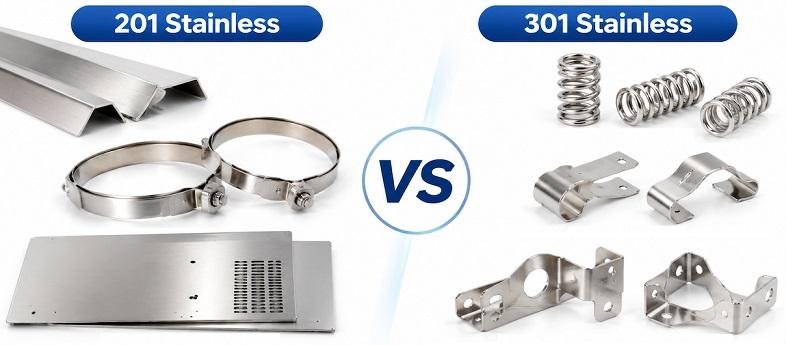
201 and 301 stainless steel are two commonly used austenitic stainless steel grades. Both offer good mechanical strength, formability, and corrosion resistance, making them suitable for a wide range of industrial, commercial, and consumer applications. However, they have different chemical compositions and mechanical characteristics, which affect their corrosion resistance, work-hardening behavior, magnetic properties, manufacturing performance, and cost.
This article explains the differences between 201 and 301 stainless steel, including their chemical composition, strength, density, hardness, stiffness, corrosion resistance, thermal properties, electrical conductivity, magnetic properties, cost, machinability, and common applications.
What is 201 Stainless Steel?
201 stainless steel is an austenitic chromium-manganese-nickel stainless steel belonging to the 200 series. It was developed as a lower-nickel alternative to traditional 300 series stainless steels. By replacing part of the nickel content with manganese and nitrogen, manufacturers can produce a stainless steel that provides useful mechanical strength and corrosion resistance at a generally lower material cost.
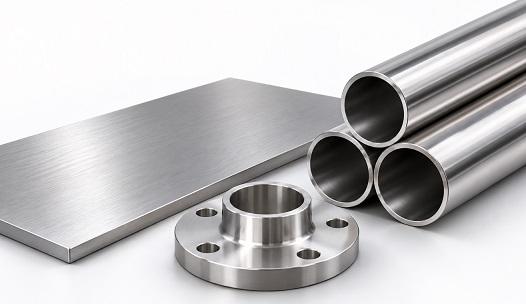
The typical chemical composition of 201 stainless steel includes approximately 16–18% chromium, 3.5–5.5% nickel, and 5.5–7.5% manganese. It also contains controlled amounts of carbon, silicon, phosphorus, sulfur, and nitrogen. Chromium is responsible for forming the protective passive oxide layer that gives stainless steel its corrosion resistance, while manganese and nitrogen help stabilize the austenitic structure.
One important characteristic of 201 stainless steel is its relatively high strength in the annealed condition compared with some conventional austenitic stainless steel grades. It can also be strengthened further through cold working. This makes it suitable for products that require a combination of strength, formability, and economical material selection.
201 stainless steel is commonly available in sheets, coils, strips, plates, and other commercial product forms. It is widely used in household appliances, kitchen equipment, decorative products, architectural components, automotive trim, and indoor industrial equipment.
Although 201 stainless steel offers good corrosion resistance in many ordinary environments, it generally has less resistance to chloride-related corrosion than higher-nickel or molybdenum-containing grades. Therefore, the operating environment should be considered carefully when selecting this material.
What is 301 Stainless Steel?
301 stainless steel is an austenitic chromium-nickel stainless steel belonging to the 300 series. It is designed to provide high strength and good ductility, particularly after cold working. Compared with 304 stainless steel, 301 generally contains lower chromium and nickel contents, which gives it a strong work-hardening response.
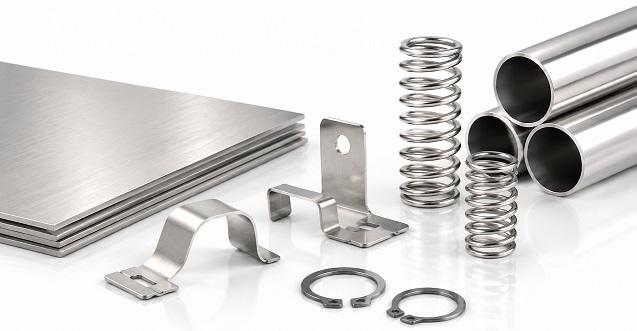
The typical chemical composition of 301 stainless steel includes approximately 16–18% chromium, 6–8% nickel, and a maximum manganese content of around 2%. Its carbon content is generally limited to 0.15%, while silicon, phosphorus, sulfur, and nitrogen are also controlled according to the applicable material specification.
One of the most important characteristics of 301 stainless steel is its excellent ability to increase in strength through cold rolling, bending, and other deformation processes. Depending on the amount of cold work, 301 stainless steel can be supplied in several temper conditions, including annealed, quarter-hard, half-hard, three-quarter-hard, and full-hard.
Unlike materials that are strengthened through conventional quenching and tempering, 301 stainless steel obtains much of its increased hardness and strength through cold working. This makes it particularly useful for springs, clips, structural components, precision strips, and other products requiring high strength and elasticity.
301 stainless steel is commonly used in automotive components, railway equipment, aircraft structural parts, industrial springs, architectural products, and precision metal components. Its combination of high strength, good corrosion resistance, and work-hardening capability makes it an important material in applications where mechanical performance is a major consideration.
What is the Difference Between 201 and 301 Stainless Steel?
201 and 301 stainless steel are both austenitic stainless steels, but their chemical compositions and performance characteristics are different. The most significant differences are nickel content, manganese content, work-hardening behavior, corrosion resistance, magnetic response, and material cost.
201 stainless steel contains more manganese and generally less nickel than 301 stainless steel. This composition helps reduce material costs while maintaining useful mechanical properties. It is particularly suitable for general-purpose products and applications where moderate corrosion resistance is sufficient.
301 stainless steel contains more nickel and has a strong work-hardening response. It can achieve very high tensile strength through cold rolling, making it more suitable for springs, high-strength strips, and structural components that require additional mechanical performance.
The following table summarizes the general differences between 201 and 301 stainless steel.
| Feature | 201 Stainless Steel | 301 Stainless Steel |
|---|---|---|
| Stainless Steel Series | 200 series | 300 series |
| UNS Designation | S20100 | S30100 |
| Material Structure | Austenitic | Austenitic |
| Chromium Content | 16–18% | 16–18% |
| Nickel Content | 3.5–5.5% | 6–8% |
| Manganese Content | 5.5–7.5% | 2% maximum |
| Density | Approximately 7.8 g/cm³ | Approximately 7.8 g/cm³ |
| Tensile Strength | Depends on condition; typically higher after cold working | Approximately 827 MPa in a representative annealed condition; significantly higher after cold working |
| Yield Strength | Varies by specification and condition | Approximately 310 MPa in a representative annealed condition |
| Work Hardening | Good | Very high |
| Hardness | Increases through cold working | Can reach very high levels through cold working |
| Stiffness | Similar to other austenitic stainless steels | Similar to other austenitic stainless steels |
| Corrosion Resistance | Good in many mild environments | Good in many mild environments |
| Magnetic Behavior | Generally weakly magnetic or non-magnetic when annealed; may become magnetic after cold working | Generally non-magnetic when annealed; becomes magnetic after cold working |
| Thermal Conductivity | Approximately 15 W/m·K | Approximately 16.2 W/m·K at 100°C |
| Electrical Conductivity | Low | Low |
| Material Cost | Generally lower | Generally higher |
| Common Applications | Appliances, kitchen equipment, decorative products | Springs, automotive parts, aircraft components, precision strips |
It is important to understand that mechanical properties depend on material thickness, product form, applicable standards, and processing conditions. In particular, cold-worked 301 stainless steel can have very different mechanical properties from annealed 301 stainless steel.
Chemical Composition of 201 vs 301 Stainless Steel
Chemical composition is one of the most important differences between 201 and 301 stainless steel. Although both materials contain chromium and nickel and belong to the austenitic stainless steel family, their different alloying-element proportions give them different mechanical and corrosion characteristics.
201 stainless steel uses a relatively high manganese content to replace part of the nickel used in conventional chromium-nickel stainless steels. In comparison, 301 stainless steel contains more nickel and less manganese. These differences influence austenite stability, deformation behavior, and the overall properties of the materials.
The following table shows the typical chemical composition limits of the two grades. Exact requirements should be confirmed against the applicable ASTM or other governing product specification.
| Chemical Element | 201 Stainless Steel (%) | 301 Stainless Steel (%) |
|---|---|---|
| Carbon (C) | 0.15 max. | 0.15 max. |
| Chromium (Cr) | 16.0–18.0 | 16.0–18.0 |
| Nickel (Ni) | 3.5–5.5 | 6.0–8.0 |
| Manganese (Mn) | 5.5–7.5 | 2.0 max. |
| Silicon (Si) | 1.0 max. | 0.75 max. |
| Phosphorus (P) | 0.06 max. | 0.045 max. |
| Sulfur (S) | 0.03 max. | 0.03 max. |
| Nitrogen (N) | 0.25 max. | 0.10 max. |
| Iron (Fe) | Balance | Balance |
Chromium Content
Chromium is an essential alloying element in stainless steel because it helps form a thin, protective chromium-rich oxide layer on the metal surface. This passive layer reduces the rate of corrosion and can regenerate when the surface is exposed to oxygen under suitable conditions.
Both 201 and 301 stainless steel generally contain 16–18% chromium. Therefore, their chromium content is relatively similar, and both can provide useful corrosion resistance in ordinary atmospheric and indoor environments.
Nickel Content
Nickel helps stabilize the austenitic structure of stainless steel and contributes to ductility, toughness, and corrosion performance.
301 stainless steel contains approximately 6–8% nickel, while 201 stainless steel contains approximately 3.5–5.5%. The higher nickel content of 301 is one of the main chemical differences between the two grades.
The difference in nickel content also affects material cost. Since nickel is an important alloying element with fluctuating market prices, 201 stainless steel can offer a more economical alternative in applications where its corrosion resistance and mechanical performance are sufficient.
Manganese Content
Manganese is used in 201 stainless steel to replace part of the nickel content and help maintain the austenitic structure. It also influences the mechanical properties and processing behavior of the alloy.
201 stainless steel generally contains 5.5–7.5% manganese, compared with a maximum of approximately 2% in 301 stainless steel. This higher manganese content is a defining characteristic of 201 stainless steel.
Although manganese contributes to alloy design and cost optimization, the overall performance of stainless steel cannot be determined by any single chemical element. Chromium, nickel, manganese, nitrogen, carbon, and the final processing condition must all be considered together.
Mechanical Properties of 201 vs 301 Stainless Steel
Mechanical properties describe how a material behaves under external forces such as tension, compression, bending, and repeated loading. These properties are particularly important when selecting stainless steel for structural components, springs, machinery, automotive parts, and precision products.
Both 201 and 301 stainless steel provide good mechanical performance. However, 301 is particularly well known for its strong work-hardening characteristics. Through cold rolling and other deformation processes, 301 stainless steel can achieve substantially higher strength and hardness than its annealed condition.
201 stainless steel also responds to cold working and can achieve higher strength through deformation. However, 301 is frequently selected when a wide range of high-strength temper conditions is required.
| Mechanical Property | 201 Stainless Steel | 301 Stainless Steel |
|---|---|---|
| Tensile Strength | Approximately 515–655 MPa or higher depending on condition and specification | Approximately 827 MPa in a representative annealed condition |
| Yield Strength | Approximately 275–310 MPa or higher depending on specification | Approximately 310 MPa in a representative annealed condition |
| Young's Modulus | Approximately 193–200 GPa | Approximately 193–197 GPa |
| Elongation | Approximately 40% | Approximately 60% |
| Hardness | Increases with cold working | Increases substantially with cold working |
| Work-Hardening Rate | Good | Very high |
| Fatigue Performance | Depends on grade condition and component design | Useful for spring and repeated-loading applications |
Tensile Strength and Yield Strength
Tensile strength is the maximum tensile stress a material can withstand before breaking. Yield strength represents the stress at which permanent deformation begins.
301 stainless steel is particularly useful when high tensile strength is required. Its strength can increase significantly through cold rolling, allowing manufacturers to produce high-strength strips and sheets for demanding applications.
201 stainless steel also provides good tensile strength and can be strengthened through cold working. For general-purpose components, it can provide a practical combination of mechanical performance and material economy.
When comparing tensile strength, it is essential to compare materials in the same temper condition. A full-hard 301 strip should not be directly compared with annealed 201 sheet because the manufacturing conditions are different.
Young's Modulus and Stiffness
Young's modulus measures a material's resistance to elastic deformation. A higher modulus indicates greater stiffness under the same loading conditions and geometry.
201 and 301 stainless steel have similar Young's modulus values because both are austenitic stainless steels. Their stiffness is generally around 193–200 GPa, depending on the material condition and reference data.
Therefore, the choice between these grades should not normally be based on a major difference in elastic stiffness. Instead, yield strength, tensile strength, hardness, thickness, and the required component geometry are more important considerations.
Hardness and Wear Resistance
Hardness describes a material's resistance to indentation and localized deformation. Both 201 and 301 stainless steel can increase in hardness through cold working.
301 stainless steel is particularly useful for applications requiring high hardness and strength because it can be supplied in quarter-hard, half-hard, three-quarter-hard, and full-hard conditions.
However, neither grade should automatically be considered a high-wear tool steel. For applications involving severe abrasion, specialized hardened stainless steels, tool steels, or surface treatments may provide better performance.
Fatigue Strength
Fatigue strength describes a material's ability to withstand repeated loading cycles without developing fatigue cracks or failure.
301 stainless steel is widely used in springs and flexible components because cold working can provide high strength and useful elastic performance. It is particularly suitable for thin strips and formed components that experience repeated bending or mechanical loading.
201 stainless steel can also be used in components exposed to repeated loading, but 301 is often preferred when high-strength spring characteristics are the primary design requirement.
Physical Properties of 201 vs 301 Stainless Steel
Physical properties describe the basic characteristics of materials, including density, weight, and other properties. These properties influence material selection in applications where weight, dimensional stability, and temperature changes are important.
Because 201 and 301 stainless steel are both iron-based austenitic alloys, their physical properties are relatively similar. Neither material provides a major weight advantage over the other.
| Physical Property | 201 Stainless Steel | 301 Stainless Steel |
|---|---|---|
| Density | Approximately 7.8 g/cm³ | Approximately 7.81 g/cm³ |
| Weight | Similar to 301 | Similar to 201 |
Density and Weight Difference
Density represents the mass of a material per unit volume. Both 201 and 301 stainless steel have densities of approximately 7.8 g/cm³.
This means that components manufactured with the same dimensions will have nearly the same weight. Therefore, weight reduction is generally not a significant reason to choose 201 over 301 or vice versa.
In practical applications, the final component weight may be influenced more by sheet thickness, structural design, and the required strength than by the small density difference between the two grades.
Dimensional Stability
Dimensional stability is important in precision components exposed to temperature variations. Both 201 and 301 stainless steel expand when heated and contract when cooled.
Their thermal expansion characteristics are broadly similar, although exact values depend on temperature and material condition. Engineers should consider thermal expansion when designing precision assemblies, particularly where stainless steel components are connected to materials with different expansion coefficients.
Thermal Properties of 201 vs 301 Stainless Steel
Thermal properties describe how materials transfer and respond to heat. They include thermal conductivity, thermal expansion, specific heat capacity, and melting temperature.
201 and 301 stainless steel have relatively low thermal conductivity compared with copper and aluminum. Both materials are suitable for many ordinary industrial and commercial environments, but they are not normally selected when high heat-transfer efficiency is the main requirement.
| Thermal Property | 201 Stainless Steel | 301 Stainless Steel |
|---|---|---|
| Thermal Conductivity | Approximately 15 W/m·K | Approximately 16.2 W/m·K at 100°C |
| Coefficient of Thermal Expansion | Approximately 17 × 10⁻⁶/K | Approximately 15.7 × 10⁻⁶/K at 0–100°C |
| Specific Heat Capacity | Approximately 500 J/kg·K | Approximately 500 J/kg·K |
| Melting Range | Depends on exact composition | Approximately 1399–1454°C |
Thermal Conductivity
Thermal conductivity measures how efficiently a material transfers heat through its structure.
301 stainless steel has a thermal conductivity of approximately 16.2 W/m·K at 100°C. Representative 201 stainless steel data indicate a value of approximately 15 W/m·K, although measurement temperature and product composition can affect the result.
Both materials transfer heat less efficiently than common thermal conductors such as copper and aluminum. This characteristic should be considered when designing heat exchangers, thermal equipment, and components requiring rapid heat dissipation.
Coefficient of Thermal Expansion
The coefficient of thermal expansion describes how much a material changes in dimension when its temperature changes.
Both 201 and 301 stainless steel expand when heated. Their thermal expansion coefficients are relatively close, although the exact values depend on temperature and alloy composition.
For precision applications, engineers should use temperature-specific material data rather than assuming that both grades have identical expansion behavior.
Specific Heat Capacity
Specific heat capacity indicates how much thermal energy is required to raise the temperature of a material by a certain amount.
201 and 301 stainless steel have similar specific heat capacities, generally around 500 J/kg·K at ordinary temperatures. This means that their thermal energy requirements are broadly comparable when equal masses are heated through the same temperature range.
Melting Temperature
The melting temperature of stainless steel depends on its chemical composition. Stainless steel alloys generally melt over a temperature range rather than at one exact temperature.
301 stainless steel has a representative melting range of approximately 1399–1454°C. The precise melting range of 201 stainless steel depends on its composition and should be obtained from the relevant material data sheet.
Melting temperature alone does not determine the maximum operating temperature of a component. Oxidation resistance, creep behavior, mechanical strength, and environmental conditions must also be considered.
Corrosion Resistance of 201 vs 301 Stainless Steel
Corrosion resistance describes the ability of a material to withstand degradation caused by moisture, oxygen, salts, acids, and other environmental factors.
Both 201 and 301 stainless steel contain approximately 16–18% chromium. This chromium content allows both grades to form a protective passive oxide layer that helps reduce corrosion under suitable environmental conditions.
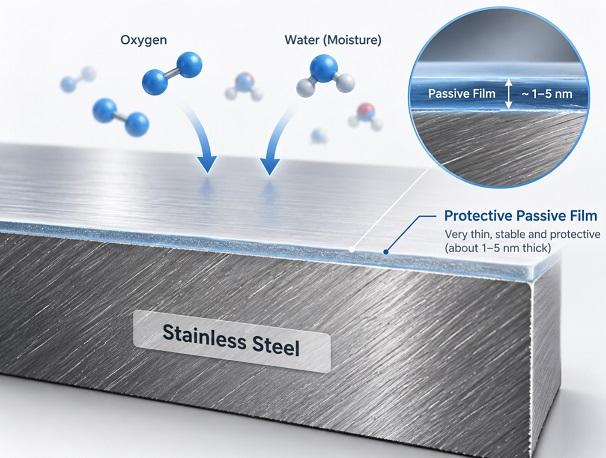
However, neither material should be considered completely corrosion-proof. Their performance depends on the chemical environment, surface finish, temperature, chloride concentration, manufacturing condition, and maintenance practices.
201 stainless steel generally performs well in indoor environments, household products, decorative applications, and other mildly corrosive conditions. However, its lower nickel content and lack of molybdenum make it less suitable for some aggressive environments.
301 stainless steel also provides good corrosion resistance in many mild environments. Its performance is comparable to common austenitic grades in a range of ordinary atmospheric and food-related applications.
| Corrosion Property | 201 Stainless Steel | 301 Stainless Steel |
|---|---|---|
| General Corrosion Resistance | Good in mild environments | Good in mild environments |
| Atmospheric Corrosion | Good under ordinary indoor conditions | Good under ordinary atmospheric conditions |
| Moisture Resistance | Suitable for many ordinary applications | Suitable for many ordinary applications |
| Chloride Resistance | Limited in aggressive chloride environments | Limited in aggressive chloride environments |
| Seawater Resistance | Generally not recommended for prolonged exposure | Generally not recommended for prolonged exposure |
| Intergranular Corrosion | Possible under sensitizing conditions | Possible under sensitizing conditions |
Both 201 and 301 stainless steel can perform well in ordinary indoor environments where exposure to moisture, salts, and aggressive chemicals is limited. 201 stainless steel is often selected for indoor decorative products, kitchen equipment, furniture components, and household appliances because it offers a useful balance between corrosion resistance and material cost. 301 stainless steel is also suitable for many indoor applications, particularly where high mechanical strength is required.
Electrical Properties of 201 vs 301 Stainless Steel
Electrical properties describe how easily a material allows electric current to flow. They are important in electrical equipment, electronic components, grounding systems, and industrial applications.
Both 201 and 301 stainless steel are electrical conductors, but their electrical conductivity is relatively low compared with copper and aluminum. Neither grade is normally selected for applications requiring highly efficient electrical current transmission.
| Electrical Property | 201 Stainless Steel | 301 Stainless Steel |
|---|---|---|
| Electrical Resistivity | Approximately 0.69 µΩ·m at room temperature | Approximately 0.685 µΩ·m at room temperature |
| Electrical Conductivity | Low | Low |
| Electrical Insulation | Not an electrical insulator | Not an electrical insulator |
Electrical Resistivity
Electrical resistivity measures how strongly a material resists the flow of electric current.
201 stainless steel has a relatively high electrical resistivity, while 301 stainless steel also has low electrical conductivity compared with common electrical conductor materials. The electrical properties of the two grades are sufficiently similar that electrical conductivity is rarely the deciding factor when selecting between them. For applications requiring efficient electrical transmission, copper, aluminum, and specially designed conductive alloys are generally more appropriate choices.
Magnetic Properties of 201 vs 301 Stainless Steel
Magnetic properties describe how a material responds to an external magnetic field. They are important considerations in applications such as electronic equipment, magnetic sensors, medical devices, and precision industrial components.
Both 201 and 301 stainless steel are austenitic stainless steel grades. In the fully annealed condition, both grades are generally considered non-magnetic or only weakly magnetic because of their austenitic microstructure.
However, neither grade is guaranteed to remain non-magnetic after manufacturing. Cold working can increase the magnetic response of both 201 and 301 stainless steel by inducing a transformation of austenite into ferromagnetic martensite. The degree of this transformation depends on the material's chemical composition, initial condition, and extent of deformation.
This behavior is particularly relevant to 301 stainless steel used in springs, precision strips, and other components that undergo extensive cold rolling, stamping, or forming. However, 201 stainless steel can also develop noticeable magnetic properties after cold working, so the magnetic response of the two grades should not be determined by grade designation alone.
For applications requiring very low magnetic permeability, it is important to evaluate the material in its final manufactured condition rather than relying solely on its original grade or annealed-state properties. Magnetic permeability testing can help verify whether the finished component meets the application's requirements.
Applications of 201 Stainless Steel
201 stainless steel is widely used in products where moderate corrosion resistance, good strength, attractive surface appearance, and competitive material cost are important.
- Kitchen Equipment: 201 stainless steel is used in kitchen utensils, sinks, decorative kitchen components, and certain food-service products where exposure conditions are suitable.
- Household Appliances: Washing machine panels, refrigerator components, appliance housings, and decorative parts may use 201 stainless steel.
- Architectural Decoration: Interior wall panels, decorative strips, furniture components, and indoor architectural products can use 201 stainless steel for its appearance and economical cost.
- Automotive Trim: Certain decorative automotive components and interior parts use 201 stainless steel because of its surface finish and mechanical properties.
- Furniture Manufacturing: Furniture frames, decorative fittings, and indoor structural components can use 201 stainless steel.
- General Industrial Products: Certain housings, brackets, covers, and formed metal components can be manufactured from 201 stainless steel.

Applications of 301 Stainless Steel
301 stainless steel is particularly useful in applications that require high strength, flexibility, and reliable mechanical performance after cold working.
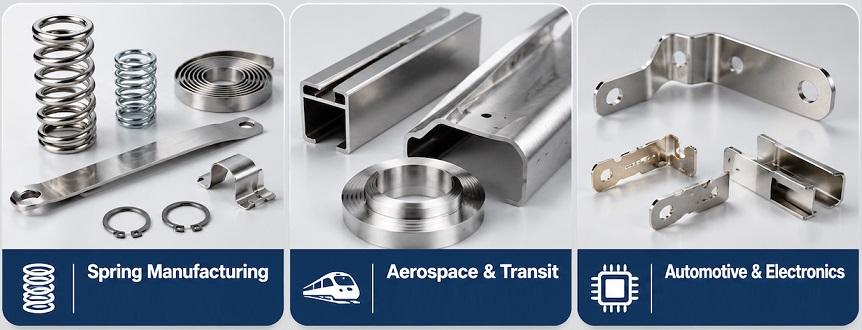
- Spring Manufacturing: 301 stainless steel is widely used for flat springs, spring clips, retaining components, and other products requiring high strength and elastic performance.
- Aerospace Industry: Aircraft structural components, precision strips, formed sections, and selected lightweight structural parts use 301 stainless steel.
- Automotive Industry: Automotive trim, clips, brackets, structural parts, and other formed components can use 301 stainless steel.
- Railway Equipment: Railway car components, structural sections, and transportation equipment use 301 stainless steel because of its strength and formability.
- Electrical and Electronic Components: Precision contacts, clips, shielding components, and spring elements can use 301 stainless steel where its mechanical properties are suitable.
- Industrial Machinery: High-strength strips, flexible components, and mechanical retaining parts are common applications.
Cost of 201 vs 301 Stainless Steel
Cost is an important factor when selecting 201 or 301 stainless steel for industrial and commercial applications. Although both materials are stainless steels, their different chemical compositions, alloying costs, manufacturing requirements, and market availability can result in different prices.
201 stainless steel is generally less expensive than 301 stainless steel because it contains less nickel. Replacing part of the nickel with manganese helps reduce dependence on nickel as an alloying material.
301 stainless steel generally has a higher material cost because of its higher nickel content. However, its strong work-hardening characteristics can provide significant mechanical advantages in applications requiring high-strength strips and formed components.
The actual price of both grades varies according to market conditions, product thickness, surface finish, production volume, supplier, and manufacturing process.
| Cost Factor | 201 Stainless Steel | 301 Stainless Steel |
|---|---|---|
| Material Cost | Generally lower | Generally higher |
| Nickel Content | Lower | Higher |
| Material Availability | Widely available in many commercial markets | Widely available in sheets, strips, and coils |
| Cold-Rolled Processing | Available in various conditions | Extensively used for high-strength temper conditions |
| Machining Cost | Depends on grade condition and operation | Depends on grade condition and operation |
| Fabrication Cost | Generally economical for common products | May increase with high-strength forming requirements |
| Long-Term Cost | Economical when environmental conditions are suitable | Can be favorable when high mechanical performance is required |
Manufacturing and Machinability of 201 vs 301 Stainless Steel
Manufacturing characteristics are important when selecting stainless steel for industrial production. Processes such as cutting, bending, stamping, drawing, machining, and welding can affect the final performance and manufacturing cost of a component.
Both 201 and 301 stainless steel can be processed using common stainless steel manufacturing methods. However, their different alloy compositions and work-hardening characteristics influence how they behave during forming and fabrication.
| Manufacturing Property | 201 Stainless Steel | 301 Stainless Steel |
|---|---|---|
| Machinability | Moderate to difficult | Moderate to difficult |
| Cold Forming | Good | Good, with strong work hardening |
| Deep Drawing | Depends on grade and condition | Can require intermediate annealing in severe operations |
| Stamping | Suitable for many applications | Suitable for precision and high-strength components |
| Weldability | Generally weldable with appropriate procedures | Generally weldable with appropriate procedures |
| Cold Rolling | Can increase strength and hardness | Produces a wide range of high-strength tempers |
| Manufacturing Cost | Generally economical | Depends on temper and processing requirements |
Machinability
Both 201 and 301 stainless steel can be more challenging to machine than many common carbon steels because austenitic stainless steels tend to work harden during machining.
Appropriate cutting tools, suitable machining parameters, and effective chip removal are important for achieving good machining quality. Excessive friction and cutting heat can negatively affect tool life and surface finish.
The actual machinability of each grade depends on its hardness, product condition, machine setup, and cutting operation.
Formability and Cold Working
Both materials can be formed through bending, rolling, stamping, and other cold-working processes.
201 stainless steel offers useful formability for many general-purpose products. It can be used for household products, panels, decorative components, and formed sheet-metal parts.
301 stainless steel is particularly important in applications involving cold rolling and controlled deformation. Its high work-hardening rate allows manufacturers to produce materials with different strength and hardness levels.
However, extensive cold working can reduce ductility. Intermediate annealing may therefore be necessary during severe forming operations, especially when multiple forming stages are required.
Weldability
Both 201 and 301 stainless steel can be welded using suitable stainless steel welding processes. These may include TIG welding, MIG welding, and resistance welding.
Welding procedures should account for heat input, filler metal selection, joint design, and the possibility of corrosion-related problems in the heat-affected zone. For critical applications, appropriate welding procedures and post-weld cleaning should be established according to the relevant standards and service environment.
201 vs 301 Stainless Steel: Which Material Should You Choose?
Choosing between 201 and 301 stainless steel depends on the specific requirements of the application, particularly in terms of strength, corrosion resistance, cost, and formability.
- Choose 201 stainless steel when cost-effectiveness, good strength, and moderate corrosion resistance are major considerations. 201 stainless steel is a more economical alternative to 301, making it suitable for indoor applications, household appliances, kitchen equipment, furniture, decorative components, and general-purpose products where exposure to corrosive environments is limited.
- Choose 301 stainless steel when higher strength, excellent formability, and better corrosion resistance are major considerations. 301 stainless steel offers higher work-hardening capability and can achieve greater strength through cold working, making it particularly useful in automotive components, springs, fasteners, railway equipment, aerospace components, and applications requiring high strength and durability.
The final selection should not be based on price or nominal strength alone. Engineers should evaluate chemical composition, mechanical properties, product condition, corrosion exposure, manufacturing requirements, and expected service life.