




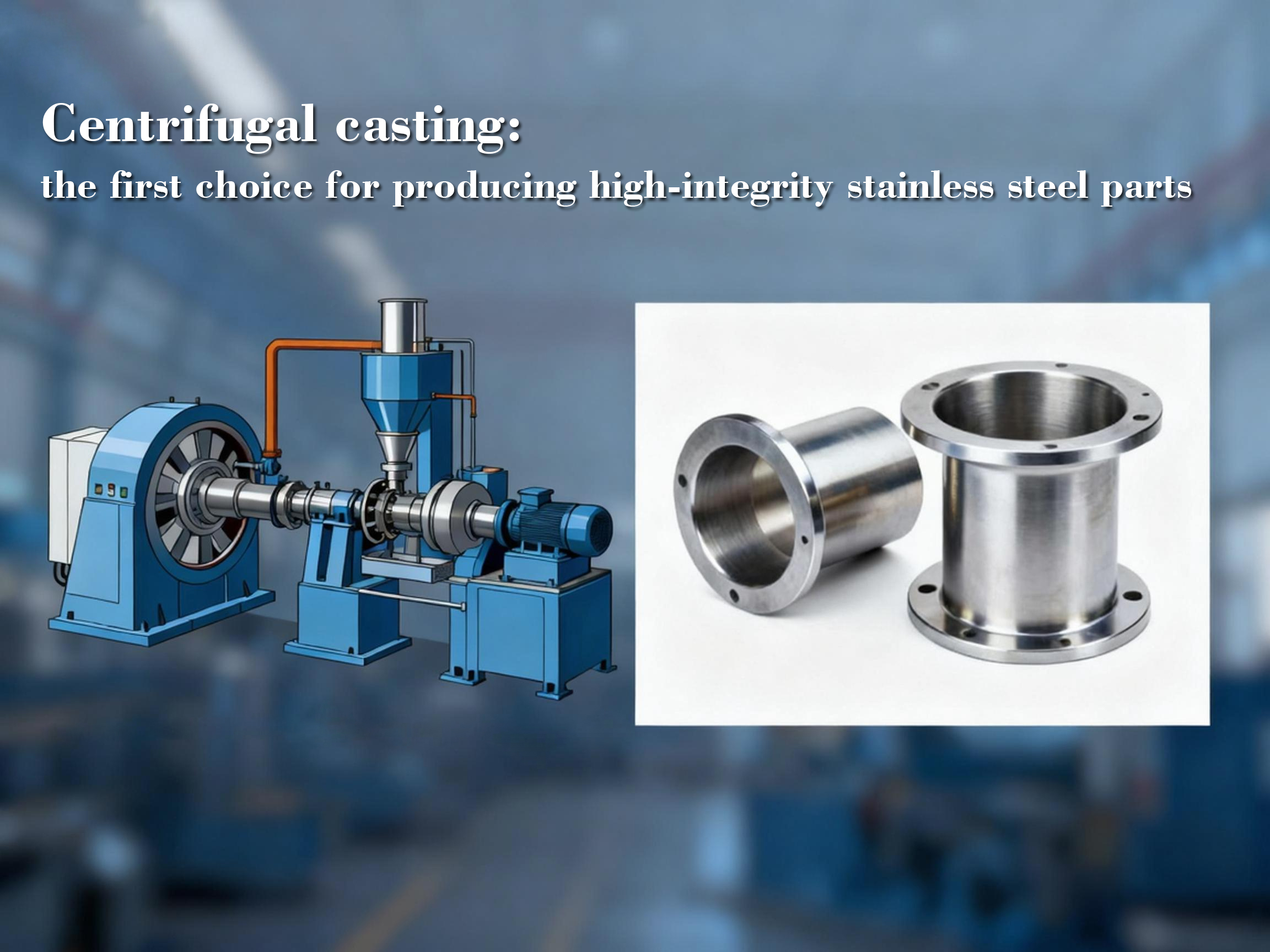
As someone who has spent a career focused on precision CNC machining, I live in a world of subtraction. My job is to take a solid block of metal and carve away everything that isn't the final part. But I learned a long time ago that the quality of my finished product is fundamentally limited by the quality of my starting material. You can't machine excellence from a flawed blank.
That’s why I’m not just a machining expert; I’ve had to become an expert in how that metal comes into being. I’ve worked with everything: forged blocks, sand-cast components, extruded bars, and plates. And for a specific class of parts—especially high-performance cylindrical components—I’ve found one manufacturing method that stands above the rest in terms of quality, density, and purity.
I'm talking about centrifugal casting.
It’s a process that marries brilliant physics with hardcore metallurgy to create some of the most robust metal components available. For my blog at hymmetal.com, I want to do a deep dive into this process. I'll explain what it is, how it works, and specifically why I believe it is the superior choice for demanding applications involving stainless steel.
If you’re an engineer, a designer, or a procurement manager, understanding this process can save you a lot of headaches—and money—down the line.
⚙️ What Is Centrifugal Casting? The 10,000-Foot View
At its simplest, centrifugal casting is a process that uses rotational force—centrifugal force—to form and solidify molten metal inside a spinning mold.
Think about the spin cycle on your washing machine. When it hits high speed, your clothes get pinned flat against the wall of the drum. Centrifugal casting applies the exact same principle, but with a much heavier "payload" and much higher stakes.
In this method, I (or rather, a foundry operator) pour molten metal into a rapidly rotating cylindrical die or mold. The immense force generated by this rotation—often as high as 100 Gs (100 times the force of gravity)—pins the liquid metal against the mold wall.
This high-pressure "pinning" does several incredible things simultaneously:
-
It Shapes the Part: It forces the metal to conform perfectly to the mold's shape, creating the part's outer diameter (OD). The inner diameter (ID) is simply formed by the amount of metal I pour in. No central core is needed to create a hollow part.
-
It Purifies the Metal: This is the real magic. Any material that is less dense than the metal itself—I’m talking about slag, dross, oxides, and even trapped gas bubbles—is lighter. The centrifugal force, which separates materials by density, squeezes all these impurities and imperfections inward toward the center.
-
It Guarantees Density: The constant, high pressure eliminates the risk of porosity or shrinkage cavities. As the metal cools and solidifies, the G-force continuously packs the molecules together, resulting in a grain structure that is incredibly dense, uniform, and strong.
Contrast this with a "static" casting, where I'd pour metal into a mold and just let gravity (1 G) do the work. It’s like pouring water into an ice cube tray. Pockets of air can get trapped, and as the metal cools and shrinks, it can pull apart, creating weak spots.
The centrifugal process is a solution to nearly all of these common casting defects.
🔬 The Nuts and Bolts: A Step-by-Step Process Walkthrough
To truly appreciate the final product, you have to understand the elegance of the process. From my perspective as a machinist, seeing this in action is seeing my perfect "blank" being born.
Here’s how I break down the journey from molten soup to a high-integrity metal tube.
Step 1: Mold Preparation
The "mold" (or "die") is a critical component. It’s typically a heavy-walled, high-strength steel cylinder, precisely machined on its inside diameter to match the exact outer diameter of the part I need.
Before anything else, operators pre-heat this mold. This step is vital. A cold mold would chill the molten metal too fast, causing cracks. A mold that's too hot will slow solidification too much. The temperature must be just right to control the cooling (solidification) rate.
Once heated, the inside of the mold receives a thin, ceramic-based refractory coating (a "mold wash"). This coating acts like the "seasoning" on a cast-iron skillet: it prevents the molten metal from sticking to the mold and helps control the heat transfer.
Step 2: The Spin-Up
The mold is mounted on a centrifugal casting machine and begins to spin on its axis (either horizontally or vertically, which I'll cover in a moment).
The speed of this rotation is a precise calculation. An engineer determines the ideal G-force based on the alloy I'm pouring, the mold's diameter, and the desired wall thickness. Too slow, and the molten metal might "rain" or "slip" inside the mold instead of pinning. Too fast, and I can introduce unnecessary stress into the part.
Step 3: The Pour
This is where the action happens. A pre-measured, precisely-weighed ladle of molten metal—let's say 316-grade stainless steel—is brought from the furnace.
I (or the operator) pour this metal into the spinning mold through a pouring launder (a type of trough or funnel). The moment that liquid, which might be over $1500^{\circ}\text{C}$ ($2732^{\circ}\text{F}$), hits the spinning mold, the centrifugal force takes over. It's instantly slung against the mold wall, spreading out evenly to form a perfect, seamless cylinder.
Step 4: Solidification Under Pressure
This is the most important metallurgical phase. The metal is now a spinning liquid tube, pinned against the mold wall with immense pressure.
The mold wall, being cooler than the molten metal, begins to draw the heat out. This starts directional solidification. The metal freezes from the outside (the OD) inward toward the center (the ID).
This is a huge advantage. As the metal solidifies, it naturally wants to shrink. In a static casting, this shrinkage creates a void or "pipe" in the middle. In centrifugal casting, the spinning force continuously feeds new molten metal from the still-liquid inner layers to the solidifying outer layers. It's self-feeding.
And remember those impurities? As that solidification front moves from the OD to the ID, it acts like a filter, "pushing" the lighter dross, slag, and gas bubbles ahead of it. They have nowhere to go but to the very last part to freeze: the inner diameter.
Step 5: Cooldown and Extraction
The machine keeps spinning until the entire part has solidified. This ensures the part maintains its shape and density. Once it's solid, the rotation stops.
The newly cast part—a red-hot tube or ring—is then extracted from the mold. At this point, it's a "near-net shape." It’s very close to its final dimensions, but it's not quite ready for service.
Step 6: The "After-Party" (My Specialty)
This is where my world of machining comes in. The part that comes out of the mold has a rough, scaly OD. More importantly, its inner diameter is a concentrated collection of all the impurities I mentioned.
This isn't a defect; it's a design feature.
The process is designed to throw all the "junk" to the ID, creating a sacrificial layer. My first job as a machinist is to set this part up in my lathe and machine away that inner bore. When I do this, I am physically removing the slag, the porosity, and the oxides, leaving behind only the 100% pure, dense, sound metal.
I also take a "proof cut" on the OD to remove the surface scale and true it up. The result? A perfectly round, high-integrity tube or ring with ideal mechanical properties, ready for final, high-precision machining.
🔄 The "Big Three" Types of Centrifugal Casting
I’ve been mostly describing one type, but it's important to know there are three distinct variations of this process.
1. True Centrifugal Casting
This is the process I've detailed above. It’s used to make parts that are cylindrical, and it relies on the G-force to form the ID. The axis of rotation can be either horizontal or vertical.
-
Horizontal Casting: This is my preference for long, thin-walled parts, like pipes, tubes, or hydraulic cylinders. Spinning on a horizontal axis (like a log roller) ensures a perfectly uniform wall thickness from one end to the other.
-
Vertical Casting: This method spins the mold on a vertical axis (like a potter's wheel). I use this for shorter, larger-diameter parts like rings, flanges, or gear blanks. Gravity plays a role here, causing the molten metal to form a natural parabola on the inside. This means the ID is slightly tapered, which I simply account for in my machining plan.
2. Semi-Centrifugal Casting
I use this method when the part is more complex than a simple tube, but still symmetrical around the center. Think of parts like large gear blanks, flywheels, or sheaves (pulleys).
In this process, I use a mold that has the full shape of the part, including a central core to define the inner bore. I spin the mold, but the goal isn't to form a hollow tube. Instead, the centrifugal force acts like a high-pressure pump, pushing the metal from the center sprue into the extremities of the mold. This ensures the gear teeth or the outer rim of the flywheel are perfectly formed, dense, and free of defects.
3. Centrifuging (or Centrifuge Casting)
This is a different beast altogether. I use this for producing multiple small, often complex-shaped parts at once.
Imagine a central "sprue" (the main channel for the metal) with "gates" (smaller channels) radiating outwards to individual mold cavities. The entire assembly is spun. The centrifugal force pressures the metal down the sprue and forces it into every tiny nook and cranny of the molds.
This is a fantastic process for producing small, high-detail components that would be difficult to make with other methods.
⭐ The Main Event: Why Centrifugal Casting and Stainless Steel Are a Perfect Match
Now we get to the core of it. Based on my work, stainless steel is one of the best possible materials for this process, and vice-versa. And this is especially true for the "exotic" grades, like duplex stainless steel.
First, let's consider the challenges of stainless steel. As a machinist, I can tell you it’s a difficult material. It's "gummy," it work-hardens in a heartbeat (meaning it gets harder as I try to cut it), and it can contain nasty, abrasive inclusions from other casting methods that will shred my cutting tools.
Here’s how centrifugal casting solves these problems.
Problem 1: Impurities and Inclusions
In a static casting, non-metallic inclusions (oxides, sulfides) get trapped randomly within the metal as it cools. When my $200 carbide insert hits one of these, it's like hitting a tiny ceramic rock. The tool chips or breaks, scrapping the part.
-
The Centrifugal Solution: As I described, the G-force systematically "un-mixes" the metal. All those abrasive, lighter-density inclusions are flung to the ID and subsequently machined away. I am left with a pristine, homogenous block of metal. This consistency is a dream for machining. It means predictable tool life, better surface finishes, and higher part-to-part consistency.
Problem 2: Porosity and Gas Pockets
Molten metal, like soda, holds a lot of dissolved gas. As it cools, this gas wants to escape, forming tiny bubbles, or porosity. In a static-cast part, this porosity can be a "leak path" for a valve or a weak spot in a high-stress component.
-
The Centrifugal Solution: The immense pressure (again, up to 100 Gs) literally squeezes the metal solid. It forces the gasses to stay in solution or pushes them to the sacrificial bore. The result is a part with virtually zero porosity. For any part that needs to hold pressure—like a pump casing or a valve body—this is not just a "nice to have," it's a structural necessity.
Problem 3: Grain Structure and Strength
In a static casting, the metal cools from all sides at once, leading to large, non-uniform grains meeting in the middle, creating a weak, coarse structure.
-
The Centrifugal Solution: The directional solidification (OD-in) combined with the rapid "chill" from the metal mold creates a very fine-grained, uniform, and dense microstructure. Fine-grained metal is, as a rule, stronger and tougher than coarse-grained metal. This uniform structure means the part has consistent mechanical properties in all directions, without the weak center I'd find in a static casting.
Answering the Big Question: What About Duplex Stainless Steel?
This is where centrifugal casting really shines. I've seen a huge increase in demand for duplex stainless steels (like 2205 or 2507), and for good reason.
-
What is Duplex? It's a family of stainless steel that has a "duplex" (two-phase) microstructure: roughly 50% austenitic (like 316) and 50% ferritic (like 430).
-
Why is it awesome? It gives me the best of both worlds: the high strength of ferritic steel (nearly double that of 316) plus the excellent corrosion resistance of austenitic steel. It's particularly famous for its resistance to chloride stress-corrosion cracking, which is the mortal enemy of parts used in saltwater or chemical plants.
Here's the problem: Casting duplex is notoriously difficult. That perfect 50/50 phase balance is very sensitive to cooling time. If it cools too slowly, a brittle "sigma" phase forms, which destroys its toughness and corrosion resistance.
The Centrifugal Solution: The centrifugal process, using a permanent metal mold, is a rapid solidification process. The metal mold acts as a massive "heat sink," pulling the heat out of the casting very quickly. This rapid chill "freezes" the ideal 50/50 austenitic-ferritic microstructure in place, preventing the formation of those destructive sigma phases.
For this reason, I argue that centrifugal casting is one of the best and most reliable methods for producing high-quality duplex stainless steel components.
⚖️ Centrifugal Casting vs. The World: A Comparative Look
So, when should I specify a centrifugal casting instead of another method? Here's my personal cheat sheet.
1. Centrifugal vs. Sand Casting
-
Sand Casting: Great for very large, complex external shapes (like a giant pump housing). The tooling (the sand mold) is cheap and fast to make.
-
Centrifugal: The permanent mold tooling is more expensive, but the part quality is in a different league. A centrifugal casting is denser, cleaner, and much stronger than a sand casting. It also requires less finish machining because the dimensions are more accurate.
-
My Verdict: If I need a one-off, complex part, sand casting is fine. If I need a high-performance, high-integrity part (like a pressure-vessel component) or I'm doing a production run, I choose centrifugal every time.
2. Centrifugal vs. Forging
-
Forging: This is the king of strength and impact toughness. The process of hammering or pressing the metal into shape aligns the grain structure, making it incredibly strong in that direction.
-
Centrifugal: While a forging might be stronger, centrifugal casting is far more flexible. I can create alloys that are impossible to forge. I can easily create a hollow part (a forged tube is very expensive). Also, the properties of a casting are "isotropic"—equal in all directions—which is actually better for parts that handle pressure from all sides (like a valve).
-
My Verdict: For a part that takes a single, directional, high-impact load (like a connecting rod), I'll use a forging. For a part that needs high-pressure integrity, superior corrosion resistance, and uniform, all-around strength (like a bearing or a valve body), centrifugal is the more economical and often the more practical choice.
3. Centrifugal vs. Seamless Pipe (Extrusion)
-
Seamless Pipe: This is a great product for, well, pipe. It's made by piercing a solid billet and drawing it out. It's efficient for standard sizes and alloys.
-
Centrifugal: This process dominates in flexibility. I'm not limited to standard sizes. I can order a custom ring or tube of any diameter, wall thickness, and length. More importantly, I can order it in thousands of different alloys, including the duplex stainless, superalloys, or bronzes that aren't available as seamless pipe.
-
My Verdict: If a standard 316 stainless pipe fits my job, I'll use it. If I need a custom 3-inch-thick duplex stainless ring with a 27-inch OD, centrifugal casting is the only way to get it.
🌎 Real-World Applications (Where I See This Process Shine)
This isn't just theory. I machine parts born from this process every day. They are used in the most demanding industries:
-
Oil & Gas: Valve bodies, pump liners, and flanges, especially in duplex and super-duplex stainless steel for subsea applications.
-
Aerospace: Jet engine compressor rings, bushings, and sleeves that require absolute reliability and material purity at high temperatures.
-
Marine: Propeller shaft sleeves, bearings, and rudder components that need to survive decades in corrosive saltwater.
-
Industrial Machinery: Hydraulic cylinder barrels, rollers for steel and paper mills, and gear blanks that need to be strong, round, and wear-resistant.
-
Automotive: High-performance engine cylinder liners, where the fine-grained, wear-resistant surface is a massive advantage.
My Final Take
As a machinist, my reputation is on the line with every part that leaves my shop. I can't build that reputation on faulty materials.
The centrifugal casting process gives me what I need to succeed. It delivers a near-net shape blank that is dense, pure, and metallurgically sound. It's a perfect marriage of physics and foundry science that actively removes the flaws I’m forced to "machine around" in other materials.
For any project involving cylindrical parts, and especially for tough-to-handle materials like stainless and duplex steels, I always start my sourcing by looking for a centrifugally cast blank. The process just makes sense.
I'm always happy to talk shop. What has your experience been with centrifugal castings? Do you have a project where this process might be a fit? Let me know in the comments below.